
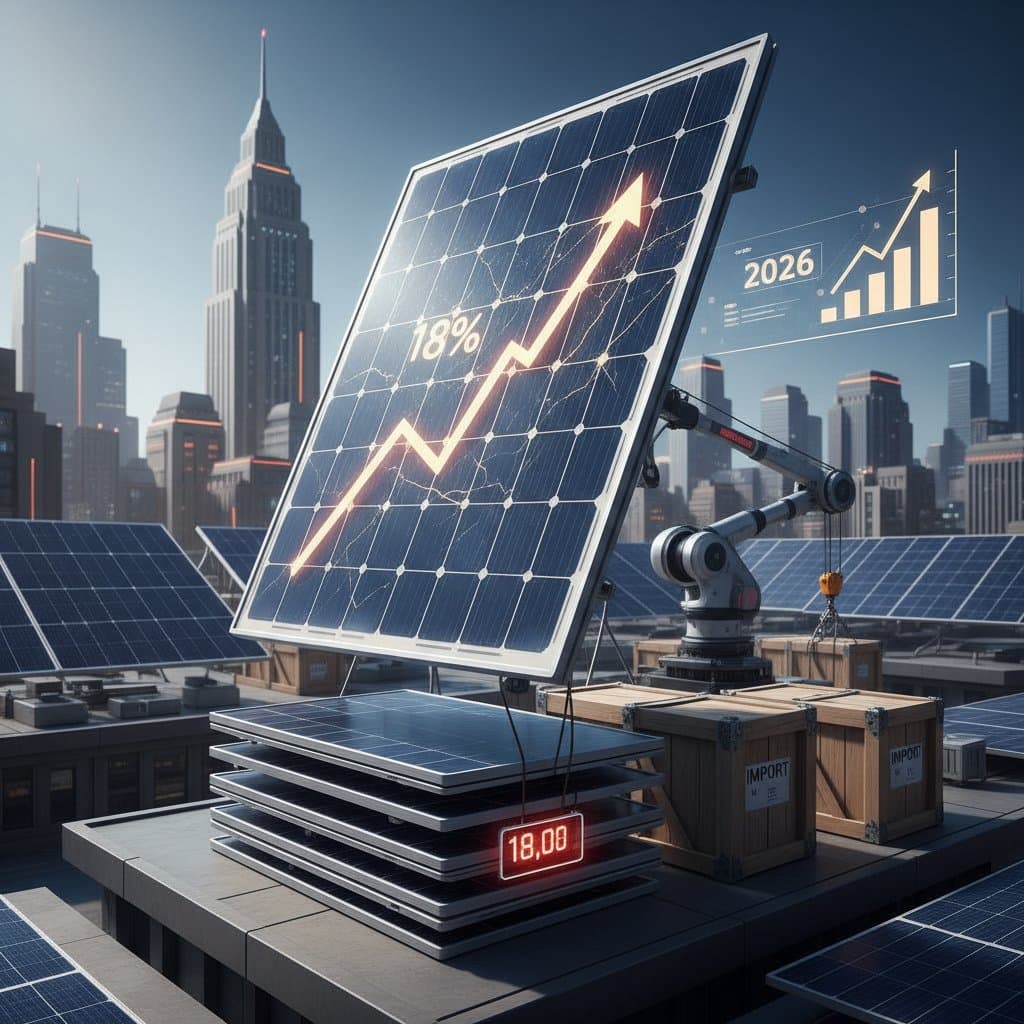
Solar Module Prices Surge 18% Ahead of 2026 Tariffs
Solar module prices in the United States rose 18 percent this spring after officials announced tariffs set for 2026. Industry analysts and equipment distributors confirm this marks one of the decade's steepest quarterly increases. Importers, developers, and installers now adjust procurement plans as trade policies alter the finances of utility-scale and commercial solar installations.
How Tariffs Sparked a Swift Market Shift
The upcoming tariffs focus on imported crystalline silicon photovoltaic modules from key Asian production areas. Although not yet active, the announcement prompted immediate price hikes. Clean Energy Market Analytics data shows monofacial module prices climbing from 26 cents per watt to over 30 cents per watt.
Distributors noted elevated quotes days after the news. Danielle Cruz, senior research director at Solar Supply Chain Monitor, explains: "Buyers are rushing to secure inventory before the next wave of tariffs hits." Suppliers factor in future risks early, even with the 2026 start date.
This trend affects more than modules. Mounting hardware, inverters, and other imported components face smaller but noticeable cost rises. Expect adjustments in logistics and compliance as supply chains adapt.
Developers Adjust Timelines Amid Rising Costs
Large-scale developers rethink schedules for projects spanning multiple gigawatts. Many planned panel purchases later this year under stable price expectations. Now, they scrutinize those plans closely.
Jason Lin, procurement head at Brightfield Renewables in California, shares: "We are evaluating whether to accelerate procurement." Suppliers warn of surcharges linked to tariff uncertainties, complicating financial forecasts.
Consultants report delays in at least 1.2 gigawatts of project awards. Lenders demand fresh cost projections before approving loans. Developers build in buffers to handle potential overruns.
U.S. Manufacturers Gain Traction
Imported goods encounter challenges, but domestic producers attract fresh attention. EPC contractors inquire about U.S.-made options to sidestep tariffs. This aligns with national efforts to boost local solar production and cut reliance on Asian imports.
Maria Thompson, vice president of sales at Ohio-based HelioFab, notes: "Demand for U.S.-made modules has increased sharply." The company runs at full capacity with 1.5 gigawatts annual output and eyes expansion through investor talks.
Other facilities in Texas and Georgia pursue growth. However, U.S. output covers less than one-third of last year's 30-gigawatt installations. Scaling up requires time and investment.
Understanding the Tariff Structure
These tariffs address solar cells and modules from transshipment countries. They aim to block routes where Chinese cells evade prior duties via third countries. Duties on Chinese-origin cells will rise progressively to full effect in 2026.
Importers face strict documentation for wafers, cells, and assembly origins. Robert Eng, trade law specialist at Green & Harlan in Washington, states: "The supply chain transparency requirements are extensive." Missing records could trigger retroactive fees and delays.
Developers allocate extra funds for contingencies. EPC firms add 3 to 5 percent to bids for customs risks. Clear records become essential for smooth project execution.
Pressures on Mounting and Installation Expenses
Tariffs hit modules hardest, but effects spread to mounting and installation. Global constraints keep steel and aluminum prices unsteady. Module increases compound these challenges in overall system budgeting.
Domestic racking suppliers win orders from risk-averse developers. Import-dependent firms absorb higher costs. Ground-mount systems, up to 15 percent of utility-scale expenses, may rise 5 to 8 percent this quarter.
Anthony Vega, engineering manager at Arizona's SolMount Systems, observes: "Projects are being redesigned to minimize structural steel." Teams seek lighter designs and efficient pile setups to counter module hikes.
Tracker makers partner with U.S. steel producers for Inflation Reduction Act incentives. These benefits could offset long-term tariff impacts. Short-term, expect varied pricing across suppliers.
Balancing Policy Goals with Industry Needs
Policymakers seek to fortify U.S. manufacturing and secure supplies. Past measures fell short against assembly hub workarounds. Tighter origin rules promise fairer competition for local firms.
Trade groups split on the approach. The Solar Energy Industries Association warns of slowed growth. Abigail Ross Hopper, SEIA president, cautions: "Abrupt trade actions create instability."
Their models predict 7 gigawatts less deployment over two years without tariffs. Meanwhile, the American Clean Energy Manufacturers Association applauds job creation in cells, glass, and encapsulants. They forecast five new assembly plants in three years with steady policy.
Adapting Financing and Contracts
Price swings prompt contract overhauls. Earlier power purchase agreements assumed cheaper equipment. Developers negotiate small escalations with buyers.
Lin from Brightfield Renewables adds: "Most PPA buyers understand that trade policy changes are outside of the developer’s control." Aligning revisions with funding schedules proves tricky.
Banks insist on tariff coverage in loans and stronger force majeure terms. New insurance options handle duty overruns. These tools aid risk control, though at added cost.
Varied Effects by U.S. Region
Impacts differ across states. California, New York, and Illinois push forward due to renewable mandates. Fixed deadlines outweigh cost bumps.
Texas and Florida, reliant on market dynamics, experience pauses. Midwest EPCs note commercial delays. Residential installers highlight lifetime savings over quick returns.
EnergySage data indicates 9 percent residential price jumps from module pass-throughs. Installers extend financing and stress rate stability. Regional strategies evolve to maintain momentum.
Reshaping Global Supply Chains
Firms in India, Mexico, and Southeast Asia eye U.S. compliance for assembly lines. Joint ventures with American partners advance. Site selections begin for new facilities.
Relocations may steady prices eventually. Construction and logistics shifts take months. Cruz predicts: "Supply diversification is underway, but it will not solve the shortage overnight."
Buyers endure tight supplies through the next cycle. Diversify sources now to mitigate risks. Monitor trade updates for procurement timing.
Boosting Efficiency to Counter Costs
Developers prioritize yield gains. Bifacial modules, N-type cells, and smart trackers draw focus. These raise output per watt, easing upfront expenses.
Installation tweaks cut labor. Pre-assembled kits, modular wiring, and automated tools save hours per megawatt. Vega emphasizes: "Installation productivity is now the critical margin lever."
Every efficiency step preserves economics. Integrate these from design phase. Track performance metrics to maximize returns.
Strategies for Thriving in Elevated Costs
The sector adapts to this policy-driven phase. Domestic growth pace and cost management will shape outcomes. Developers succeed by locking in supplies early and optimizing designs.
Monitor announcements for clarity. Explore incentives like domestic content bonuses. Position projects to leverage manufacturing expansions for sustained viability.