
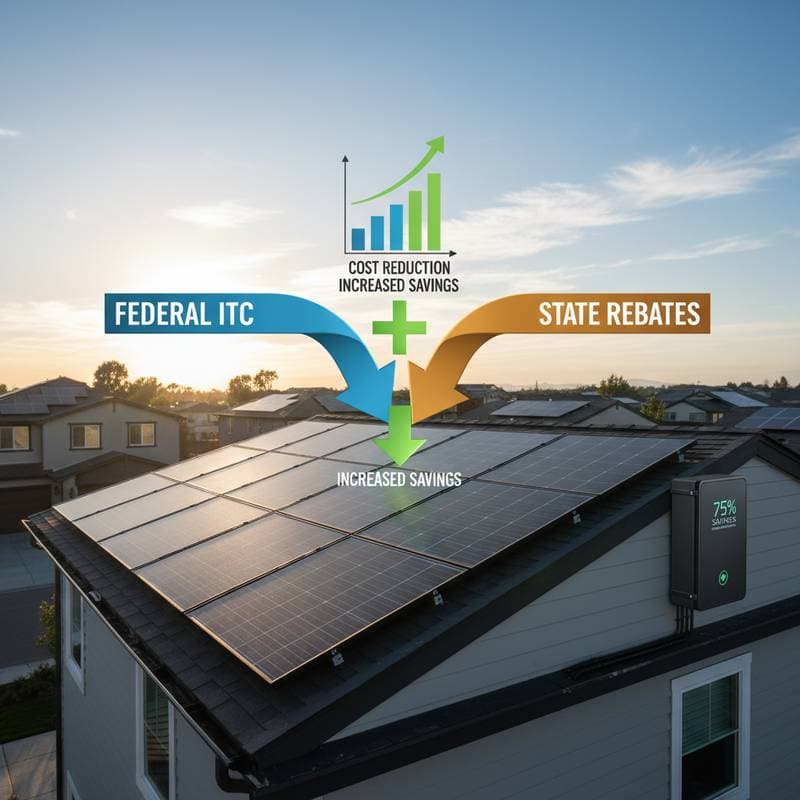
Layer Federal and State Incentives for Solar Savings
Homeowners and businesses that install solar systems gain significant advantages by combining federal and state incentives. The Inflation Reduction Act strengthens the federal Investment Tax Credit and provides a solid foundation for renewable energy projects. Pairing this credit with state rebates and programs reduces initial expenses and shortens the time to recover investments. Knowledge of how to apply these incentives properly unlocks the greatest financial advantages.
Understanding the Federal Investment Tax Credit
The federal Investment Tax Credit, known as the ITC, enables eligible solar system owners to deduct a percentage of installation costs from their federal taxes. Eligible expenses cover solar panels, inverters, balance-of-system components, and associated labor. Homeowners who buy systems directly or finance them through loans qualify for the credit. In third-party ownership arrangements, the benefit transfers to the system owner, often the financier.
Commercial installations follow comparable guidelines and may include extra depreciation options. The ITC supports both new builds and retrofits as long as the system generates electricity for a U.S.-based home or business. Alone, the federal credit substantially decreases project costs. The true potential emerges when integrated with state initiatives.
Exploring State Incentives and Rebates
States provide diverse solar incentives such as tax credits, performance payments, or upfront rebates. These vary by region, utility service area, and regulatory structure. Utilities in certain areas offer per-watt rebates that lower installation prices directly. Other states grant renewable energy certificates, property tax exemptions, or sales tax waivers on solar gear.
Consider a state that offers a 10 percent tax credit alongside the federal ITC. This combination offsets a substantial share of upfront costs. Additional support comes from low-interest loans via green banks or energy offices, easing the economic load for participants.
The Mechanics of Incentive Stacking
Stacking involves applying several incentives to one solar project. Success depends on grasping the sequence and interplay among benefits. State incentives typically reduce the base cost first, upon which the federal ITC calculates. This approach aligns with IRS guidelines and prevents overlap in expense claims.
Take a $25,000 residential solar setup with a $3,000 state rebate. The adjusted cost drops to $22,000, and the federal credit applies to this figure. Such layering yields savings greater than any single incentive alone. Consult program rules to confirm the exact order in your area.
Key Factors in Timing and Eligibility
Incentive programs feature distinct eligibility rules and deadlines. Verify that installations satisfy technical and paperwork standards prior to claiming benefits. Certain state initiatives demand pre-approval or enrollment before work starts. Overlooking these steps risks forfeiting available funds.
Federal credits require system ownership and sufficient tax liability to use the full amount. Excess credit carries over to subsequent years until exhausted. Businesses might transfer benefits via partnerships based on their funding setup. Review IRS forms and state guidelines early to prepare.
Applying Incentives to Commercial and Community Solar
Commercial and community solar ventures benefit from blending federal and state incentives to bolster financial viability. State renewable portfolio standards in some areas yield payments for energy output or certificates. These ongoing income streams, added to federal credits and depreciation, yield strong returns on investment.
Community solar allows multiple users to share one system's production and often qualifies for dual-level incentives. Developers design these setups to distribute savings to participants while adhering to tax laws. Ensure project agreements specify how benefits flow to all parties involved.
Ensuring Compliance Through Documentation
Thorough records prove vital when combining incentives. Keep invoices, receipts, and certifications that confirm eligibility. State offices typically need evidence of system size, grid connection, and payment verification to approve rebates. The IRS demands comparable proof for credit filings.
Engage a tax advisor familiar with renewable incentives to review submissions. Mistakes can postpone reimbursements or invite reviews. Installers aid by supplying detailed cost summaries and project completion forms. Organize files digitally for easy access during applications.
Optimizing Incentives in Different Markets
Federal and state credits together foster broader solar adoption in residential, commercial, and nonprofit settings. In regions with high electricity rates, these programs shorten payback periods considerably. Nonprofits, unable to claim credits directly, benefit from power purchase agreements or third-party financing that cuts energy bills.
Beyond basic rebates, some states include performance incentives that pay based on output over time. Integrating these with initial credits enhances overall economics. Coordinate with installers and advisors from the planning stage to seize all opportunities.
Secure Savings Through Strategic Planning
Combining federal and state solar incentives offers a proven method to trim costs and elevate project outcomes. Homeowners and businesses that study program details amplify their financial gains. Installers build trust by guiding clients on incentive navigation, leading to higher satisfaction and completion rates.
The synergy of Investment Tax Credits and state supports reshapes solar economics across the country. Prompt action locks in savings, raises property worth, and trims future energy outlays. Diligent application coordination and record-keeping deliver peak advantages and support enduring energy self-reliance.