
Why Attic Insulation Unlocks Solar's True Potential
Homeowners across the United States turn to rooftop solar installations to lower energy bills and reduce reliance on the grid. Many overlook the significant impact of attic insulation on solar performance and financial returns. A well-insulated attic reduces energy consumption by up to 30 percent, which directly enhances the return on investment for solar systems. This connection between insulation and solar productivity involves both technical and economic factors, emphasizing why energy efficiency measures should precede solar projects.
The Energy Balance Behind Solar ROI
Solar panels produce electricity, but their value in cutting household expenses hinges on overall energy demand. An under-insulated attic allows heat to escape or enter, forcing heating, ventilating, and air-conditioning systems to consume more power from the grid or solar array. This inefficiency extends the payback period and increases system strain.
"Energy efficiency always comes first," said Michael Torres, senior energy consultant at SunEdge Systems in Arizona. "If a home wastes energy through poor insulation or air leaks, solar panels end up offsetting inefficiency rather than creating savings."
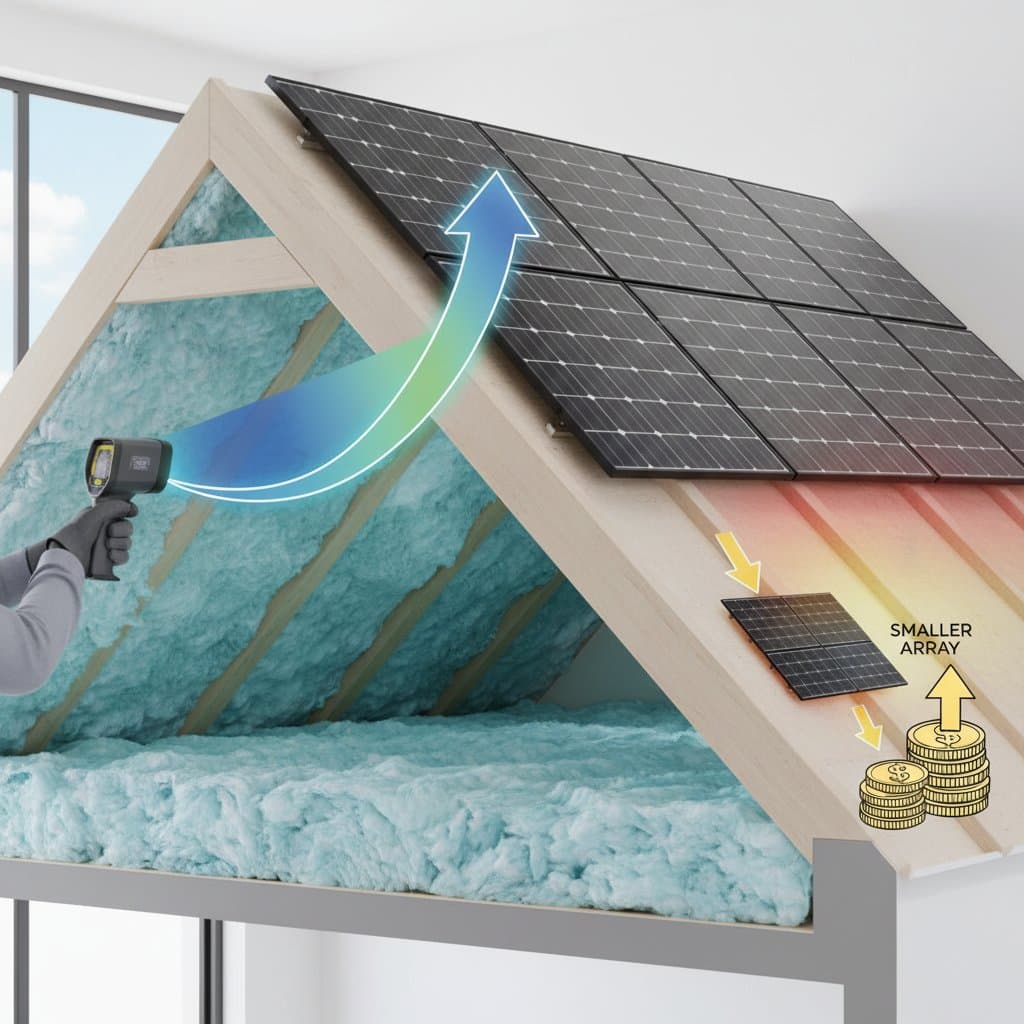
Addressing insulation first lowers baseline energy use. As a result, a smaller solar array meets a greater portion of demand, reducing initial costs and boosting long-term returns.
How Attic Insulation Works with Solar
Attic insulation serves as a thermal barrier that minimizes heat transfer between living spaces and the roof. In warm climates, it blocks heat from entering the home. In colder areas, it retains indoor warmth. These effects stabilize temperatures and ease the burden on heating and cooling systems.
Common insulation options include fiberglass batts, cellulose, and spray foam, rated by R-value for thermal resistance. Higher R-values deliver superior performance. The U.S. Department of Energy suggests R-30 to R-60 for attics, based on regional climate.
When combined with solar panels, insulation influences output. Cooler attics lower panel temperatures, enhancing photovoltaic efficiency. Solar cells perform best below certain temperature limits; excess heat from the roof can reduce conversion rates by several percentage points. Proper insulation and ventilation counteract this, supporting both comfort and energy production.
The Economics of Insulation Before Solar
Solar buyers often prioritize panel capacity and efficiency, yet insulation provides clear financial benefits. Analysis from the National Renewable Energy Laboratory indicates that lowering energy use prior to installation can shrink system size by 20 to 40 percent. Smaller setups decrease equipment and labor expenses, accelerating payback.
Insulating an average attic costs much less than a modest solar array. Savings from reduced heating and cooling persist year-round. "We often see homeowners save enough on heating and cooling after insulation upgrades to reduce their solar array size by several panels," said Karen Liu, project manager at GreenPeak Efficiency in Colorado. "That can translate to thousands in upfront savings."
For installers, suggesting insulation improves client outcomes and streamlines projects. Lower energy needs require fewer panels, shorten timelines, and minimize roof modifications. Homeowners gain an optimized cost-to-performance balance.
Regional Variations in Efficiency Gains
Attic insulation benefits vary by climate, but its role in solar efficiency applies nationwide. In the Southeast and Southwest, it curbs heat accumulation that overworks air conditioning during peak summer use. In the Midwest and Northeast, it maintains warmth in prolonged winters, cutting electricity for heating.
Research from an energy analytics firm shows that upgraded insulation in mixed climates cuts energy use by 26 percent on average. In hotter states, reductions reach 32 percent. These decreases amplify solar benefits, shortening payback from roughly ten years to about eight.
Technical Integration During Installation
Attic insulation and solar installation overlap technically at critical stages. Mounting penetrations, conduit paths, and access points demand precise sealing to preserve insulation effectiveness. Unsealed areas lead to air leaks that compromise both insulation and solar gains.
Installers increasingly collaborate with insulation experts to sequence tasks. Upgrade insulation before solar work starts. Post-mounting, attic access becomes restricted. Prioritizing insulation allows safe navigation without risking solar components.
John Patel, operations director at Skyline Solar in Texas, said his team follows this approach routinely. "We found that when insulation is installed after solar, the crew has to work around conduit runs and racking bolts, which risks damaging wiring or creating gaps around mounts," he said. "Doing insulation first keeps everything cleaner and safer."
Policy Incentives and Cost Recovery
Federal and state programs enhance the appeal of pairing efficiency with solar. Tax credits apply separately to insulation and solar under energy-efficiency laws. Utilities provide rebates for air sealing, duct improvements, and insulation that support renewables.
Combining incentives lowers net project expenses. Contractors offer whole-home packages integrating insulation, sealing, and solar with unified financing. These options streamline applications and highlight combined returns.
Analysts observe that such bundles raise loan approvals and lower defaults, as immediate savings from efficiency bolster cash flow. Lenders benefit from improved client financial stability.
The Technical Case for Roof Temperature Control
Roof temperature subtly affects solar performance. Photovoltaic modules lose 0.4 to 0.5 percent efficiency per degree Celsius above standard conditions. Hot roofs push panels past 60 degrees Celsius, cutting output by several percent.
Insulation moderates this by limiting heat flow from the roof to the interior. Paired with ventilation, it promotes airflow beneath the roof. Cooler conditions boost panel efficiency, prolong shingle durability, and control attic moisture.
"Temperature control is an often-overlooked factor in solar performance," said Dr. Elena Ruiz, a building science researcher at the Pacific Energy Institute. "Insulation and ventilation work together to stabilize roof conditions, which benefits both the home and the solar hardware."
Evaluating Return on Investment
Assess combined insulation and solar ROI through direct and indirect gains. Direct benefits encompass bill reductions and scaled-down system costs. Indirect advantages include extended roof lifespan, enhanced comfort, and optimized HVAC operation.
Case studies reveal that pre-solar insulation trims total energy expenses by 25 percent and allows 2 to 3 kilowatts less capacity. This adjustment saves thousands on projects, often recouping insulation costs in two years.
Contractors who explain these dynamics earn trust and set accurate expectations for performance and economics.
Steps to Integrate Insulation and Solar
Start with a full energy audit for solar plans. Auditors employ thermal imaging and blower door tests to pinpoint insulation deficiencies and leaks. Resolve these to size solar systems accurately for actual needs.
Incorporate audits into sales to stand out. Bundled upgrades establish providers as comprehensive experts on building performance and renewables.
This synergy between insulation and solar reflects an industry evolution. Efficiency and generation complement each other for superior financial and environmental results. For homeowners, pre-installation attic upgrades represent a strategic choice that optimizes returns, safeguards investments, and realizes clean energy potential.