
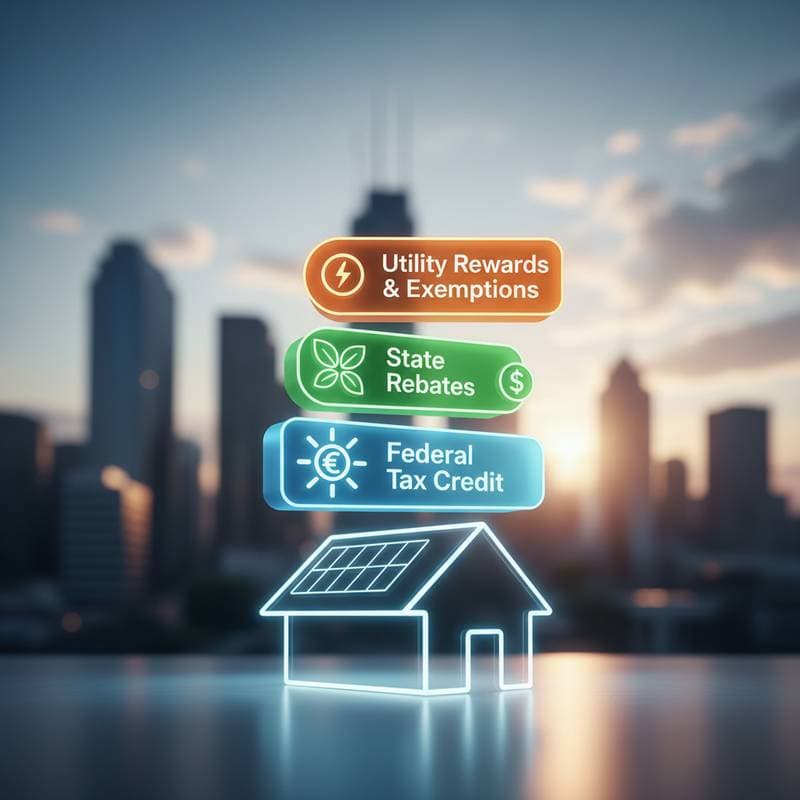
Maximize Solar Savings: Stack Rebates for Over $15,000 in Incentives
Homeowners installing solar panels in the United States often recover more than $15,000 in incentives by combining federal, state, and utility programs. This stacking approach works best in regions where local initiatives align with the federal Investment Tax Credit, which offsets a large share of system expenses. Legal and efficient combination of these benefits separates modest savings from transformative financial gains.
Build on the Federal Investment Tax Credit
The federal Investment Tax Credit (ITC) serves as the core incentive for solar installations nationwide. Eligible customers deduct a percentage of total system costs from their federal taxes, covering solar panels, inverters, mounting hardware, other components, and installation labor.
A standard residential rooftop system priced at $25,000 qualifies for over $7,000 in federal credits. The ITC applies to owned or financed systems but excludes leased arrangements or power purchase agreements, as ownership is essential for claiming the benefit.
Tax experts stress precise record-keeping. "Clients frequently forfeit credits due to missing invoices or payment proofs," notes Maria Lopez, senior tax consultant at GreenEdge Advisors. "The IRS demands detailed breakdowns of equipment and labor to approve claims promptly."
Layer in State Rebates for Upfront Relief
Many states provide rebates that complement the federal credit, often reducing initial costs by hundreds to thousands of dollars. Programs in New York, Maryland, and Massachusetts deliver direct cash payments, while others offer tax relief or performance incentives.
The New York State Energy Research and Development Authority (NYSERDA) administers a declining-block rebate, paying a fixed amount per watt installed. For a 7 kW system, this yields over $2,000 based on current rates. Maryland's Residential Clean Energy Rebate Program grants a standard per-system amount, disbursed months after verification.
Apply state rebates first to lower the system's net cost before federal credit calculations. This method avoids overlap while delivering substantial reductions. Experienced installers typically manage applications to guarantee accuracy and timeliness.
Tap Utility Incentives for Ongoing Returns
Utility programs elevate total savings past $15,000, particularly in areas with robust net metering or renewable energy credit systems. Funded by customer charges, these rebates often face annual limits, requiring prompt action.
Xcel Energy in Colorado runs the Solar Rewards program, compensating owners for kilowatt-hours generated through tradable renewable energy credits. A standard system might yield hundreds of dollars yearly, scaled to size and output. In California, utilities like Sacramento Municipal Utility District (SMUD) and Los Angeles Department of Water and Power (LADWP) offer tiered incentives based on capacity and technology.
"Utility programs form a vital financing element," observes David Chen, policy analyst at the Solar Energy Industries Association. "They deliver direct payments and foster market stability for developers via reliable credit revenues."
Benefit from Property and Sales Tax Exemptions
Certain states waive property or sales taxes on solar setups, generating indirect savings of thousands. Property exemptions shield home values from tax hikes post-installation. Sales tax waivers cut equipment costs by several percent upfront.
Florida, Texas, and Arizona enforce broad exemptions for residential solar. In premium real estate areas, property tax avoidance accumulates significant yearly benefits. Integrated with ITC and utility rebates, these measures complete the savings framework that boosts solar uptake.
Choose Financing to Capture Full Incentives
Financing choices directly affect incentive eligibility and value. Cash or conventional loans enable direct claims on all credits by the homeowner.
Specialized solar loans from banks and credit unions match payments to anticipated bill reductions. Leases and power purchase agreements shift ownership to providers, who claim the ITC and share savings via lower rates. Ownership-focused buyers opt for models that retain full incentive control.
Engineering, procurement, and construction firms incorporate rebate stacking in proposals. "Demonstrating combined figures boosts client commitment," says Alicia Turner, regional manager at SunMount Systems in Denver. "A $25,000 estimate often nets below $10,000 after incentives."
Navigate Timing and Documentation Essentials
Incentive programs enforce unique timelines, qualifications, and proof requirements. Overlooking deadlines risks losing substantial funds. State and utility rebates demand inspection reports, grid connection approvals, and completion forms.
The federal ITC uses tax returns with Form 5695 for homes. Installers assign specialists to oversee submissions, monitoring progress and adapting to rule changes. Utilities may limit slots annually, spurring installers to prioritize allocations.
Administrators advise early initiation. "Enroll in state or utility programs upon contract signing," recommends Lisa Graham, program manager at Solar North America. "Post-installation delays cause issues, particularly with depleting budgets."
Account for Regional Savings Differences
Incentive totals vary by location. California or New York residents might surpass $15,000 in combined benefits, whereas those in non-program states depend mainly on federal aid.
Commercial and industrial users access broader options, such as rapid depreciation and extras for U.S.-made components or battery additions. Large-scale projects can yield six-figure advantages.
Secure Your Incentives Through Coordinated Planning
Realizing peak rebate value demands collaboration among installers, utilities, and tax advisors, alongside thorough documentation. Successful setups merge federal, state, and local elements with exemptions and utility offsets.
For homes and small enterprises, stacking delivers clear advantages: slash initial expenses by over half, gain enduring energy autonomy, and enjoy prompt economic returns.