
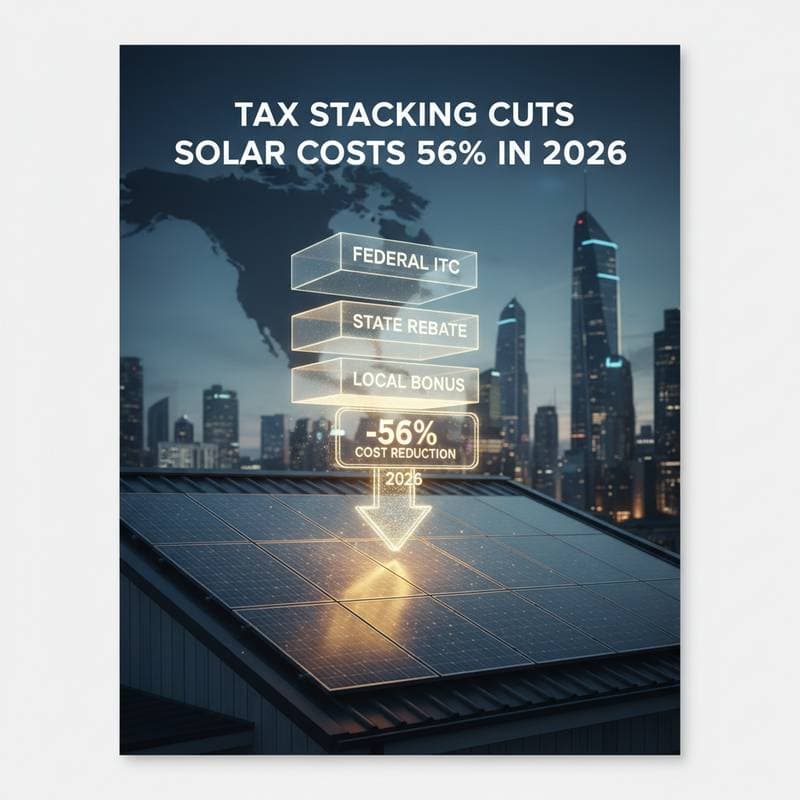
Tax Stacking Delivers 56% Savings on Solar Projects in 2026
Tax stacking gains traction in the solar sector as combinations of federal and state incentives transform project finances. Installers, developers, and investors layer credits, deductions, and rebates to cut initial expenses and enhance sustained profitability. Optimized stacking reduces project costs by over half, achieving up to 56% savings for eligible setups in 2026.
Defining Tax Stacking for Solar Initiatives
Tax stacking involves integrating multiple tax advantages from various government levels and initiatives. A solar project might access the federal Investment Tax Credit, production incentives, state rebates, and local property tax relief. Developers often incorporate energy community bonuses, low-income enhancements, or domestic content multipliers to apply several financial layers at once.
Success depends on identifying compatible credits and their interactions. Incentives carry unique eligibility standards, timelines, and record-keeping demands. Proper structuring maximizes after-tax cash flows while adhering to federal rules against duplicate benefits or overlaps.
Elements Driving the 56% Savings Projection
Analysts project 56% savings through integrated incentive categories. The federal Investment Tax Credit forms the foundation, providing a percentage credit on overall project expenses. Stackable additions include:
- Energy Community Bonus: Extra credit percentage for projects in fossil fuel transition zones.
- Domestic Content Bonus: Incentives for incorporating U.S.-made solar panels, inverters, or frames.
- Low-Income or Affordable Housing Enhancements: Credits aimed at installations for low-income residents or housing projects.
- State and Local Rebates: Cash payments or credits from state agencies or city programs.
- Accelerated Depreciation: Benefits under the Modified Accelerated Cost Recovery System to expedite capital recovery.
Strategic combinations of these factors can total savings nearing or surpassing 56% of installation costs. Results vary by site, ownership model, and program adherence.
Strategies Adopted by Developers and Installers
Developers construct detailed financial models that embed multiple incentives from the outset. Firms increasingly hire specialized tax advisors to spot stacking potential during initial planning. Installers revise bids to illustrate post-tax ownership costs, clarifying true expenses for clients.
Support services proliferate to streamline this work. Software tools match incentives to project locations automatically. Accounting experts provide complete compliance packages, minimizing errors and accelerating lender approvals.
Applying Tax Stacking in Diverse Market Areas
Savings from tax stacking differ by project scale. Utility-scale endeavors secure the highest credits through volume and fulfillment of domestic or community criteria. Commercial and industrial installations gain from depreciation plus state rebates atop the federal credit.
Residential projects, though modest in size, simplify stacking with federal and local combinations that avoid intricate accounting. Community solar initiatives pair low-income enhancements with state credits to cut subscriber fees while preserving margins. Nonprofits and public organizations access credits via direct payment mechanisms, widening participation.
Ensuring Eligibility and Regulatory Adherence
Programs demand specific proofs, so thorough documentation proves essential. Developers track evidence of U.S. sourcing, community status, or income levels for relevant enhancements. Third-party audits often verify compliance prior to credit claims.
Experts advise precision in stacking to prevent errors like double counting. Certain incentives bar costs subsidized elsewhere, and others restrict overlaps. Collaboration among legal, financial, and technical teams validates every credit claim against potential reviews.
Impacts on Solar Market Dynamics
Tax stacking shifts investment approaches throughout the industry. Lenders adjust yield calculations for elevated after-tax returns, easing funding conditions. Suppliers tweak prices and sourcing to aid bonus qualifications.
State leaders monitor these developments, adjusting rebates to align with federal offerings. Such alignment fosters local expansion and supports smaller installers alongside community efforts.
Navigating Implementation Hurdles
Tax stacking introduces planning intricacies despite its advantages. Developers manage concurrent deadlines, policy updates, and changing standards. Firms lacking tax specialists struggle to claim full benefits, spurring alliances with investors or advisors for compliance.
Project timing proves crucial. Adders hinge on construction or procurement benchmarks. Proactive scheduling safeguards maximum credit amounts.
Optimizing Solar Investments Through Incentive Layering
Tax stacking serves as a vital tool for bolstering solar project finances. Installers and developers who master incentive integration distinguish viable from exceptional ventures.
Those committing to compliance resources, expert collaborations, and upfront modeling capture peak advantages. Ongoing awareness of local rules and updates sustains competitive edges as incentives advance.