
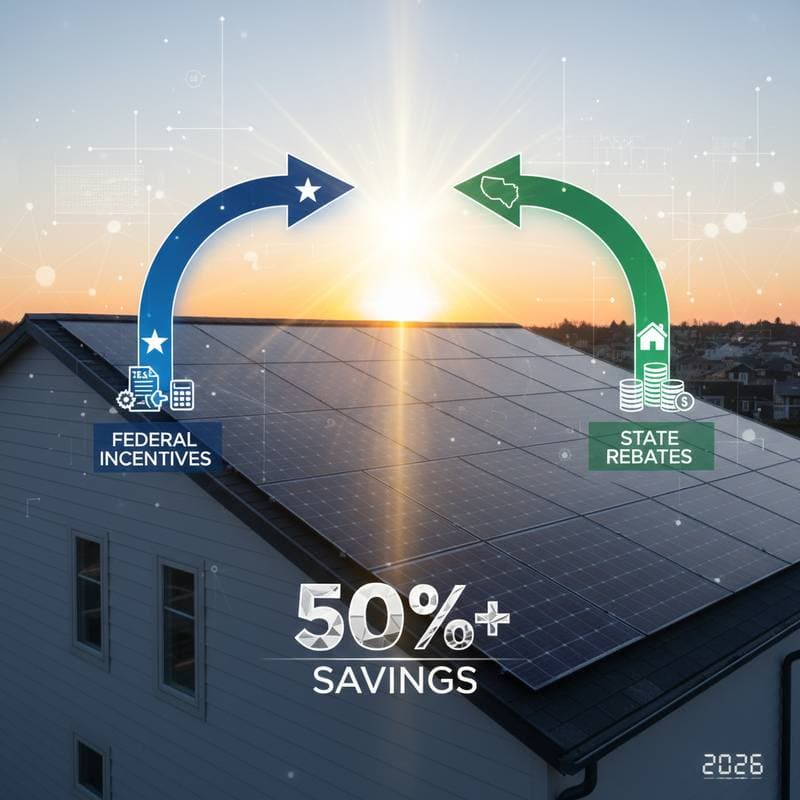
Maximize Solar Savings: Stacking State and Federal Incentives for Up to 50% Off in 2026
The United States solar industry enters a period of enhanced financial benefits as federal and state incentives align under the Inflation Reduction Act. Residential, commercial, and utility-scale developers benefit from combining multiple incentives, which creates one of the most advantageous cost structures in the sector's history. System owners lower installation expenses and shorten payback periods by layering federal tax credits with state rebates and performance incentives.
Analysts indicate that the average cost of residential solar installations has decreased by over 15 percent since the expansion of tax credits. When paired with state support, certain consumers realize effective reductions surpassing 50 percent. These factors reshape economics for installers, developers, and investors nationwide.
Federal Solar Incentives Explained
The Investment Tax Credit, known as the ITC, forms the foundation of federal solar support. This credit permits system owners to subtract a large share of installation costs from federal taxes. The Inflation Reduction Act broadens the ITC with bonus adders for domestic content, energy communities, and low-income initiatives.
Projects incorporating United States-manufactured modules, inverters, or structural elements qualify for extra percentage points. The energy community adder applies to sites in areas historically reliant on fossil fuels. Low-income bonuses support residential and community solar efforts in underserved regions.
Data from the Solar Energy Industries Association shows these adders can elevate total federal benefits above 50 percent of project costs in select scenarios. Compliance presents challenges, as each bonus demands thorough records on sourcing, location, and eligibility. Developers often engage consultants and legal experts to manage these details.
Layering State Incentives with Federal Benefits
State programs differ across regions, yet most complement federal incentives without overlap. California, New York, Massachusetts, and Illinois maintain established rebate and performance systems. Texas and Florida provide utility rebates or property tax exemptions that minimize ongoing expenses.
Massachusetts' SMART program delivers fixed payments per kilowatt-hour produced, extending over a decade. These payments supplement federal ITC benefits and enhance revenue without affecting eligibility.
New York's NY-Sun program offers upfront incentives tied to system size and location. NYSERDA reports indicate average residential rebates cut initial costs by thousands of dollars, with commercial projects securing incentives in the six figures. State programs integrate seamlessly with the ITC to amplify overall savings and refine investment returns.
Steps to Stack Incentives Effectively
Effective stacking involves precise sequencing and record-keeping. Programs define "net cost" differently, so federal credits apply to eligible expenses after deducting state grants or rebates. An upfront state rebate reduces the base for federal calculation.
Consider a $20,000 system installation with a $2,000 state rebate. The federal ITC then bases on $18,000. Precise accounting prevents compliance errors and preserves benefits.
Commercial and utility projects involve intricate computations, especially with power purchase agreements or leases. Ownership must align with credit eligibility. Michael Daugherty, tax director at a national renewable energy advisory firm, notes, "The most common mistake we see is misalignment between ownership and credit eligibility. Getting the ownership structure wrong can delay or even disqualify the federal incentive."
Meeting Domestic Content Standards
Large-scale projects emphasize the domestic content adder, which incentivizes United States-made components. Qualification requires thresholds for domestic steel, iron, and manufactured goods. Mounting systems and racking, typically steel-based, contribute significantly to compliance.
Companies like Array Technologies in New Mexico and Nextracker in California expand local production to assist engineering, procurement, and construction firms. Structural foundations, such as helical piles and ground screws, follow similar rules. Domestic sourcing secures the bonus and reduces import-related supply risks.
Wood Mackenzie data reveals a 40 percent increase in domestic capacity for solar mounting and trackers since the Inflation Reduction Act. This growth meets developer needs for full incentive qualification.
Financing Options Aligned with Incentives
Lenders and tax equity investors adapt models to incorporate combined benefits. Reliable incentive projections enhance project viability and lower funding costs.
Residential loans now factor in anticipated rebates, enabling reduced monthly payments immediately. Commercial ventures utilize tax equity financing, where investors fund upfront in return for tax credits.
Sarah Lin, senior vice president of project finance at Sunbridge Capital, explains, "We now evaluate project value based on a blended incentive model. Federal credits establish the baseline return, but state and utility programs can push internal rates of return up by several percentage points."
This strategy appeals to smaller utility-scale efforts, especially in states with robust renewable standards. Incentives buffer against equipment price swings or grid connection delays.
Regional Strategies for Incentive Stacking
Regions tailor stacking approaches to local conditions.
California: The Self-Generation Incentive Program rebates paired storage systems. Combined with the federal ITC, which includes storage charged mainly by solar, owners offset costs for both components.
Illinois: The Adjustable Block Program aids distributed generation via renewable energy credits. These credits sell to utilities under long-term agreements, generating steady income alongside federal incentives.
Minnesota: Community solar gardens leverage subscriber revenue and federal credits. Developers apply these benefits to decrease subscription fees for participants.
These examples illustrate how stacking adapts to state contexts while adhering to federal standards.
Navigating Compliance and Documentation
Incentive stacking requires rigorous documentation. Federal guidelines mandate evidence of payments, cost breakdowns, and sourcing. State systems, often overseen by utilities or energy offices, add layers of verification.
Engineering, procurement, and construction firms invest in software and auditors for efficient tracking. Rystad Energy reports estimate compliance adds one to two percent to budgets, yet proves vital for eligibility.
Inadequate records delay payments or trigger reductions. Residential users face extended rebate waits or tax adjustments. Commercial errors risk credit recapture and financial losses.
Driving Business Growth Through Incentives
Combined incentives reshape project development nationwide. Utility-scale teams expedite schedules to secure current credit rates, while residential providers highlight stacks in promotions.
BloombergNEF analysis shows payback periods for residential systems in high-incentive states now half of pre-Inflation Reduction Act levels. Commercial returns often surpass 10 percent, positioning solar as a top distributed energy option.
Benefits extend to manufacturers, suppliers, and workforce. Domestic content boosts demand for local racking, modules, and inverters, while installations spur job growth.
Positioning Projects for Future Incentives
Industry progress demands closer federal-state alignment. Stakeholders seek uniform reporting and digital tools for incentive calculations based on design and site.
Forward-planning developers assess supply chains, confirm domestic eligibility, and document from purchase to activation. As programs evolve, stacking credits, rebates, and bonuses sustains solar economics. Mastery of this process positions businesses to lead expansion in residential, commercial, and utility sectors.