
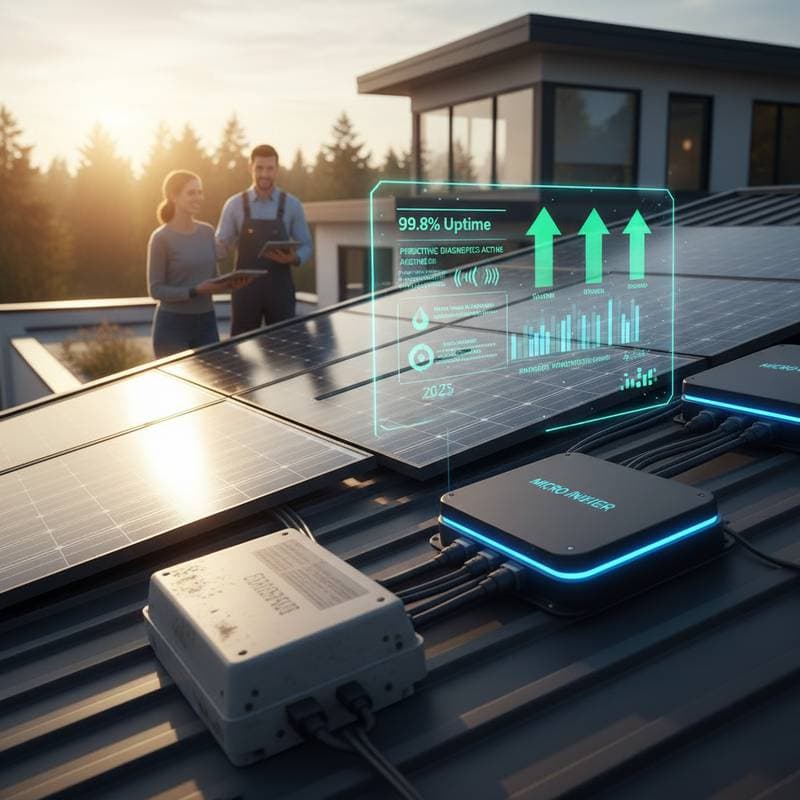
Micro-Inverters Lead in Reliability Over String Systems in 2025
String inverters long served as the reliable foundation for residential and small commercial solar installations. Installers favored them for straightforward design, cost efficiency, and ground-level access. Micro-inverters, despite module-level power optimization, faced skepticism due to higher costs and intricate components that questioned their durability. Recent U.S. field data, however, demonstrates a clear reversal: micro-inverters now exceed string inverters in reliability, uptime, and service longevity.
Evolution of Inverter Reliability
Early micro-inverters encountered challenges with failure rates in extreme climates. Installers reported frequent rooftop repairs and inconsistent support from manufacturers. String inverters appeared more resilient, with easier servicing that minimized disruptions.
Initial studies highlighted issues like thermal overload, material breakdown, and water penetration in micro-units. Manufacturers addressed these through enhanced protective coatings, robust circuit designs, and rigorous testing protocols. These engineering refinements now yield superior performance in real-world conditions.
Key Insights from Performance Data
Monitoring platforms across the U.S. and Europe indicate micro-inverter systems suffer fewer outages than string configurations. Failure isolation proves critical: a single micro-inverter issue affects only one panel, preserving overall output. String failures, conversely, halt production across multiple modules until resolved.
Over five years, micro-inverter arrays achieve 99 percent uptime, surpassing the 97 to 98 percent of comparable string systems. Module-level insights enable swift issue detection, cutting maintenance time and costs. Even with DC optimizers, string setups demand more hands-on diagnostics.
Changing Views Among Installers
Many installers who previously preferred string systems now adopt micro-inverters as standard. Rising labor expenses and demands for seamless operation drive this preference. Reduced service needs enhance client satisfaction and profitability.
A Midwest installer noted, "I used to replace a couple of string inverters every season. Now, with micros, I might get one bad unit in a year, and it is a quick swap." This feedback aligns with industry patterns, where long-term ownership costs guide decisions over initial savings.
Innovations Driving Superior Performance
Thermal management remains central to micro-inverter advancements. Previous models struggled with heat buildup under dark panels in warm areas. Current designs incorporate efficient heat dissipation, durable switches, and protective layers to withstand harsh elements.
Firmware enhancements add self-monitoring for temperature, voltage, and health indicators. These features predict problems, enabling warranty-covered swaps before breakdowns occur. While string inverters offer diagnostics, their centralized design amplifies failure impacts.
Economic Advantages of Enhanced Reliability
Falling solar hardware prices diminish the relative cost of premium inverters. Micro-inverters recoup their investment quickly through higher yields and fewer repairs, particularly on shaded or varied roofs. This benefit accelerates payback periods.
In distributed and small commercial projects, micro-inverters reduce callbacks and boost satisfaction. Engineering firms adjust templates for seamless integration, prioritizing reliability in bids. Utility-scale applications still lean toward strings for scale efficiencies, yet micro-influenced features appear in string designs.
Insights from Historical Challenges
Past inverter issues stemmed from unproven parts and hasty production growth. Industry responses emphasized ongoing testing, validation, and data-driven iterations. Micro-inverter developers now apply these practices rigorously.
Programs feature extended stress simulations, independent audits, and live performance tracking. This approach has elevated micro-inverters to match or exceed string dependability in key areas.
Broader Market Impacts
Commercial deployments increasingly use micro-inverters on complex roofs to minimize shading losses and simplify expansions. Their modularity supports irregular layouts without efficiency penalties.
String inverters persist in large-scale settings due to centralized servicing and cost structures. However, micro-inverter principles inspire improvements in string monitoring and safety compliance across the board.
Role of Monitoring and Warranties
Cloud platforms aggregate data from vast installations, enabling analytics and remote fixes. This infrastructure minimizes on-site visits and accelerates resolutions.
Extended warranties, often over 20 years, pair with low failure rates to build trust. Streamlined support contrasts with some string providers' administrative hurdles.
Sustainability Through Durability
Reliable inverters cut waste and environmental costs from replacements. Longer lifespans align with solar's efficiency goals, promoting resilient components and upgradable systems.
Establishing New Standards in Solar Dependability
Field evidence confirms micro-inverters' reliability edge, reshaping installer choices and manufacturer strategies. This development underscores a focus on sustained value over short-term savings.
System owners benefit from predictable output and minimal upkeep. As the sector matures, micro-inverters position solar for broader, more reliable adoption in diverse applications.