
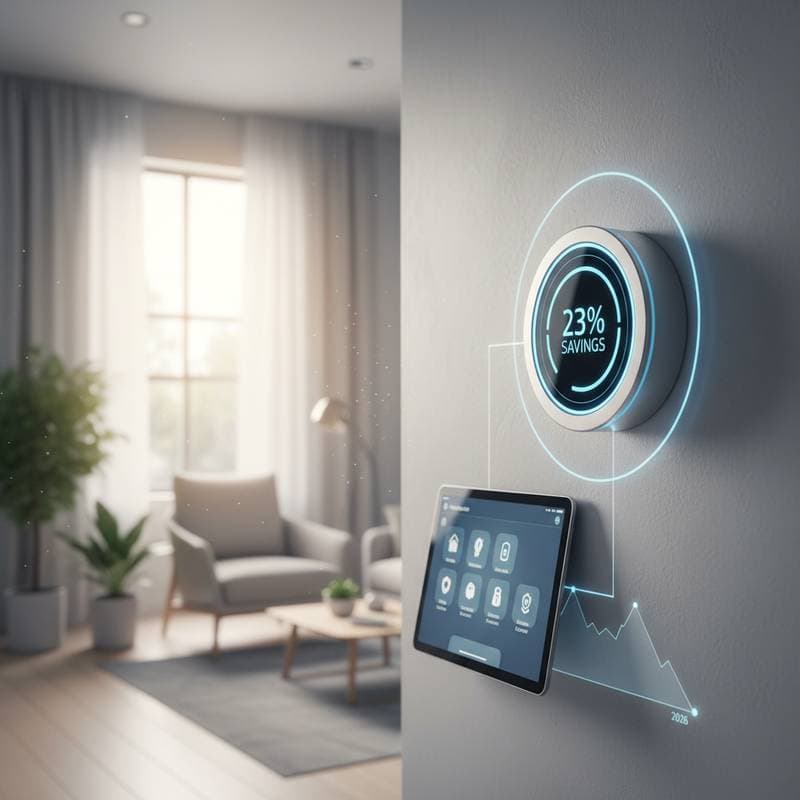
Why Smart Thermostats Deliver 23 Percent Savings: Top 2026 Recommendations
Homeowners often approach energy-saving devices with caution after encountering products that fail to meet expectations. However, smart thermostats stand apart, backed by independent studies showing average energy reductions of 23 percent. Personal research aligns with these findings, provided installation and usage follow best practices.
This 23 percent figure arises from behavioral prompts, automated adaptation, and precise optimization features absent in traditional programmable thermostats. Technology advancements and compatibility with comprehensive home automation systems now simplify energy oversight, allowing algorithms to manage routine adjustments effectively.
The following sections explain the basis for these savings, factors distinguishing superior models, and recommended devices for balancing comfort and control.
Core Technology Driving Energy Efficiency
A smart thermostat functions as more than a basic interface; it serves as a sophisticated data hub with integrated sensors, wireless connectivity, and predictive algorithms. Leading models incorporate sensors for occupancy detection, humidity monitoring, and air quality assessment. They also connect with smart vents and multi-zone systems to target airflow precisely.
Internal machine learning examines usage patterns, such as heating or cooling durations and occupancy schedules. This information enables proactive space preparation. Instead of relying on manual inputs upon arrival, the system initiates adjustments in advance based on anticipated needs.
Engineers from major manufacturers highlight ongoing refinements in predictive capabilities. Current algorithms process user habits alongside weather forecasts, enabling fluid temperature shifts that minimize energy consumption.
Maintaining Comfort Alongside Savings
Many homeowners worry that efficiency gains sacrifice livability. Experience demonstrates the contrary for properly set up smart thermostats. These units sustain steady indoor environments through subtle modifications, avoiding the fluctuations typical of manual or simple programmable alternatives.
Adaptive algorithms consider occupancy to focus efforts strategically. For instance, if sensors register inactivity in specific areas, the system dials back conditioning there while preserving optimal levels in active zones. This approach yields significant reductions without detectable discomfort.
Advanced models feature recovery mechanisms that calculate time required to attain setpoints. During a programmed morning adjustment, the thermostat activates sufficiently early to achieve the target precisely, ensuring a smooth start to the day.
Proven Performance and Dependability
Long-term fieldwork reveals that a thermostat's worth emerges from sustained operation. Early smart models faced connectivity glitches, sensor inaccuracies, and irregular software support. Contemporary versions address these challenges, though proper setup remains essential.
Engage professionals for installation to position sensors optimally and integrate with HVAC components. Faulty wiring or placement diminishes precision and erodes savings potential. With correct configuration, devices operate reliably over extended periods with little upkeep.
Routine care involves automatic firmware updates for algorithmic enhancements and periodic sensor checks. Maintain Wi-Fi connectivity and app currency to support seamless performance.
Top Smart Thermostat Models for 2026
Selecting the right model depends on home size, existing smart ecosystem, and budget. The following recommendations highlight devices excelling in savings, ease of use, and integration, based on performance metrics and user feedback.
-
Nest Learning Thermostat (4th Generation): This model leads with its robust learning engine, achieving up to 23 percent savings through geofencing and motion-based adjustments. It integrates seamlessly with Google Home and offers a sleek design with a large display. Ideal for larger homes, it includes air quality monitoring and energy reports via app.
-
Ecobee Smart Thermostat Premium: Known for multi-room sensors, this unit optimizes zoning for unevenly heated spaces, often exceeding 20 percent efficiency gains. Compatible with Alexa and Apple HomeKit, it features a built-in speaker for voice control and security alerts. Users appreciate its straightforward setup and detailed usage insights.
-
Honeywell Home T10 Pro: A reliable choice for zoned systems, it delivers consistent 22 percent reductions with touchscreen controls and remote sensor support. It works well with most HVAC setups and provides scheduling flexibility. This model suits budget-conscious households seeking durability without advanced smart features.
-
Emerson Sensi Touch: Affordable yet effective, this thermostat saves around 21 percent by learning routines and integrating with smart assistants. Its color touchscreen simplifies navigation, and it supports energy dashboards. Perfect for smaller homes or rentals due to easy DIY installation.
Evaluate compatibility with your current systems before purchase. Test initial setups to confirm sensor accuracy and app responsiveness.
Broader Impacts on Environment and Finances
Smart thermostats offer advantages extending past individual households. Each conserved kilowatt-hour eases grid strain and cuts greenhouse gas emissions. Scaled to widespread adoption, these devices contribute meaningfully to sustainability goals.
They also aid utilities in balancing peak demands, fostering stability and decreasing reliance on high-emission backup sources. Financially, the typical payback period falls within one to two years, yielding ongoing returns.
Steps to Integrate Smart Thermostats Effectively
Begin by assessing your home's HVAC compatibility and energy usage patterns. Choose a model aligning with your smart platform preferences. Follow installation guidelines meticulously, or hire certified technicians for complex setups.
Customize schedules and enable learning modes promptly. Monitor initial reports to refine settings, such as adjusting for sunlight exposure or insulation variances. Regular reviews ensure maximum benefits, combining savings with enhanced daily comfort.