
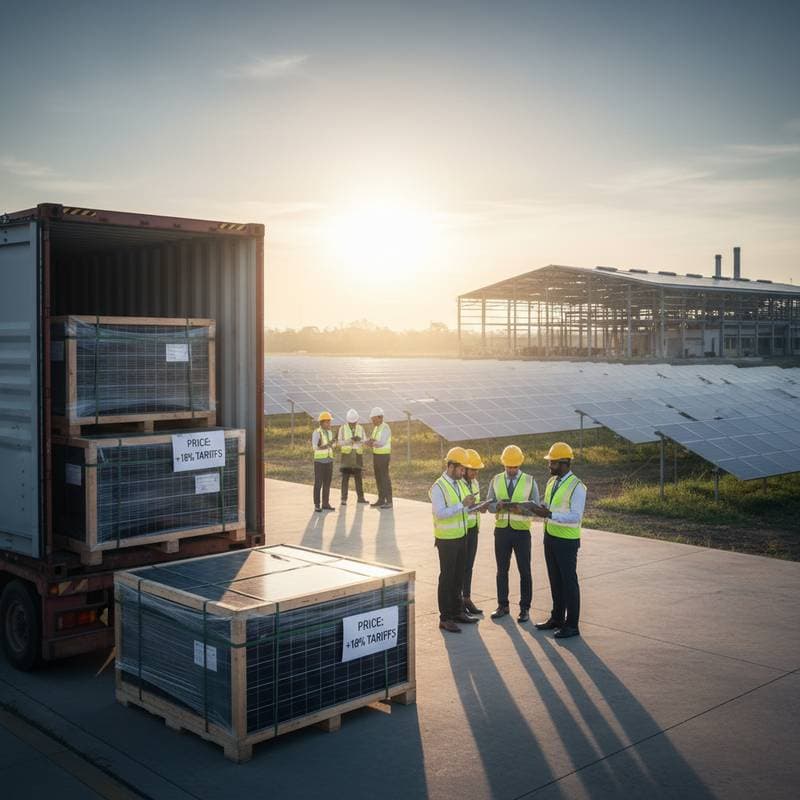
Solar Tariffs 2026: 18% Panel Price Surge Hits Now
Utility-scale and distributed solar developers across the United States face an abrupt cost escalation. New import tariffs push module prices up by an estimated 18 percent. This increase, triggered by tightened enforcement of trade restrictions and the scheduled phase-out of temporary tariff exemptions, influences procurement decisions for projects planned for the next two installation cycles.
Data compiled by Wood Mackenzie and confirmed by several Tier 1 module suppliers shows the average landed price for imported crystalline silicon photovoltaic panels climbing from roughly $0.27 per watt to nearly $0.32 per watt. The shift appears most prominently in procurement contracts for modules sourced from Southeast Asia, which supply the majority of U.S. demand.
Policy Shifts Drive Immediate Market Reaction
The surge results from renewed trade barriers on solar products manufactured in countries accused of circumventing existing antidumping and countervailing duty orders. Customs and Border Protection intensifies inspections of supply chains tied to China-origin wafers and cells. These actions create extended delays at ports and increase logistics costs.
Uncertainty surrounding tariff enforcement forces repricing of several projects, according to Laura Jensen, Vice President of Procurement at SunGrid Renewables, a California-based EPC contractor. She notes, "We are now modeling module costs that are 15 to 20 percent higher than what was budgeted earlier this quarter."
Developers report shipping delays stretching from an average of four weeks to as long as three months in some cases. These disruptions prompt EPCs to seek alternative suppliers in India, South Korea, and the United States. Domestic capacity remains limited relative to demand.
Domestic Manufacturing Gains Momentum
The tariff escalation accelerates investment in U.S.-based module assembly and cell production. Several manufacturers announce plans to expand production lines in Texas, Georgia, and Ohio. They cite strong demand from developers aiming to qualify for domestic content bonuses under the Inflation Reduction Act.
Trina Solar, which operates a module assembly facility in the Midwest, states that the new market environment enhances the competitiveness of its U.S.-made products. James Lin, General Manager of Trina Solar USA, explains, "Our domestic pricing structure now aligns closely with imported modules after tariffs. Developers are starting to see value in securing local supply even with slightly higher upfront costs."
Industry analysts estimate that U.S. module production capacity could exceed 25 GW within the next installation cycle if planned factories reach full operation. Most of that capacity will rely on imported cells until domestic cell manufacturing scales up.
Mounting and Installation Costs Under Pressure
Rising panel prices influence system design and installation strategies. Mounting system suppliers report that developers reevaluate tracker configurations and pile choices to offset higher module costs. Fixed-tilt systems, which require fewer components and less labor, regain attention for smaller utility projects.
Every cent increase in module pricing forces project teams to reexamine total installed cost, according to Carlos Rivera, Director of Engineering at ArrayBuild Systems, a Texas-based racking manufacturer. He adds, "We are seeing more demand for optimized pile foundations and preassembled tracker components that reduce field labor."
For commercial and industrial installers, the impact proves more immediate. Procurement managers indicate that clients delay projects or reduce system size to stay within budget. Residential installers may experience a slower effect since many rely on inventory purchased before the tariff adjustment.
Financing and Contract Implications
The tariff-driven price increase ripples through power purchase agreement negotiations and project financing structures. Lenders and investors require updated cost models and revised construction schedules to reflect higher capital expenditure. Analysts at BloombergNEF estimate that PPA prices for new utility-scale solar could rise by 6 to 9 percent depending on module sourcing and location.
Developers working under fixed-price EPC contracts face the greatest exposure. Some firms invoke force majeure clauses or seek renegotiation due to unforeseen policy changes. Others turn to hedging mechanisms, such as forward module purchase agreements, to stabilize costs.
The financial community watches closely, says Ethan Grant, Senior Analyst at CleanTech Research Partners. He observes, "Tariff volatility adds another layer of risk to a market already dealing with interconnection delays and supply chain bottlenecks."
Regional Differences in Impact
The effect of the tariff increase varies by region. States with established domestic supply chains, including Ohio and Georgia, position themselves better to absorb the shock. Developers in the Southwest and Midwest, which rely heavily on imported panels, face steeper adjustments.
In markets with high solar penetration such as California and Texas, utilities may delay procurement rounds to reassess pricing. Community solar developers in the Northeast report difficulty securing competitively priced modules. This complicates subscription-based project models that depend on low capital costs.
Industry Response and Policy Outlook
Trade associations, including the Solar Energy Industries Association, urge federal agencies to provide clarity on enforcement timelines. SEIA President Abigail Ross Hopper states in a recent statement that unpredictable policy shifts could undermine progress toward national clean energy targets.
Several state governments explore incentives to attract domestic component manufacturing. Economic development agencies in the Southeast report active negotiations with multiple international suppliers interested in setting up wafer and cell production lines.
Adapt Procurement Strategies for Resilience
Project developers and EPCs must adjust procurement strategies to manage the new cost environment. Experts recommend diversified sourcing across multiple regions. They also advise early locking of supply contracts and close coordination with logistics providers to minimize transit delays.
Technical teams should reevaluate system designs to extract higher energy yield per installed watt. Options include bifacial modules, advanced tracking algorithms, and optimized inverter loading ratios. Such efficiency gains help offset the financial burden of tariff-driven module price increases.
As the solar industry adapts, the tariff shift highlights the importance of resilient supply chains and long-term planning. Companies that integrate domestic manufacturing partnerships, flexible procurement models, and adaptive design practices position themselves best to maintain profitability and project momentum.