
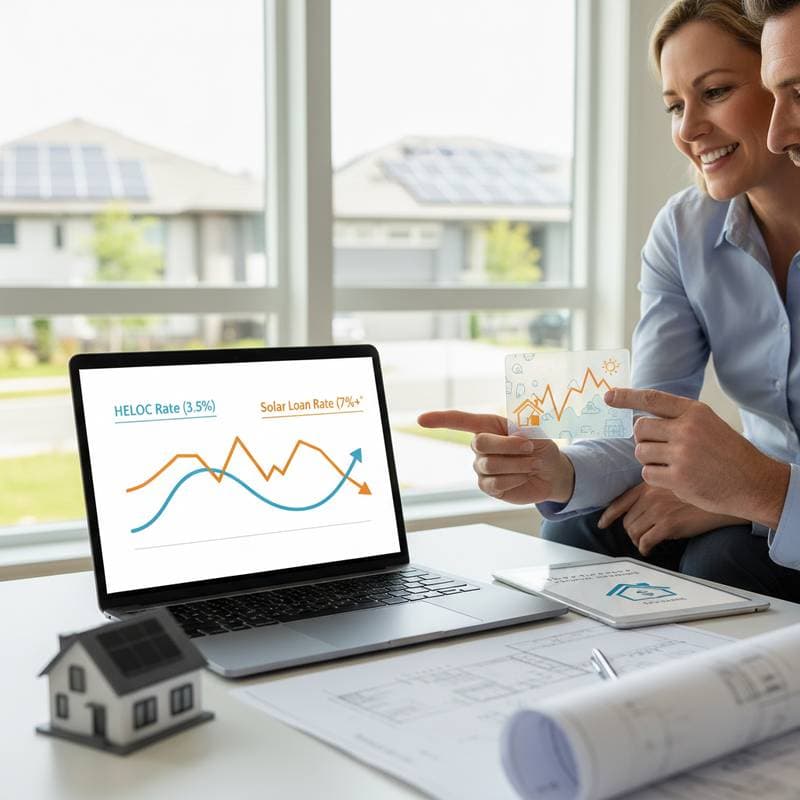
Why 3.5% HELOC Rates Outperform Solar Financing Options
Solar financing has evolved significantly over the years. Experts once considered home equity loans a cumbersome method for funding rooftop solar systems. Installers and financiers preferred purpose-built loan products that integrated seamlessly into sales processes and dealer networks. However, with home equity lines of credit, or HELOCs, available at around 3.5%, the financial calculations challenge nearly every solar financing provider.
The solar loan sector relies on customers accepting interest rates that frequently double or triple those obtainable from personal banks. This disparity grows as homeowners recognize the opportunity to borrow against home equity at a much lower cost. When the difference between a HELOC and a solar-specific loan exceeds five or six percentage points, even compelling sales arguments lose their persuasiveness.
Understanding the Financial Impact on Homeowners
Consider a practical example often shared with installers addressing customer concerns. A homeowner owning a $300,000 property with $150,000 in equity might secure a HELOC at 3.5%. For a $25,000 solar installation, this results in monthly payments of about $112 over 25 years.
In comparison, financing the same system via a standard solar loan at 8% to 9% interest elevates payments to approximately $200 monthly. This $88 monthly gap undermines the core savings proposition behind most solar investments. Customers then question the financial benefits, and the system payback period extends well beyond the timelines presented in sales demonstrations.
Solar loans have long defended their elevated rates through promises of convenience, zero-down payments, and rapid approvals. Yet such advantages pale when homeowners can achieve thousands in lifetime savings simply by contacting their bank.
The Evolution of the Solar Loan Market
The surge in solar financing emerged as installers sought to mirror the cash flow benefits of leasing arrangements. Firms such as Mosaic, Sunlight Financial, and GoodLeap developed platforms that rendered solar loans as straightforward as obtaining a credit card. Although rates exceeded those of mortgages or home equity options, customers seldom made direct comparisons. Marketing highlighted immediate bill reductions and the notion that loan costs would balance against energy savings.
Solar loan providers depend on dealer fees to sustain their operations. Installers cover these fees, which can amount to 15% or more of the project total, to promote options like zero-interest or low-payment plans. These costs embed into the customer's loan rate. Consequently, while installers receive prompt payment, homeowners face loans resembling subprime products rather than secured home improvement financing.
This model appeared viable when home equity rates stood higher. The landscape shifted dramatically as HELOCs entered the mid-3% range, rendering solar loans notably costly.
The Advantages of HELOC Flexibility
HELOCs offer more than affordability; they provide superior adaptability. Homeowners draw funds as required, pay interest solely on the used amount, and frequently opt for interest-only payments during the initial draw phase. This setup allows space to accelerate principal reduction upon receiving tax credits or rebates.
Solar loans lack such versatility. They feature full amortization from the outset, with unchanging payments designed for extended terms. Borrowers commit long-term, and early repayments yield limited benefits due to interest front-loading and fee recovery mechanisms.
Installers sometimes claim HELOCs complicate sales because they involve bank interactions. This held true prior to widespread digital banking adoption. Today, many lenders process HELOC applications in minutes. Some connect directly to existing mortgage platforms for seamless management. The barriers have diminished considerably.
Reasons Installers Favor Solar Loans
Even with clear financial advantages, numerous installers hesitate to endorse HELOCs. The rationale becomes evident. Integrated dealer loans ensure predictable cash flow. Installers receive swift compensation, lenders assume credit risks, and transactions remain centralized. Recommending a HELOC diverts customers externally and risks deal disruption.
This approach carries potential drawbacks. As homeowners increasingly research financing independently, installers overlooking HELOCs appear less credible. Customers detect when suggestions prioritize dealer benefits over sound economics. Several companies have forfeited future business after clients discovered substantial savings via home equity options.
Implications for Solar Finance Providers
Persistent low HELOC rates compel solar finance companies to overhaul their offerings. Certain providers now test hybrid approaches combining home equity elements with dealer convenience. Others pursue direct-to-consumer models to lower dealer fees.
Banks possess an inherent edge through lower capital costs. They extend secured loans against property at reduced risk, unlike solar lenders handling unsecured consumer debt with elevated default probabilities. Without rate reductions of several percentage points, market forces will continue directing homeowners to established banks.
This situation echoes the solar leasing era, when third-party ownership seemed dominant until loans rose in popularity. A similar reversal may unfold, with conventional lenders regaining territory once held by specialized solar financiers.
Steps for Homeowners to Choose Wisely
Homeowners considering solar installations should initiate evaluations by comparing borrowing costs against anticipated energy savings. A HELOC with lower rates and absent hidden fees warrants thorough review. Essential considerations include alignment with overall household budgeting.
Certain individuals value the stability of fixed payments and the focus of a solar-dedicated loan. Others favor the autonomy of a revolving credit line. Regardless, the figures demonstrate that a 3.5% HELOC accelerates solar payback compared to 8% or 9% loans.
Advancing Efficient Solar Financing Strategies
The solar sector excels through innovation, yet it must prioritize customer-centric financial solutions. Leading installers will guide clients in assessing all alternatives, including those without dealer commissions. Such openness fosters confidence, which in turn sustains enduring market growth.