
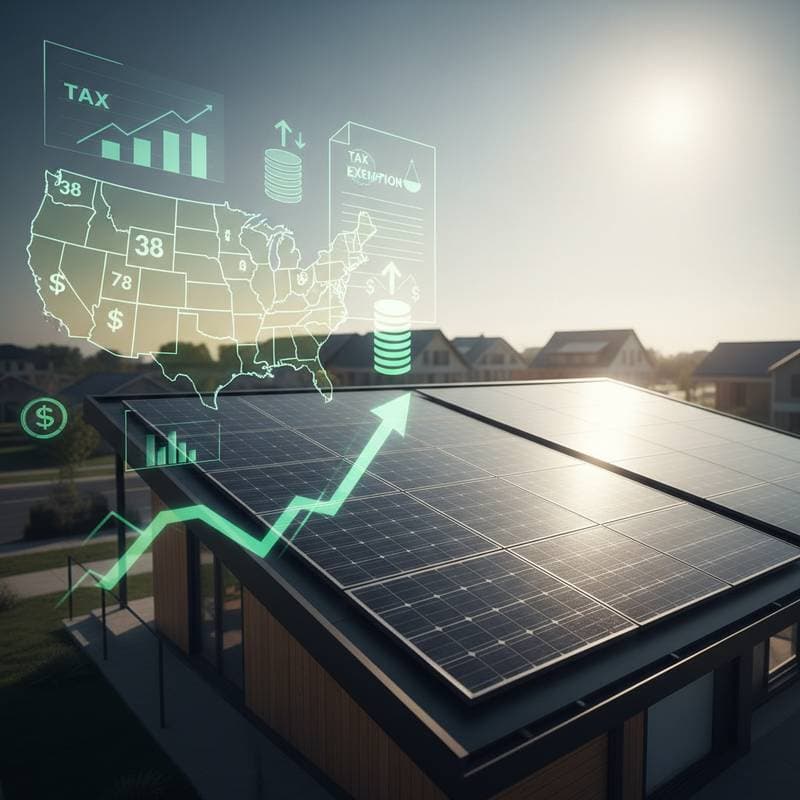
Solar Property Tax Exemptions Expand to 38 States, Transforming Project Viability
Property tax exemptions for solar energy systems now exist in 38 states, forming a key pillar of the U.S. solar incentive framework. These policies exclude the value of installed solar equipment from property assessments, which lowers costs and enhances financial returns for residential, commercial, and utility-scale projects. As solar adoption grows, these exemptions drive investment decisions and support broader clean energy goals.
Data from the Solar Energy Industries Association highlights these exemptions as vital state-level incentives. They help developers assess project feasibility in varied markets, from urban rooftops to rural solar farms.
Understanding Property Tax Exemptions for Solar Systems
Property tax exemptions prevent the added value of solar installations from increasing a property's taxable assessment. For instance, a homeowner adding a 10 kW rooftop system worth $25,000 avoids any tax hike based on that value. In larger commercial setups exceeding several megawatts, the financial relief compounds significantly.
Most exemptions cover solar photovoltaic and thermal technologies, with some including paired battery storage. Options range from full exclusions, which remove the entire system value, to partial ones that limit the exemption to a set percentage.
Key States with Strong Exemption Policies
Several states have crafted detailed exemption frameworks to attract solar investments and reduce risks.
- California excludes the full value of active solar systems from assessments on residential, commercial, and industrial properties, bolstering its top position in solar capacity.
- New York grants a 15-year exemption for solar and wind systems, with local opt-out provisions.
- Texas delivers a complete exemption for the appraised value of on-site solar energy devices.
- Florida offers full exemptions for residential installations and partial for nonresidential ones, ensuring predictable tax outcomes.
States like Illinois, Minnesota, and Arizona blend exemptions with unique valuation approaches for utility-scale projects.
Financial and Technical Benefits for Developers
Property taxes can represent up to 15 percent of annual operating costs for commercial and industrial solar projects. Exemptions boost the internal rate of return by 1 to 3 percentage points, per Wood Mackenzie analysis.
"Property tax relief changes the economic fundamentals of a project," noted Laura Mitchell, senior policy analyst at Wood Mackenzie Power & Renewables. "Developers can reallocate savings toward better equipment, tracking systems, or energy storage integration."
For a 100 MW utility-scale plant, exemptions eliminate millions in lifetime tax liabilities, lowering the levelized cost of energy and improving competitiveness against fossil fuels.
Impacts on Residential and Commercial Sectors
In residential markets, exemptions address homeowner concerns about post-installation tax increases that could erode energy savings. Installers use this benefit to demonstrate clear returns on investment.
"Homeowners want to know their investment will not trigger higher annual taxes," said Kevin Lopez, regional sales director for SunBright Solar in Colorado. "When we explain that the system’s added value is excluded from property assessment, it closes a lot of deals."
Commercial owners factor exemptions into site selection and financing. They prioritize properties where tax treatment supports viable solar deployments across portfolios.
Navigating Implementation Challenges
Exemption application varies by jurisdiction, leading to inconsistencies in how county assessors enforce rules. Developers encounter differing documentation needs and interpretations, even within the same state.
"Uniformity is the biggest challenge," said Chris Hansen, tax counsel for BrightEdge Renewables in Illinois. "Even within one state, the process can vary from one county to the next. Some assessors understand the exemption immediately, while others need legal clarification."
Automatic exemptions streamline processes in some areas, but others demand applications or certifications. Project teams must track deadlines to secure benefits and avoid penalties.
Evolving Policies and Emerging Trends
States compete for clean energy projects by expanding exemptions, with several legislatures debating new adoptions. This shift targets regions hampered by high property taxes.
Refinements address battery storage and agrivoltaic systems, where solar arrays integrate with farming. Clear guidelines preserve agricultural tax status for such dual-use setups.
Exemptions complement federal tools like the Investment Tax Credit, shortening payback periods. A 2 MW commercial project in an exempt state can recover costs in half the time without such support, based on Clean Energy Strategies modeling.
Local Economic Considerations
Exemptions may dip short-term tax revenues, but they foster job creation, leases, and broader economic gains. National Renewable Energy Laboratory research shows each megawatt of solar generates over $1 million in local activity during construction.
Some states use payment-in-lieu-of-tax programs to balance budgets. These provide municipalities with steady payments while preserving project appeal.
Opportunities for Manufacturers and EPC Firms
Wider exemptions spur demand for modules, inverters, and racking systems. Engineering, procurement, and construction firms see stalled projects advance in cost-sensitive markets.
"Every point of cost reduction or tax relief translates into more megawatts deployed," said Dana Kim, vice president of operations at HelioBuild EPC in Arizona. "We are seeing renewed activity in secondary markets like Kansas and Missouri that were previously cost-prohibitive."
With reduced risks, developers opt for durable materials and efficiency-enhancing technologies, benefiting suppliers.
Variations Across Regions
Exemption details differ by region. Northeastern and Western states often provide broad, extended coverage, while Southern and Midwestern ones impose limits on size or duration.
Michigan caps exemptions by capacity, and North Carolina links them to ownership types. Nevada and Massachusetts, however, apply universal rules regardless of scale.
Multi-state operators rely on policy experts to manage these differences and maintain compliance.
Projecting Future Growth
Analysts forecast that exemptions will accelerate solar capacity additions in coming years. As policies strengthen, solar's edge over other sources sharpens.
Debates focus on extending coverage to standalone storage and securing long-term exemptions matching project lifespans of 25 to 30 years. Standardized assessor guidance could further ease adoption.
Securing Solar Investments Through Policy Alignment
With 38 states now aligned on property tax exemptions, solar stakeholders gain tools to optimize economics and scale deployments. Developers and owners should review local rules and update compliance strategies regularly.
These policies underscore a commitment to renewable integration, yielding stable returns and innovation opportunities. By minimizing tax barriers, they position solar as a cornerstone of sustainable energy progress.