
- Audit original draft for logical flow and paragraph length
- Replace vague claims with precise, actionable details
- Enforce no contractions, em dashes, or formulaic closers
- Integrate required checklist at the start of the markdown
- Condense to stay underwhile preserving core incentives guidance
Max Out Solar Tax Credits by Stacking State and Federal Incentives
The U.S. solar market continues to expand as new policy tools make it easier for homeowners, businesses, and developers to reduce upfront costs. Federal and state tax incentives remain the most effective way to lower installation expenses and improve project economics. By understanding how to combine these programs, solar investors can significantly improve the return on each installed kilowatt.
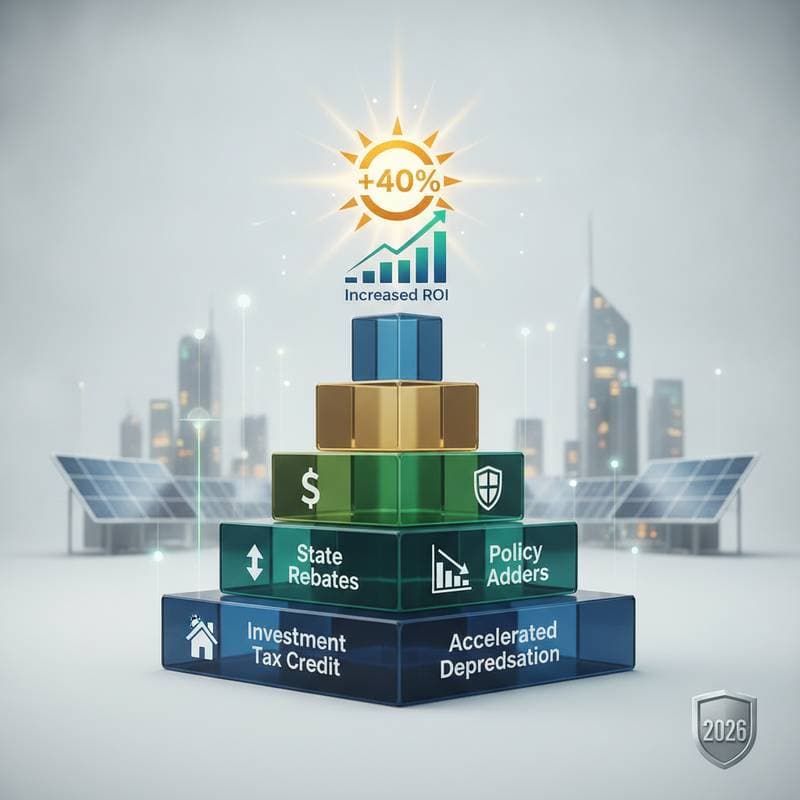
Industry analysts estimate that when state level rebates, production based incentives, and the federal Investment Tax Credit are combined, total project costs can fall by as much as 40 percent. Yet many projects still leave available incentives unclaimed due to confusion around eligibility, timing, or documentation.
Understanding the Federal Investment Tax Credit
The ITC is the foundation of solar tax policy in the United States. It allows a taxpayer to deduct a percentage of the cost of a solar energy system from their federal income taxes. The credit applies to both residential and commercial installations, including utility scale projects, community solar arrays, and commercial and industrial rooftops.
The ITC covers solar modules, inverters, racking systems, balance of system components, and labor costs associated with installation. This comprehensive coverage makes it one of the most powerful incentives available to solar investors.
Expanding Benefits Through Domestic Content and Energy Communities
Recent policy updates introduced new adders to the ITC that reward projects using domestically produced materials or located in designated energy communities. These adders can increase the total credit value by several percentage points. A project that uses U.S. manufactured modules, inverters, and mounting systems may qualify for a domestic content bonus. Projects built in regions affected by fossil fuel industry transitions may qualify for an energy community bonus.
State Level Incentives Create Additional Savings
While the ITC provides a national baseline, state programs add another layer of opportunity. These incentives vary widely and can include tax credits or deductions, rebates for system installation, performance based incentives that pay per kilowatt hour generated, sales and property tax exemptions, and renewable energy certificates.
States such as New York, Massachusetts, and Maryland offer strong rebate and performance based incentive programs that can dramatically shorten payback periods. In the commercial sector, utility administered incentive programs in California and Illinois continue to drive investment in both rooftop and ground mounted systems.
Combining Federal and State Benefits
Stacking incentives requires careful coordination among accountants, legal advisors, and project developers. The key is understanding how different credits interact and in what sequence they must be applied. Typically the process begins by calculating the net system cost after state rebates are applied. The federal ITC is then calculated based on the remaining eligible cost.
For instance, a commercial system that receives a 100000 dollar state rebate on a 1 million dollar project would have a remaining eligible cost of 900000 dollars. The ITC percentage is then applied to that adjusted amount. Accountants emphasize the importance of documentation because every incentive program has its own application process, eligibility criteria, and timelines.
Timing and Depreciation Considerations
Commercial and industrial system owners can combine the ITC with accelerated depreciation through the Modified Accelerated Cost Recovery System. This allows a significant portion of the system cost to be depreciated in the first year, further lowering taxable income. When combined, the ITC and MACRS often provide a combined tax benefit equal to 50 percent or more of the upfront cost in the first year of operation.
For residential customers the process is simpler. The ITC can be claimed directly on an individual tax return. Most state incentives are structured as direct rebates or credits that do not interfere with the federal calculation.
How to Qualify and File
Eligibility for stacking credits depends on ownership structure and project type. To claim the ITC the taxpayer must own the system. This typically excludes customers under third party leases or power purchase agreements since the lessor retains ownership. Developers should work with certified public accountants experienced in renewable energy transactions.
Real World Impact for Developers and Installers
For engineering, procurement, and construction firms, understanding how to stack incentives can make the difference between a project moving forward or stalling. Mounting system suppliers may see higher demand for U.S. made products as developers pursue the domestic content adder. Installers who can guide clients through the incentive process gain a clear competitive edge.
Policy Certainty and Market Strategy
While incentives are powerful, they are also subject to change. State budgets, regulatory adjustments, and federal policy updates can alter credit values or eligibility rules. Developers must monitor policy developments continuously to avoid financial surprises. Industry groups provide updated guidance on incentive programs, and many states maintain official databases where applicants can verify current program terms.
Implementing Your Incentive Strategy
Stacking state and federal solar incentives directly affects cash flow, project viability, and long term profitability. Successful developers integrate incentive modeling into the earliest stages of project design. Homeowners begin by identifying state or local programs and coordinating with a qualified installer. Commercial clients work with experienced financial advisors to optimize ITC, MACRS, and state level benefits. Those who maintain an informed, proactive approach gain the greatest advantage in the competitive U.S. solar market.