
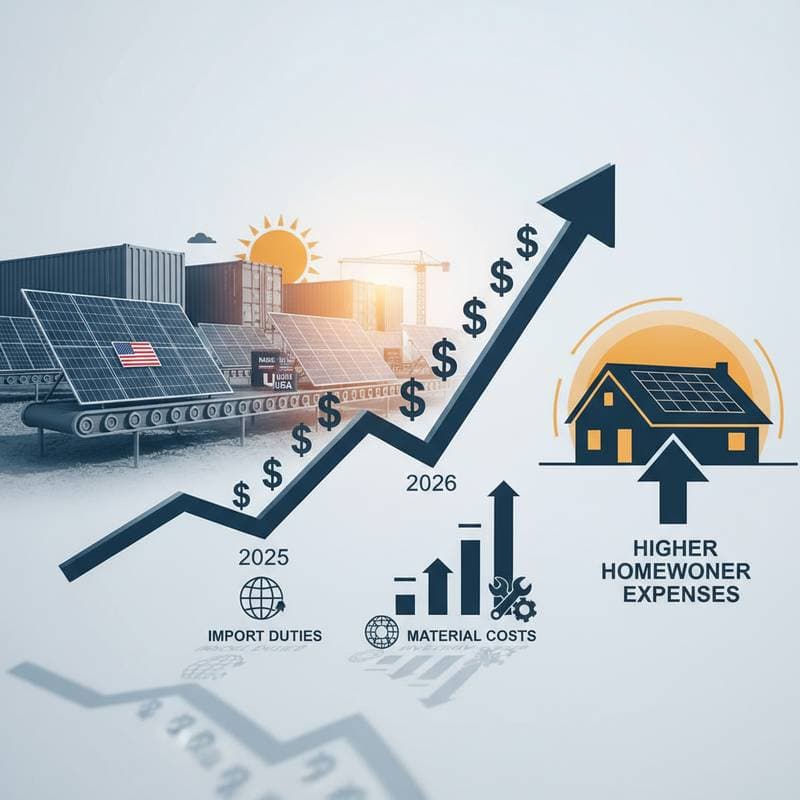
2026 Solar Tariffs: Real Panel Prices You Will Pay
The latest solar import tariffs approach, and the industry prepares for pricing adjustments. This policy change extends beyond trade disputes and manufacturing incentives. It affects project budgets, equipment sourcing, and homeowner installation estimates. After multiple tariff cycles, developers and installers recognize that trade policy eventually influences cost per watt.
Industry observers track major solar tariff developments from the initial Section 201 safeguard case onward. Patterns emerge consistently: policymakers promote domestic growth, importers redirect supply chains, and installers endure uncertainty pending customs directives. This tariff round resembles past ones, yet market conditions differ. Module prices hover at historic lows, inventories remain elevated, and U.S. manufacturers expand operations. Tariffs will elevate prices; the key factors involve magnitude and duration.
Targets of the Tariffs
The tariff measures address imported crystalline silicon photovoltaic modules and cells, plus select assembly components. They extend Section 201 safeguards, apply anti-dumping and countervailing duties, and introduce remedies against circumvention via Southeast Asian nations. The U.S. International Trade Commission and Department of Commerce intensify enforcement following evidence of Chinese firms relocating production to evade duties.
The objective centers on bolstering U.S. solar manufacturing through fair competition. Tariffs, however, often produce uneven outcomes. Complex supply chains and enforcement lags allow importers adjustment periods. Importers incur elevated compliance expenses, and developers incorporate these into project bids.
Effects on Panel Pricing
What do these tariffs imply for solar panel costs? Past announcements added 8 to 25 cents per watt to module prices within months, varying with inventory and tariff-free sources. Current U.S. prices for standard monofacial modules range from 25 to 30 cents per watt for utility-scale purchases. If new tariffs align with precedents, prices may reach 35 to 40 cents per watt after stockpiles dwindle.
Residential installers encounter higher wholesale rates, typically 45 to 55 cents per watt prior to markups. A tariff increase could elevate this to 60 cents per watt shortly. For a standard rooftop system, this adds hundreds of dollars in equipment costs, excluding labor and permits.
Such increments extend across projects. A two-cent rise on a 100-megawatt utility installation generates millions in added expenses. Even slight increases challenge the slim margins of local installers.
Advances and Constraints in Domestic Production
U.S. solar manufacturing achieves notable strides. New assembly lines launch, wafer and cell plants construct, and firms pursue vertical integration. Facility tours reveal tangible quality and efficiency gains. Scale remains the challenge: domestic output meets only a portion of demand, and supply chains rely on imported wafers and cells subject to tariffs.
Rapid domestic ramp-up could stabilize prices by curbing import dependence. Delays in expansion or rising feedstock costs might counteract benefits, creating supply shortages. Previous cycles saw developers postpone projects awaiting price stability or waivers. Similar risks persist.
Insights from Installers
Installers in multiple states express varied views. Some support the policy for overdue domestic strengthening. Others view it as renewed volatility complicating customer interactions. One installer noted, "Every time tariffs change, we spend weeks redoing quotes. Customers think we are playing games with pricing, when really we are just trying to keep up with the supply chain."
This reaction holds merit. Solar sales demand reliability. Tariff shifts disrupt financing and extend lead times. Even minor hardware cost increases, paired with uncertainty, can delay agreements. Installers must explain adjustments transparently, emphasizing solar's enduring value despite short-term rises.
Responses from Importers
Importers adapt procurement approaches. They cultivate ties with manufacturers outside tariff scopes. Some leverage federal domestic content incentives to counter duties. Port-adjacent warehousing grows, enabling inventory storage during duty evaluations.
Developers adopt contracts distributing tariff risks between parties. Fixed-price agreements prove challenging; flexible clauses proliferate. This evolution reshapes U.S. solar equipment transactions.
Projected Price Outcomes
Supply chain analyses and enforcement details outline three pricing paths:
-
Limited Shift
Moderate tariffs pair with effective domestic scaling. Prices increase 5 to 10 cents per watt briefly, then level as facilities activate. -
Balanced Upheaval
Enforcement outpaces output growth. Prices climb 10 to 15 cents per watt, prompting project delays for greater certainty. -
Intense Shortage
Tariffs compound with trade limits, tightening wafer supplies. Utility-scale prices surpass 50 cents per watt, possibly stalling major pipelines.
The limited shift appears probable, though history indicates early phases often yield steeper fluctuations than expected.
Guidance for Purchasers
Homeowners and businesses eyeing solar should prioritize timing. Current prices capture pre-tariff dynamics for imminent installations. Postponing to future cycles risks higher costs absent swift domestic gains. Robust financing and incentives preserve attractive payback periods amid moderate adjustments.
Strategies to Mitigate Tariff Effects
The solar sector navigates tariff rounds through adaptation. Forthcoming shifts introduce turbulence yet foster domestic competitiveness. Panel prices next year hinge more on market responses than tariff levels alone. Successful scaling eases volatility; otherwise, budgets require recalibration. Plan purchases, explore incentives, and monitor enforcement to safeguard investments.