
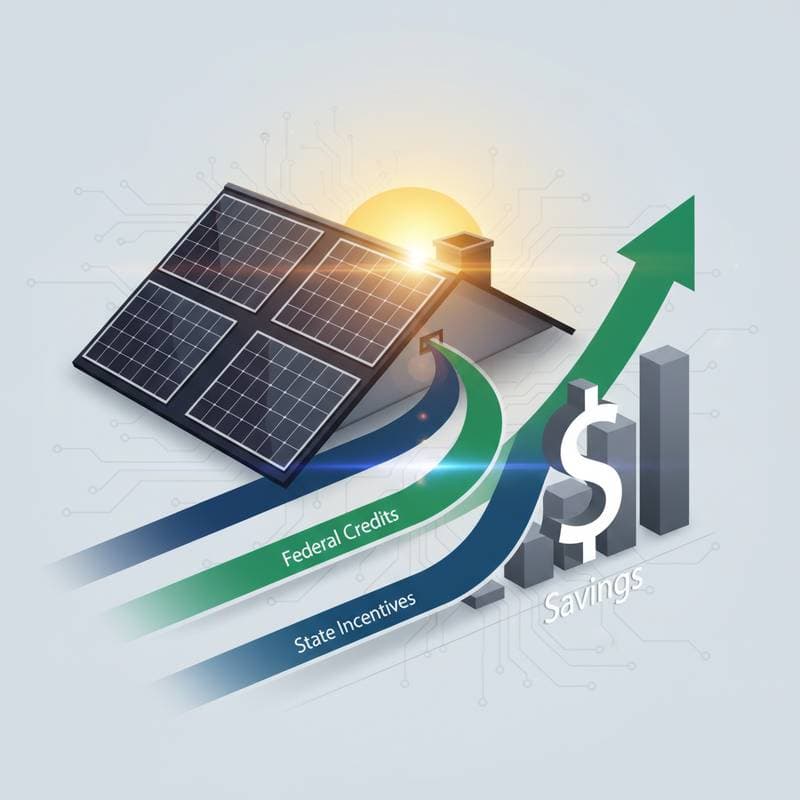
Maximize Solar Savings: Stack Federal and State Incentives
The Inflation Reduction Act has transformed solar financing across the United States by introducing a 30 percent federal investment tax credit. This credit applies to a wide range of projects, from residential rooftops to large-scale commercial installations. Pairing it with state incentives amplifies the financial benefits, making solar more accessible and profitable for diverse stakeholders.
Homeowners benefit from lower upfront costs, while businesses achieve quicker returns on investment. Installers and developers gain a competitive edge by guiding clients through these opportunities. Proper stacking requires attention to eligibility rules and timing to ensure compliance and full value realization.
Understanding the Federal Investment Tax Credit
The federal investment tax credit serves as the foundation for solar incentives. Taxpayers deduct 30 percent of qualified installation expenses, including solar panels, inverters, labor, and grid connection fees. This credit covers residential systems, commercial arrays, and community solar projects without geographic restrictions.
Eligible costs exclude non-solar elements like roofing repairs or unrelated site work. Taxpayers claim the credit on their federal income tax returns for the year the system enters service. For those with limited tax liability, options exist to carry forward unused credits or transfer them under new IRA provisions.
Layering State Incentives with Federal Credits
State programs complement the federal credit through rebates, additional tax credits, or performance payments. In California, for instance, the Self-Generation Incentive Program offers rebates that reduce the net cost before applying the federal credit. New York provides a state tax credit of up to 25 percent, which stacks directly with the 30 percent federal amount.
Massachusetts features property tax exemptions and solar renewable energy certificates that enhance long-term savings. These state benefits often target specific goals, such as energy efficiency or local manufacturing. Homeowners calculate total savings by first applying non-taxable rebates, then claiming credits on the adjusted basis.
To maximize stacking, review state-specific guidelines early. Some incentives require pre-approval or limit combinations to prevent overlap. Consult state energy offices for current rebate schedules and application processes.
Essential Rules for Effective Stacking
Timing influences how incentives interact. State rebates treated as purchase price reductions lower the base for the federal credit. Incentives classified as taxable income, however, allow the full project cost to qualify for the 30 percent deduction.
Document all applications meticulously to support tax filings. For example, if a $20,000 rebate reduces a $50,000 system to $30,000, the federal credit applies to $30,000, yielding $9,000 in savings. Tax experts recommend separating rebate types in contracts to clarify treatment.
Commercial entities combine the ITC with Modified Accelerated Cost Recovery System depreciation. This approach recovers over 50 percent of costs in the first five years when paired with state deductions. Businesses track these benefits through detailed financial modeling to optimize cash flow.
Bonus Credits for Targeted Projects
The Inflation Reduction Act introduces adders that increase the base credit by 10 to 20 percent. Projects in low-income communities qualify for a 10 percent bonus, while those in fossil fuel-dependent areas add another 10 percent. Using domestically produced components unlocks a further 10 percent.
These bonuses apply to community solar and nonprofit installations, promoting equity in clean energy access. In Illinois, state community solar programs align with federal adders, enabling developers to serve underserved areas profitably. Colorado offers similar synergies through its renewable energy credits.
Developers assess project sites against IRA criteria using tools from the Department of Energy. Meeting domestic content rules involves sourcing U.S.-made racking and wiring, which also strengthens supply chain resilience. Stacking these elements can elevate total incentives beyond 50 percent of costs.
Opportunities for Solar Businesses and Installers
The evolving incentive landscape reshapes operations for solar professionals. Developers design financing packages that leverage stacked credits to attract customers with reduced upfront payments. Installers differentiate services by offering incentive audits and filing assistance.
Andrew Birch, CEO of OpenSolar, notes that clear communication about these benefits shortens payback periods and boosts adoption rates. He emphasizes that installers who simplify the process gain a market advantage. Manufacturers adapt by prioritizing domestic production to access bonus credits.
Engineering, procurement, and construction firms integrate compliance checks into bids. This preparation ensures projects qualify for all layers of incentives, improving project margins. Training staff on IRA updates maintains accuracy in proposals and contracts.
Steps to Secure Stacked Incentives
Begin with a project feasibility assessment that includes federal and state eligibility reviews. Homeowners gather quotes from certified installers and estimate tax liability to gauge credit usability. Businesses engage renewable energy accountants for customized projections.
File state rebate applications before construction starts, as many operate on first-come, first-served bases. After installation, submit federal tax forms with supporting documentation, such as IRS Form 3468 for the ITC. Track system performance to claim any ongoing state incentives.
Regularly monitor updates from federal and state agencies, as rules evolve to enhance accessibility. Partnering with experienced professionals streamlines the process and minimizes errors. This proactive approach unlocks the full potential of stacked incentives.
Driving Solar Growth Through Incentives
Mastering federal and state incentive stacking positions stakeholders for substantial gains. Homeowners enjoy energy independence with minimal financial burden, while businesses secure sustainable returns. Developers contribute to national goals of equity and manufacturing revival.
As programs mature, coordination between levels of government will sustain momentum. Those who navigate this framework effectively accelerate the transition to clean energy. The result fosters broader participation and long-term environmental benefits.