
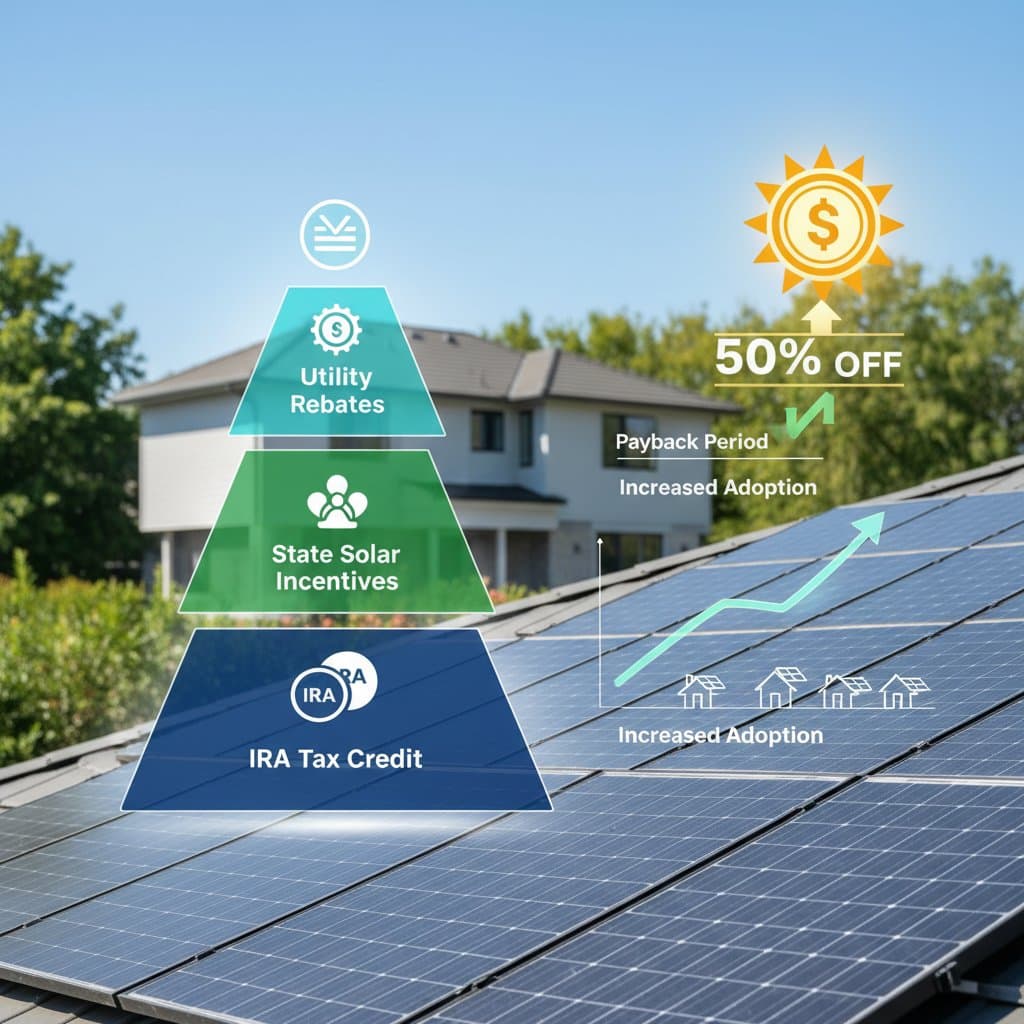
Maximize Solar Savings: Stack Rebates Under the IRA for Up to 50% Off
Homeowners and small business owners increasingly recognize a vital provision in the Inflation Reduction Act that permits combining multiple solar incentives to reduce installation costs by approximately 50 percent. This approach represents a deliberate alignment of federal tax credits with local and utility rebates, rather than any evasion. Proper application of these incentives renders solar systems more financially viable than initial estimates suggest.
Understanding the Provision
The federal Investment Tax Credit, enhanced by the IRA, allows property owners to deduct 30 percent of solar installation expenses from federal taxes. Simultaneously, numerous states, counties, and utilities provide direct rebates or performance incentives that lower initial outlays. The provision functions because the IRA does not mandate subtracting these rebates from the base cost before applying the federal credit, enabling the full 30 percent credit on the original system price alongside any local rebates.
Consider a $20,000 solar system installation where a $4,000 local rebate applies. The federal credit remains $6,000 based on the full $20,000, combined with the rebate for total savings of $10,000. This results in a net cost of $10,000, achieving 50 percent reduction from the starting price.
Impact on the Solar Industry
Installers find this stacking provision a compelling tool for sales, as it addresses customer concerns over upfront expenses and facilitates quicker project commitments. For property owners, the benefit lies in shortened payback periods; systems once requiring eight to nine years to recoup now often break even in four to five years, influenced by local electricity rates and system efficiency.
Analysts observe that this mechanism boosts sales in incentive-rich regions. Installers in California, Massachusetts, New York, and Colorado note heightened project initiations from customers previously postponing due to costs. Consequently, residential solar deployment expands, enhancing distributed energy capacity nationwide.
Federal Design and Local Execution
Legislators crafted the IRA's ITC to complement existing incentive programs, aiming to broaden renewable energy access across demographics and locations. The absence of explicit restrictions on combining incentives permits the Internal Revenue Service to approve full ITC claims post-rebate receipt, provided rebates qualify as nontaxable.
Local entities vary in rebate delivery: some issue payments to contractors, others to owners upon verification. In either scenario, rebates preserve the federal credit basis unless program rules dictate otherwise.
Incentives Available for Stacking
Key incentive categories that align under this framework include:
- Federal Investment Tax Credit (ITC): Reimburses 30 percent of costs for equipment, labor, and permits.
- State or Municipal Rebates: Administered by energy offices or local governments, these range from hundreds to thousands of dollars per project.
- Utility Rebates: Tied to system size or energy output, these offer lump sums or performance payments for grid contributions.
- Renewable Energy Certificates (RECs): In select states, owners sell generation attributes for supplementary income.
- Low-Income or Community Grants: Targeted aid for underserved or rural areas, stackable with the ITC.
Overlaps among these can yield 45 to 55 percent total savings, varying by jurisdiction and qualifications.
Addressing Double-Dipping Concerns
Installers and owners sometimes fear audits from incentive combinations. Renewable energy tax specialists confirm that proper documentation eliminates most risks, as the ITC only adjusts for incentives altering the tax basis.
State and utility rebates typically avoid this adjustment. Owners should retain invoices, approvals, and payment records, and consult tax advisors for complex setups, especially commercial ones.
Strategies for Installers
Contractors highlight stacking benefits in proposals and tools like interactive savings calculators during consultations. These demonstrate personalized reductions, broadening appeal.
Navigating diverse programs requires vigilance; many installers collaborate with incentive management platforms to handle applications, eligibility checks, and submissions. Such partnerships minimize errors and expedite approvals, optimizing project timelines.
Evolving Policy Landscape
As stacking gains traction, discussions emerge on its sustainability. Critics view it as excessive federal outlay, while proponents stress its necessity for equitable clean energy growth.
No changes have materialized yet. Advocacy groups press for preservation, citing benefits to employment and economies. Utilities refine programs to manage incentive interactions consistently.
Steps to Secure Combined Incentives
Prospective owners should verify federal and local eligibility with installers, who supply region-specific breakdowns. Post-installation, claim the ITC on tax returns and pursue rebates via designated processes.
Installers must monitor incentive availability, as funds often limit quickly. An organized incentive tracker ensures clients maximize benefits, enhancing project viability.
This IRA provision redefines solar economics for residential and small commercial sectors. Strategic planning unlocks substantial savings, lowering entry barriers and promoting widespread adoption while policies endure.