
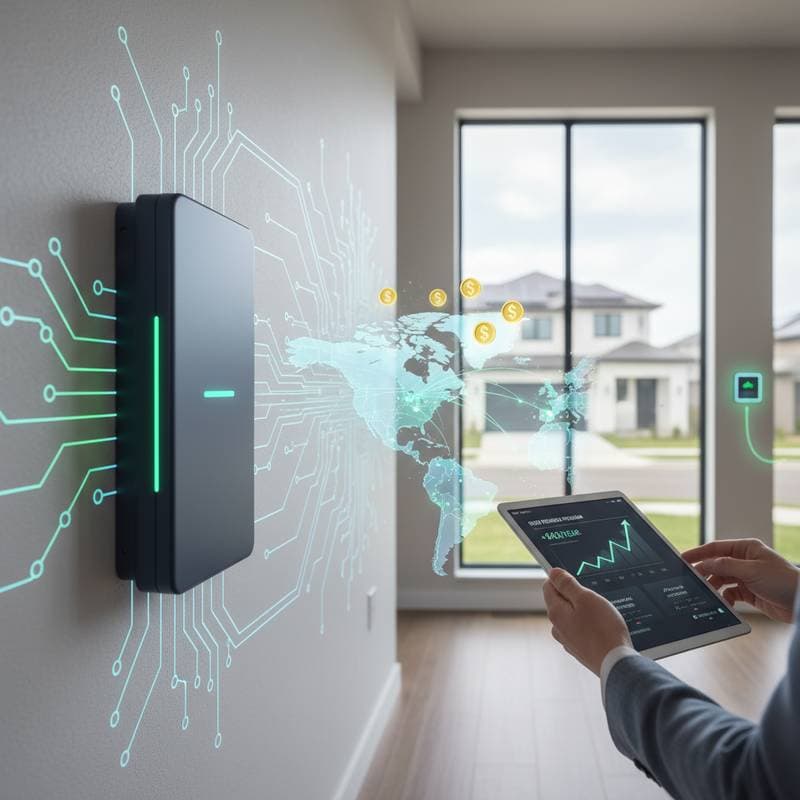
Earn Up to $400 Annually by Renting Your Home Battery to the Grid
Home batteries serve purposes beyond mere backup during power outages. Throughout the United States, homeowners generate consistent income by permitting their batteries to assist the electric grid. Virtual power plant programs enable utilities and energy aggregators to compensate participants for sharing stored energy during periods of high demand. For numerous households, this arrangement yields up to $400 in passive income each year, achieved by allowing the battery to operate precisely when the grid requires support.
How Battery Rental Functions
The process operates on a simple principle. A home battery stores electricity from solar panels or draws it from the grid during off-peak times. Virtual power plant programs link thousands of such batteries via a software network, forming a distributed energy resource capable of real-time responses to grid needs.
During instances of elevated grid demand, the program operator withdraws modest quantities of energy from enrolled batteries. Homeowners maintain control over their backup capabilities, yet a segment of the stored power discharges to bolster grid stability. In exchange, the operator provides compensation to the homeowner in the form of annual payments or monthly credits.
This approach enables utilities to alleviate pressure on existing infrastructure. At the same time, it offers consumers an innovative method to derive income from equipment they already possess. Although the payments do not substitute for full-time wages, they effectively reduce the costs associated with storage systems and enhance the return on investment.
Providers of These Programs
Virtual power plant programs expand rapidly as utilities seek adaptable grid resources. Leading companies, including Tesla, Sunrun, and Enphase, develop software platforms that orchestrate thousands of batteries. Regional energy providers and retail electricity suppliers partner with these platforms to oversee demand response initiatives.
Requirements for participation differ based on location and provider. Certain programs fall under utility leadership, whereas others involve independent aggregators that engage directly with homeowners. Generally, participants must possess:
- A compatible battery system linked to the internet
- Enrollment in an eligible utility rate plan
- Authorization for restricted remote dispatch during grid events
Upon enrollment, the platform oversees battery performance, records energy contributions, and computes payouts on an automated basis. These programs prioritize ensuring that homeowners retain sufficient stored energy for personal needs prior to any grid contributions.
Earnings and Payment Models
Annual earnings typically range around $400, although actual amounts vary according to system capacity, program guidelines, and regional grid dynamics. Compensation derives primarily from the volume of energy supplied during demand events.
Certain programs provide a fixed participation fee, securing a baseline payment irrespective of dispatch occurrences. Alternative models base rewards on performance, reimbursing participants for each instance their battery delivers energy. Individuals with greater battery capacities or residences in areas experiencing frequent peak demands often realize elevated returns.
In addition to cash disbursements, select utilities extend bill credits or discounted rates within their compensation frameworks. Participants benefit from thoroughly examining program conditions to comprehend payment calculation methods and issuance schedules.
Advantages Extending Past Financial Gains
While the income aspect attracts interest, the program yields extensive benefits. Renting a battery to the grid assists in:
- Stabilizing local power networks through the mitigation of demand peaks
- Diminishing greenhouse gas emissions via optimized energy allocation
- Bolstering community resilience with enhanced grid dependability amid high-demand phases
- Expediting renewable energy integration by rendering storage economically viable
For solar system owners, battery rental aligns seamlessly with prevailing incentive schemes. Such participation accelerates the payback timeline for solar and storage installations, converting substantial investments into dependable revenue streams.
Maintaining Oversight and Security
Prospective participants frequently express concerns regarding control. Individuals prefer to avoid scenarios where external entities deplete their battery reserves during personal necessities. Contemporary virtual power plant platforms mitigate these issues with defined operational boundaries.
Homeowners establish preferences that reserve a minimum charge threshold for backup requirements. Automated dispatch events adhere strictly to these parameters. Communication of data between the battery and aggregator employs encryption, complemented by ongoing monitoring of system efficacy to uphold dependability.
The integration proves unobtrusive. Following initial setup, homeowners encounter minimal need for adjustments. The software manages involvement autonomously, dispatching energy solely when advantageous to both the homeowner and the grid.
Influences from Policy and Market Trends
Energy regulators and utilities promote distributed storage involvement within comprehensive grid modernization strategies. Conventional power facilities struggle to adapt swiftly to fluctuating demands, whereas interconnected batteries respond in mere seconds.
State and federal initiatives foster storage deployment, incorporating elements that facilitate virtual power plant engagement. This regulatory trajectory highlights the increasing acknowledgment of consumer-held assets as essential grid components.
As utilities confront escalating capacity constraints, compensated participation frameworks will proliferate. Homeowners who install batteries presently position themselves advantageously to capitalize on these prospects without necessitating further equipment acquisitions.
Initiating Participation
For those possessing a home battery or contemplating installation, enrollment in a rental program entails straightforward procedures:
- Verify eligibility by consulting your utility or battery manufacturer regarding available virtual power plant programs in your region.
- Validate system compatibility, as some programs demand particular inverter types or communication standards.
- Register via your provider, a process often completed online with varying approval durations.
- Configure preferences to specify the extent of aggregator authority over battery charge and discharge operations.
- Examine payment conditions to grasp compensation computation and distribution timelines.
Following approval, the system responds automatically to grid solicitations in accordance with selected configurations. Participants receive periodic reports detailing shared energy, accrued earnings, and realized environmental impacts.
Enduring Benefits for Homeowners
Participation in a virtual power plant extends beyond immediate payments to prolong battery longevity. Regulated cycling during grid events sustains system activity and equilibrium, averting degradation from extended idleness.
Select manufacturers provide prolonged warranties for batteries in managed programs, acknowledging that refined usage mitigates wear. When paired with consistent income, these elements amplify the financial and operational merits of home storage solutions.
Unlocking Revenue from Energy Assets
Renting a home battery to the grid marks a pivotal evolution in perceptions of energy possession. Systems once dedicated to individual backup now fulfill communal roles, fostering grid robustness alongside tangible financial incentives.
Current solar and storage investors find virtual power plant involvement transforms assets into annual revenue generators. Prospective adopters discover that assured earnings render storage installation a more persuasive choice, enhancing both personal and collective energy futures.