
Can Solar + EV Bundles Save You $3,000 in 2026?
Electric vehicle adoption continues to grow rapidly across the United States. Many homeowners now consider combining rooftop solar installations with home EV charging setups. Energy economists and installation companies project that these integrated bundles could deliver savings of approximately $3,000 for consumers. These benefits arise from combined rebates, lower installation expenses, and reduced electricity costs during the initial years.
For the solar industry, this trend opens significant business potential. It connects residential solar demand with the expanding electric vehicle market. Installers, manufacturers, and utilities adapt their approaches to serve this unified customer base.
Changes in Selling Home Energy Systems
Residential solar installations have long served as independent investments to offset home electricity use. EV chargers typically come from automotive dealers or electrical specialists. Now, providers merge these elements into one comprehensive package.
A Wood Mackenzie report indicates that almost 20 percent of new residential solar customers plan to include an EV charger in the same project. Analysts expect this figure to increase as bundled options evolve.
John Taylor, senior vice president of product development at SunCharge Energy in California, explains that their bundled service reduces installation costs by 15 percent on average. He states, "Combining electrical upgrades, permitting, and software configuration into one job eliminates duplication. Our average customer saves about three thousand dollars compared to separate installations."
How These Bundles Operate
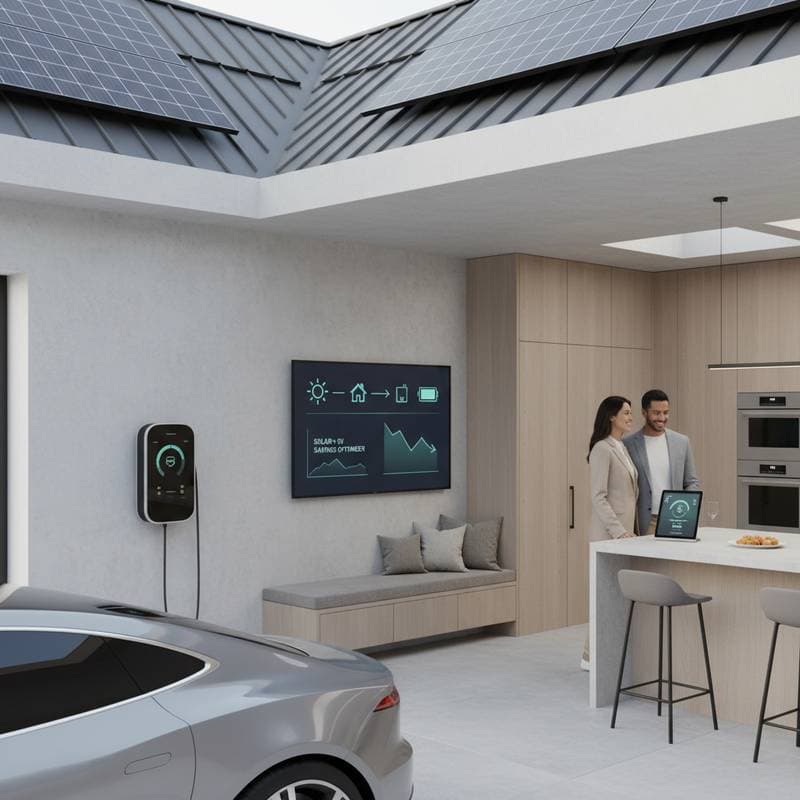
A standard solar plus EV bundle features a rooftop photovoltaic array of 6 to 10 kilowatts, a level 2 charger rated at 7.6 to 11.5 kilowatts, and a supporting app for energy management. Installers configure the setup to align daytime solar output with both home needs and vehicle charging.
Under time-of-use utility rates, the system schedules charging automatically for optimal efficiency. The charger links with the inverter or energy management tool to prioritize solar power. This setup reduces grid reliance by at least 25 percent for homes with regular driving habits.
Key components include:
- Photovoltaic modules on roof racking or ground mounts
- String or microinverters tied to the home electrical panel
- AC or DC level 2 EV charger that supports standard vehicle connections
- Energy management controller or gateway device
Teams complete both installations in one visit, cutting labor by up to 30 percent. Shared wiring, single permitting, and joint inspections shorten the overall process.
Financial Breakdown of the $3,000 Savings
Industry projections base the $3,000 savings on three main areas:
- Lower labor and permitting expenses – Unified electrical tasks prevent repeated site work, trenching, and panel modifications.
- Discounted bundled equipment – Suppliers provide price reductions for combined purchases, trimming material costs by hundreds of dollars.
- Incentives from federal and state programs – Tax credits apply to both systems in one initiative, boosting return on investment.
Maria Lopez, an energy consultant at GreenBridge Analytics, emphasizes that local rules influence these gains. She notes, "In markets like California, New York, and Colorado, rebate programs for EV chargers and solar align. When handled properly, customers access thousands in combined benefits."
Utilities add to the equation with rebates for smart EV chargers that adjust to grid needs. These incentives typically range from $300 to $1,000 based on the model and features.
Handling Installation Details and Coordination
Bundled projects demand precise planning despite their financial appeal. Installers must select appropriate conductors, breakers, and panels to support the solar array and charger demands.
In homes with older wiring, a service upgrade might be required, which could reduce some upfront savings. To counter this, manufacturers develop streamlined solutions for easier integration.
Enphase Energy, for instance, offers a unified solar and EV platform with a shared communication hub. Electricians connect multiple circuits to a single smart load center, minimizing breakers and ensuring code compliance.
New mounting options also help. Quick-mount rails and prewired harnesses decrease rooftop work by about 25 percent. Such improvements bolster the overall cost reductions.
Factors Driving Market Growth and Policy Support
This bundling movement supports national efforts to advance transportation electrification and renewable energy distribution. Federal backing for both areas encourages consumers to combine investments for better results.
Solar providers view bundles as a strategy to sustain growth where solo solar sales lag. Carla Mendoza, director of marketing at BrightPeak Solar in Texas, observes, "The next adoption surge will involve EV-owning households. We package solar, storage, and charging into one financing option. It streamlines decisions and delivers instant value."
Data confirms this pattern. Electric vehicle uptake rises in suburban areas with high solar use. Installers offering dual systems present stronger appeals.
Options for Financing and Ownership
Homeowners finance bundles via loans, leases, or power purchase agreements. Solar lenders increasingly cover EV chargers as part of their portfolios.
Mosaic, a leading solar financier, includes up to $2,000 for EV-related equipment in its residential loans. This spreads costs over the same period as the solar components.
Leasing firms test subscription plans that bundle solar, charging, and upkeep into fixed monthly fees. These suit those seeking low initial outlays and steady expenses.
BloombergNEF research highlights integrated financing as a sector catalyst. Combining technologies under one agreement raises project sizes while keeping payments affordable.
Overcoming Adoption Hurdles
Not every installer possesses the skills for bundled work. Smaller operations may lack EV licensing or rebate knowledge.
Training initiatives fill these voids. The North American Board of Certified Energy Practitioners provides modules on vehicle infrastructure. Topics cover circuit sizing, load assessments, and protocol integration.
State regulations vary, adding complexity. Certain areas mandate distinct permits for chargers, even with solar. Outdated rules delay multi-resource projects.
Associations push for unified processes. The Solar Energy Industries Association advocates template permits and shared inspections to ease bureaucracy.
Benefits of Intelligent Energy Oversight
Smart features elevate bundles beyond savings. Inverters, chargers, and management systems adjust loads in real time for better efficiency and grid support.
Upon plugging in, the EV draws solar power first, resorting to the grid only as needed. Advanced setups enable vehicle-to-home power flow during high-demand periods.
Bidirectional charging pilots operate in select states. Successful scaling could amplify bundle advantages.
Installer Competition and Strategies
Rivalry grows around integrated packages. Large firms like Sunrun and Tesla Energy market full home energy solutions with solar, storage, and charging.
Regional players collaborate with charger makers or dealers. These alliances expand reach and aid vehicle owners with seamless charging setups.
Distributors evolve too. Wholesalers stock chargers, mounts, and controls, enabling contractors to offer complete services from one source.
Building a Unified Energy Ecosystem
Solar and electric vehicle integration transforms home energy dynamics. These packages cut costs, streamline setups, and improve user satisfaction. The $3,000 savings often tip the scale toward combined purchases over individual ones.
Utility programs for demand response and flexible rates will heighten the pairing's worth. Future energy users will view homes and vehicles as connected units, fueled by on-site clean power.