
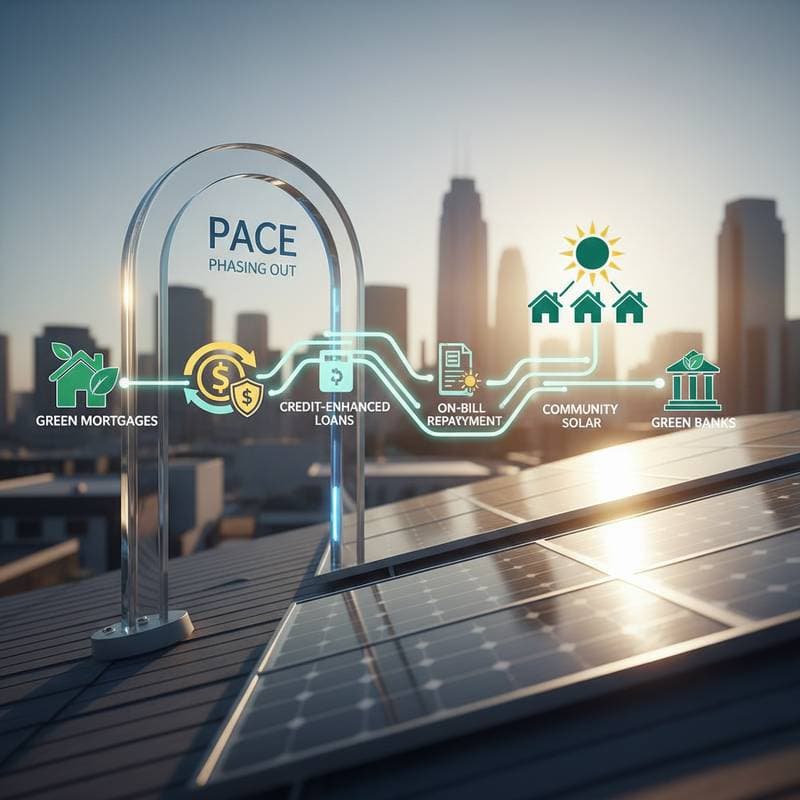
Solar Financing Beyond PACE: Strategies for 2026
Property Assessed Clean Energy (PACE) has served as a prominent financing mechanism for residential and commercial solar installations over the past decade. This program enabled property owners to fund solar systems, energy efficiency improvements, and water conservation efforts via their property tax assessments. The core concept linked repayment to the property rather than the borrower, providing investor stability and broadening access to clean energy for homeowners.
PACE now faces political hurdles, regulatory oversight, and inconsistent state-level implementation. As program availability diminishes, the solar industry prepares for the transitions ahead. By the conclusion of existing initiatives, installers, lenders, and advocates require innovative mechanisms to address emerging needs. Observations from the progression of solar finance, from initial feed-in tariffs to the establishment of green banks, highlight this period as a critical turning point.
Origins and Challenges of PACE
PACE originated from a straightforward policy principle: homeowners could undertake energy enhancements without initial outlays if repayments attached to property taxes. This structure proved ideal for durable installations like rooftop solar panels, which frequently exceed mortgage durations. Local authorities issued bonds, private investments channeled through administrators, and obligations transferred with property sales.
Initially, this collaboration between governments and investors appeared optimal. However, complexities arose. Mortgage providers and federal agencies expressed concerns over PACE's senior lien priority. Detractors pointed to varying consumer safeguards across regions. Certain states developed comprehensive systems with explicit disclosures and contractor monitoring, whereas others permitted excessive potential for misuse.
Outcomes varied widely. In select areas, PACE facilitated solar adoption for thousands of households. Elsewhere, regulatory ambiguities or opposition halted progress. Elevated administrative expenses combined with stricter guidelines have reduced accessibility, especially for smaller installers who valued its straightforwardness.
Addressing the Emerging Financing Shortfall
PACE's decline reveals a distinct financing void. Numerous homeowners ineligible for standard unsecured solar loans require viable routes to ownership. Lenders previously focused on PACE-supported assets now expand into diverse offerings, yet none match the blend of competitive rates, extended periods, and property-secured commitments.
Installers report tangible impacts. Discussions with mid-sized contractors in the Southwest reveal consistent challenges. Customers increasingly abandon projects post-credit evaluation or hesitate due to elevated rates. Previously, sales representatives highlighted how repayments integrated into tax bills without affecting credit profiles, appealing to those seeking ease and reliability.
Solar financing fragments without PACE. Installers test combined approaches, pairing modest loans with utility incentives or bill-integrated repayments. Some revert to third-party ownership models, which had waned amid preferences for direct purchases.
Promising Alternatives to Bridge the Gap
Market adaptations yield several viable options. While no single substitute fully mirrors PACE, these developments demonstrate the persistent evolution of solar financing.
1. Green Mortgages and Retrofit Loans
Emerging mortgage variants integrate energy upgrades during home purchases or refinances. Borrowers incorporate solar expenses into principal amounts, distributing costs across extended timelines. Success demands collaboration among lenders, appraisers, and evaluators who recognize solar's financial benefits, such as reduced utility expenses that enhance property values by 3-4% on average.
2. Credit-Enhanced Solar Loans
Private financiers introduce risk-reduction strategies to broaden unsecured loan availability. Approaches include insurance guarantees or enhancements supported by green banks. These measures lower default probabilities, enabling extended durations and reduced rates that rival PACE's former appeal. For instance, programs in California now offer 15-20 year terms at 4-6% interest for qualified applicants.
3. Utility-Based On-Bill Financing
Utilities initiate programs where customers repay solar or efficiency investments via monthly bills. This method provides PACE-like convenience without tax involvement. Alignment of payments with energy reductions allows immediate savings visibility; participants often recoup costs within 7-10 years through lowered bills.
4. Community Solar Subscriptions
For those unable or unwilling to host rooftop arrays, community solar provides shared access. Subscribers claim portions of off-site projects, earning proportional bill credits. This expands clean energy reach without property liens; over 5 million U.S. households now participate, with growth projected at 20% annually through 2030.
5. Green Banks and Revolving Funds
State and local green banks occupy PACE's former role. Public seed capital draws private investments, yielding sub-market rates and adaptable terms for solar projects. Blended models merge grants, rebates, and loans; New York's Green Bank, for example, has financed over $1 billion in clean energy, prioritizing underserved communities.
Preparing Installers for the Shift
The PACE exit demands adjustments. Installers must reassess sales strategies, train staff on new options, and revise promotional content. Financing discussions, once brief, now necessitate thorough explanations and relationship development to guide customers through choices.
Opportunities abound nonetheless. Solar lending has advanced since PACE's inception, with digital tools enabling rapid approvals and streamlined processes. Loan aggregators facilitate large-scale securitization, gradually lowering expenses. Partnerships with lenders providing lenient criteria and clear pricing sustain compelling offers.
Commercial sectors may see accelerated advancements. Owners pursue energy service agreements, leases, and performance contracts linked to output metrics. Institutional capital returns to distributed solar, drawn by reliable returns and diversification benefits.
Strengthening Trust in Solar Investments
PACE's trajectory underscores that financing represents only one element of consumer assurance. Clear practices, responsibility, and superior installation quality prove equally vital. Even superior terms fail against subpar work or opaque dealings.
Advancing Solar Finance for Lasting Impact
The era following PACE introduces varied lending, utility collaborations, and community approaches. Installers benefit from maintaining diverse lender alliances, tracking new initiatives, and embedding financing education in interactions. Policymakers should nurture progress while avoiding prior pitfalls. Homeowners gain enduring advantages from solar, as payment mechanisms continue to refine and expand accessibility.