
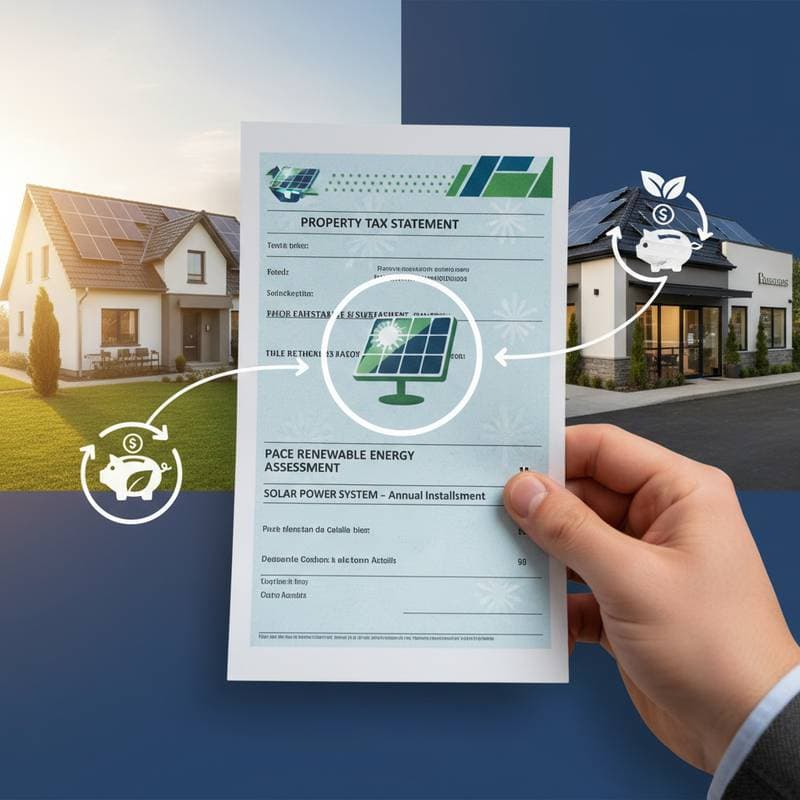
Understanding PACE Financing for Solar Installations
Property Assessed Clean Energy, known as PACE, emerges as a reliable financing tool that ties renewable energy enhancements to property tax mechanisms. This approach secures repayment against the property itself, rather than the owner's personal finances, which permits homeowners and commercial owners to deploy solar arrays without substantial initial outlays. Such a framework accelerates clean energy uptake and delivers stable repayment options for lenders and users alike.
The Mechanics of PACE Programs
Local governments initiate PACE programs by approving funds for energy-efficient modifications. Owners commit to reimbursing the amount via a surcharge on their property tax statements. Repayment durations often span 15 to 25 years, corresponding to the useful life of the installed systems, so energy cost reductions can balance the ongoing assessments.
In contrast to conventional loans, PACE obligations remain with the property upon sale. This continuity minimizes risks for owners who relocate mid-term. For solar projects, it guarantees that future buyers assume the payments, fostering confidence in long-term investments like photovoltaic panels on rooftops.
Broadening Solar Energy Opportunities
PACE significantly boosts solar accessibility by sidestepping common hurdles such as stringent credit checks or large capital requirements. Repayment hinges on the property's assessed value and payment record, not individual credit profiles, which invites participation from diverse groups including modest-income households and small enterprises.
These initiatives fund comprehensive solar setups, encompassing panels, wiring, inverters, and efficiency enhancements. Programs frequently extend to battery storage integration, enabling owners to store excess power for evening use or outages. This setup lowers utility bills, enhances energy security, and diminishes dependence on peak grid supplies.
Protections and Regulatory Framework
State and local regulations govern PACE, incorporating safeguards for users and investors. Authorities vet contractors, define qualifying projects, and confirm ownership prior to imposing assessments. Modern programs mandate detailed explanations of costs, durations, and transfer effects to inform participants fully.
Initial concerns about opaque terms and inconsistent contractor performance prompted reforms. Administrators now enforce rigorous standards, including independent audits and accessible records. These measures build confidence, sustain program viability, and prompt more communities to launch PACE for solar and conservation efforts.
Aligning with Energy Policy Objectives
PACE advances regional clean energy targets by spurring on-site solar growth. Municipalities gain from upgraded infrastructure without burdening public funds directly. The solar sector experiences reliable demand, which sustains employment and fortifies supply networks.
This financing dovetails with efforts to curb emissions and elevate structure efficiency. Integrating renewables into tax frameworks channels private capital toward communal aims. Communities achieve greater durability, ease grid pressures, and progress toward self-sufficient energy systems.
Applications in Commercial Settings
Commercial PACE, or C-PACE, applies these principles to expansive structures and operations. Enterprises finance solar canopies, LED retrofits, climate control systems, and conservation measures under a single levy. Extended terms ensure that operational savings surpass yearly dues, optimizing liquidity alongside performance gains.
Developers leverage C-PACE to layer funds into new builds or renovations. It satisfies compliance mandates and elevates asset worth. Investors regard these assessments as secure, given their precedence over other claims in tax collections.
Overcoming Implementation Hurdles
PACE rollout differs by location, relying on legislative support and administrative readiness. Established areas show robust engagement, whereas emerging ones assess feasibility. Targeted outreach educates owners and providers on assessment dynamics and sale transitions.
Success requires collaboration between officials, financiers, and installers. Uniform processes and precise records dispel uncertainties. Successful cases highlighting savings and seamless handovers cultivate broader acceptance.
Contributions from Solar Professionals
Installers drive PACE utilization by guiding clients through options. Programs often demand certification, covering rules, qualifications, and reporting. Professionals weave financing into consultations, aiding choices that match budgets and objectives.
This integration widens client pools for providers. Pairing loans with system bids streamlines decisions and boosts conversions. In dynamic markets, it yields predictable income and project volume.
Building Momentum for Solar Growth
Property owners pursue affordable renewables, positioning PACE as a versatile solution. It merges policy incentives with market forces, yielding communal and economic gains. Stakeholders from installers to officials profit from a balanced system emphasizing inclusion, reliability, and sustained worth.
Ongoing training, open dialogue, and uniform rules shape expansion. For participants, PACE bridges affordability and ecological duty. With vigilant administration, it propels solar integration and resilient property evolution in homes and businesses.