
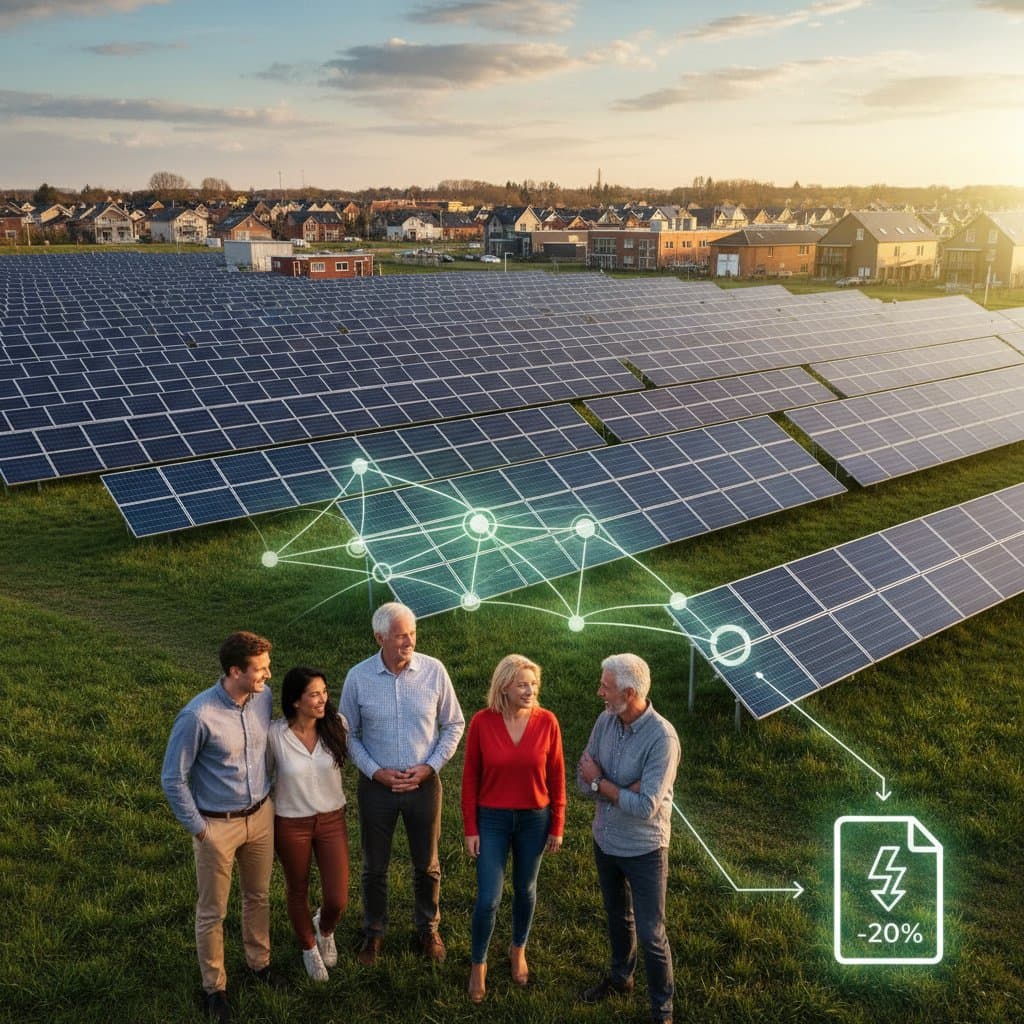
Access Community Solar for 20% Savings Without Property Installation
Community solar enables households and businesses to utilize solar energy without placing panels on their own property. Subscribers join a shared solar farm and receive credits on utility bills proportional to their allocated share of the generated energy. This approach frequently results in reduced electricity expenses, stable budgeting, and a diminished carbon footprint. Programs often deliver savings of up to 20 percent, positioning community solar as a viable alternative for individuals unable to install or uninterested in rooftop systems.
Understanding Community Solar Operations
A community solar project, also known as a solar garden or shared array, develops in a centralized location. Participants subscribe to acquire or lease a segment of the energy production. The utility monitors output from the project and allocates credits to subscribers' bills according to their portion.
Subscribers maintain their standard utility service, with no disruptions or on-site equipment. The subscription offsets a portion of the monthly charges. If a subscriber relocates within the utility's territory, the subscription typically transfers to the new location. Such portability attracts renters, condominium residents, and those anticipating moves.
Eligibility for Participation
Program eligibility depends on the specific initiative and utility region, though most welcome residential customers, small businesses, and nonprofits. Renters represent an increasing share of participants, as they lack authority for rooftop modifications. Homeowners facing shaded roofs or association restrictions find value here. Even those with existing rooftop installations may subscribe to address higher energy demands.
The enrollment process remains simple. Customers enter a subscription agreement outlining their capacity share and anticipated savings. Billing occurs either via the project operator or in coordination with the utility. Numerous programs require no initial payment and permit cancellation with advance notice, ensuring financial adaptability.
Mechanics of the 20 Percent Savings
The 20 percent savings indicate the standard discount relative to conventional utility rates. This stems from a crediting mechanism where subscribers pay for their solar portion at rates below the credit value, yielding net reductions.
Precise savings vary with regional electricity costs, subscription scale, and program design. Certain projects lock in a consistent discount, while others modify based on output. Regardless, the model fosters cost predictability. Subscribers bypass upkeep, financing, or structural alterations linked to personal panel ownership.
Advantages Extending Past Financial Gains
Community solar advances widespread clean energy use by extending renewable access. It bolsters area-specific solar expansion, generates employment in construction and upkeep, and aids utilities in diversifying sources. Communities gain improved air quality and strides in sustainability, independent of individual property investments.
Businesses and institutions leverage subscriptions to fulfill ecological objectives without upfront spending. Educational institutions, religious organizations, and public buildings join to trim energy outlays and showcase commitment to the environment. The collective framework spreads advantages widely, beyond those with optimal roof setups.
Steps to Enroll in a Program
Prospective participants consult their utility or state energy agency for sanctioned projects. Developers often provide web-based portals for eligibility checks using zip codes and utility details. Upon program selection, individuals submit a brief application and grant utility account authorization for credits.
Examine contract duration, exit provisions, payment processes, and projected discounts prior to commitment. Established operators present this data transparently and offer assistance in clarifying choices. Clear reporting on charges and generation allows ongoing benefit monitoring.
Resolving Frequent Inquiries
Does community solar supplant my utility service?
No. Subscribers stay with their current electric provider. The subscription appends solar credits to bills, lowering the balance due.
Does enrollment necessitate home installations?
No equipment installs at the residence. Generation happens at the communal site, with automatic bill adjustments via the utility.
What occurs if output falls short of projections?
Credits reflect genuine solar production. Programs calibrate subscriptions to align with yearly averages, though payments cover only generated energy. Seasonal fluctuations even out annually.
Is exiting the program feasible amid life changes?
Yes. Providers generally permit cancellation with notification or subscription transfer within the utility zone.
Advancing Sustainable Energy Through Shared Solar
Community solar grows rapidly as utilities and operators meet demands for adaptable renewables. It empowers households and enterprises to harness solar benefits despite rooftop limitations. The format eliminates obstacles like ownership requirements, roof suitability, and initial investments.
Participants secure installation-free savings and predictable reductions alongside contributions to cleaner power. Communities receive targeted funding and ecological advancements. Enrollment involves entering a zip code, picking a suitable option, and finalizing the agreement.
With additional projects launching, community solar enhances renewable availability and provides tangible economic returns. Early adopters lock in reliable savings while aiding a robust, eco-friendly energy landscape.