
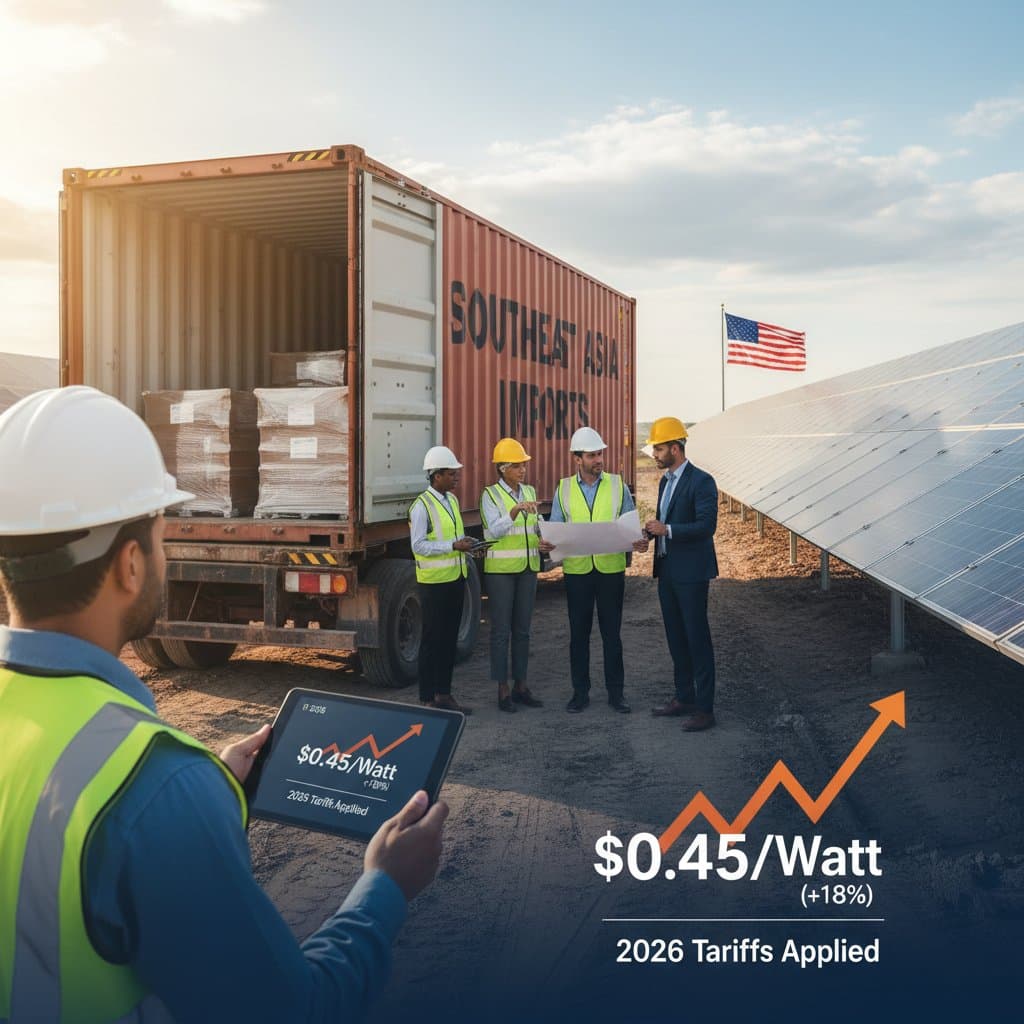
Solar Module Prices Set to Rise 18% Next Month Due to 2026 Tariffs
U.S. solar module prices will increase by 18% next month as importers prepare for tariffs under the 2026 trade policy changes. Distributors, developers, and engineering, procurement, and construction firms place orders quickly to sidestep elevated costs. These shifts will influence procurement approaches in commercial, residential, and utility-scale sectors.
Data from two leading solar distributors indicates that imported crystalline silicon modules will climb from $0.27 per watt to approximately $0.32 per watt. This rise stems from renewed and broadened tariffs on Southeast Asian products, which supply most U.S. solar imports. Experts project that the policy will impose over $1.5 billion in total costs on the domestic solar supply chain within the next year.
Tariffs Target Southeast Asian Imports
The duties focus on modules and cells from nations such as Vietnam, Malaysia, Thailand, and Cambodia. These locations host factories set up by global manufacturers to bypass earlier limits on Chinese products. U.S. authorities aim to address evasion in current trade rules through these import fees.
A high-ranking Department of Commerce official explained that the policy seeks to promote U.S. production. The official stated, "Our objective is to create a level playing field for U.S. manufacturers." The official added, "Domestic producers have faced sustained price pressure from low-cost imports that benefited from indirect subsidies."
The Solar Energy Industries Association in Washington, D.C., cautions that the tariffs may hinder installation expansion. SEIA president Abigail Ross Hopper declared in a statement that the duties "will raise costs for developers, delay projects, and create uncertainty for installers trying to plan procurement." Hopper noted that domestic manufacturing growth demands coordinated incentives, not measures that interrupt supply lines.
Developers Accelerate Inventory Purchases
Utility-scale developers hurry to buy modules at current rates before tariffs apply. Multiple companies report a spike in orders for Southeast Asian modules over recent weeks. A sourcing manager at a prominent Texas-based EPC firm shared that the company "front-loads purchases to cover all committed projects through next quarter." The manager mentioned redirecting warehouse stock to ongoing work to minimize tariff risks.
Residential installers adapt as well. Small firms dependent on wholesalers confront slimmer margins and less room to buffer price changes. Jennifer Martinez, CEO of SunEdge Solar in Arizona, observed, "We see lead times extend and suppliers restrict allocations." Martinez continued, "Every penny on module cost matters, and an 18% increase will ripple through labor, permitting, and financing."
Analysts predict that as stockpiles dwindle, tariffs will drive full price adjustments. Certain distributors now alert clients to upcoming rate changes. Others amend agreements with clauses that permit pricing shifts if duties escalate beyond expectations.
Domestic Production Gains Momentum
U.S. solar manufacturing has grown swiftly in recent quarters, with new facilities for modules, cells, and wafers in various states. However, these sites still scale up and fall short of meeting demand. Projections show domestic output surpassing 20 GW upon project completion, though imported parts prove vital for immediate goals.
Ethan Karp, senior analyst at CleanTech Research Group, remarked, "Domestic production is increasing, but it will take time before it can replace the full volume of imports." Karp added, "Tariffs may support long-term investment, but in the short term, they will raise costs across the board."
U.S.-based producers like First Solar, Qcells, and REC Silicon stand to gain from stronger pricing and higher demand. First Solar, based in Arizona, manufactures thin-film cadmium telluride modules exempt from these duties. The firm has long maintained that steady trade rules foster equitable competition and enduring sector balance.
Varied Effects Across Market Segments
The price hike impacts segments in distinct ways. Utility-scale initiatives, benefiting from bulk buys and lower per-watt rates, might offset some costs via extended power purchase agreements. Residential and commercial setups face quicker financial strain.
In residential installations, modules account for about 30% of overall expenses. An 18% module price rise could lift average system costs by roughly 5%. This adjustment may lengthen homeowner return timelines and alter loan terms. Commercial and industrial ventures, with narrow profit thresholds, risk lower returns absent new rebates.
Developers weigh postponing select projects until local supply firms up or fresh sources appear. Options include suppliers in India and Mexico for broader sourcing. These providers, though limited in volume, attract interest as tariff-avoiding allies for U.S. purchasers.
Responses to Policy Changes
Trade specialists describe the tariffs as elements of a plan to onshore clean energy production. The goal involves bolstering energy independence and lessening foreign supply dependence. Critics in the market contend that the rollout timing jeopardizes active contracts.
David Gahl, executive director of the Solar and Storage Industries Institute, emphasized, "The industry needs predictability." Gahl explained, "Policy shifts that occur mid-cycle make it difficult for developers to plan financing and procurement schedules. Investors require stability to commit capital at scale."
State energy agencies examine incentive revisions to counter cost surges in smaller projects. Such tweaks could sustain deployment pace by softening tariff effects. Regions with strict renewable mandates prioritize keeping targets viable amid rising prices.
Evolving Supply Chains and Logistics
Tariffs will elevate logistics expenses as importers alter routes. Freight handlers note rising needs for U.S. vessels and rail to qualify for better tariff treatment. Customs agents update paperwork for stricter origin checks, complicating import processes.
Storage and distribution hubs face demands too. Sites in California and Texas enlarge capacity for pre-tariff goods. Consultants observe that these moves signal readiness for ongoing restrictions, not brief changes.
Shifts in Financing and Agreements
Rising costs from tariffs reshape project financial models. Lenders review module price forecasts, shipment schedules, and added risks. Existing power purchase agreements might need talks if vendors apply tariff surcharges.
EPC companies revise templates with clauses for tariff variations. These terms divide cost changes between owners and builders. A Wood Mackenzie analysis reveals that 60% of recent solar EPC deals feature tariff provisions, up from under 20% prior to the announcement.
Developers pursue forward deals and hedges against volatility. While typical in commodities, banks now test solar-specific tools to fix prices over set terms.
Strategies for Effective Procurement
The next months will reveal the U.S. solar sector's adaptability to trade flux. Firms that strategize buys, spread suppliers, and partner with local makers will handle uncertainties best.
Experts suggest these steps:
- Place advance orders to capture current tariff levels before duties activate.
- Diversify suppliers by assessing markets like India, Mexico, and U.S. producers without duties.
- Revise EPC and supply contracts to incorporate pass-through or contingency terms for tariffs.
- Update financial plans to reflect new module costs and funding scenarios.