
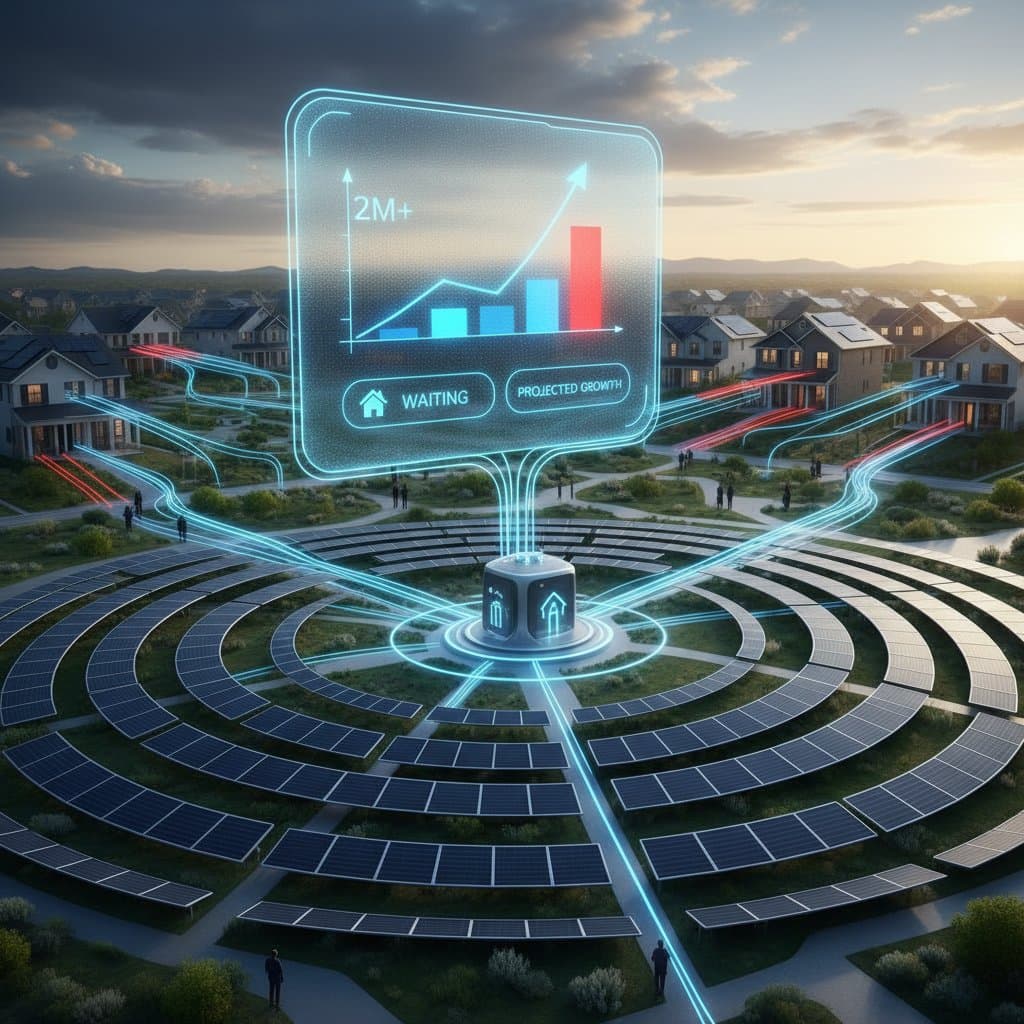
Over 2 Million Households Await Community Solar Access
Roughly two million U.S. households currently wait for access to community solar programs, based on data from state regulators and subscription managers. This backlog reflects surging demand for shared solar alongside persistent challenges in grid integration, regulatory frameworks, and financing. Although community solar capacity expands steadily, subscriber interest surpasses project completions in nearly every participating state.
Why Demand Exceeds Available Supply
Community solar programs enable households and small businesses to subscribe to a share of an offsite solar array, earning credits on utility bills. This approach suits renters, condominium owners, and low-to-moderate income customers unable to install rooftop systems. However, capacity limits, interconnection queues, and policy intricacies leave millions in limbo.
SunShare, a developer based in Minneapolis, indicates that subscription demand in select utility territories surpasses available capacity by over 300 percent. David Amster-Olszewski, CEO of SunShare, notes, "We see customers signing up within hours of new capacity announcements." The primary issue centers on accelerating project launches to match this enthusiasm.
Research from Wood Mackenzie reveals that community solar represents under 10 percent of total U.S. solar capacity, yet subscriber interest could double that portion with relaxed regulations. Analysts project that current waitlists equate to about 2.5 GW of unrealized potential.
Interconnection Processes Create Major Delays
Interconnection stands as a primary barrier, with projects enduring years of utility studies, infrastructure upgrades, and queue oversight. These steps often prolong timelines well beyond projections for developers.
In New York, a leader in community solar markets, over half of proposed projects linger in interconnection stages. Jeff Cramer, president of the Coalition for Community Solar Access (CCSA), explains, "Developers are ready, financing is lined up, subscribers are waiting, but utilities cannot process interconnections fast enough." This problem persists across numerous states.
Utilities point to technical limitations and grid stability as reasons for caution. Certain feeders already host substantial distributed generation, necessitating expensive enhancements for new connections. Such delays defer developer revenues and deny subscribers anticipated bill reductions.
State Policies Introduce Variability and Risk
Community solar operates under state-specific regulations, resulting in diverse program designs and outcomes. Variations in subscription limits, credit values, and ownership guidelines foster investor hesitation and customer uncertainty. Established markets in Minnesota and Massachusetts feature robust structures, whereas Illinois and Colorado refine their approaches.
A National Renewable Energy Laboratory (NREL) report identifies inconsistent credit valuation as a key financing risk. NREL analyst Emily Chen states, "When credit rates are revised, project economics can shift overnight." Stable policies in select states draw investment, while others experiment with evolving models.
The subscription system demands robust administration for customer enrollment, credit tracking, and maintenance. Developers frequently partner with third-party platforms for management, incurring per-subscriber costs that compress profit margins.
Securing Land, Permits, and Funding Poses Ongoing Challenges
Developers encounter standard obstacles in acquiring suitable land, obtaining permits, and arranging financing, even in supportive policy environments. Proximity to substations or load centers restricts site options, and local approvals prove inconsistent. Projects sometimes meet resistance over land utilization or aesthetic concerns.
Lenders exercise caution amid uncertainties in credit policies and subscriber retention. Greg Barron, head of project finance at Sunvest, a Wisconsin-based engineering, procurement, and construction firm, observes, "Institutional investors want predictable cash flows." High churn or policy shifts complicate financial assessments.
To counter these elements, developers pursue hybrid strategies, securing commitments from stable entities like municipalities or schools alongside residential participants. This method ensures revenue steadiness and eases operations, though it constrains broader household involvement.
Advances in Installation Techniques Support Efficiency
Project scale and site conditions shape mounting and deployment methods. Community solar arrays typically span 1 MW to 5 MW, sited on brownfields, capped landfills, or marginal agricultural land. Fixed-tilt ground mounts prevail, with single-axis trackers adopted where terrain and grid links allow.
Prefabricated mounting solutions now shorten on-site work and hasten builds upon regulatory clearance. Helical piles and ground screws supplant traditional driven posts in delicate soils, trimming timelines and environmental effects. These efficiencies activate only post-approval of interconnections and permits.
Leading States and Growth Opportunities
Minnesota, New York, and Massachusetts lead with over half of the nation's operational community solar capacity. Emerging areas like New Mexico, Maryland, and Virginia launch pilots or increase limits. Experts anticipate these regions will alleviate waitlist strains as processes mature.
CCSA data shows that states offering clear credit systems and efficient interconnections advance projects swiftly. Cramer adds, "Clear rules and predictable outcomes build investor confidence."
Unlocking Potential Through Systemic Improvements
The existing waitlist exposes foundational hurdles yet underscores readiness for scale. Utilities invest in enhanced interconnection platforms and digital queue tools to expedite approvals.
As grid enhancements and policy refinements progress, the pool of two million subscribers could fuel widespread distributed solar growth. This shift promises increased needs for mounting hardware, inverters, and construction expertise in community solar. Ultimately, execution through coordinated regulatory and utility advancements will determine access to these benefits.