
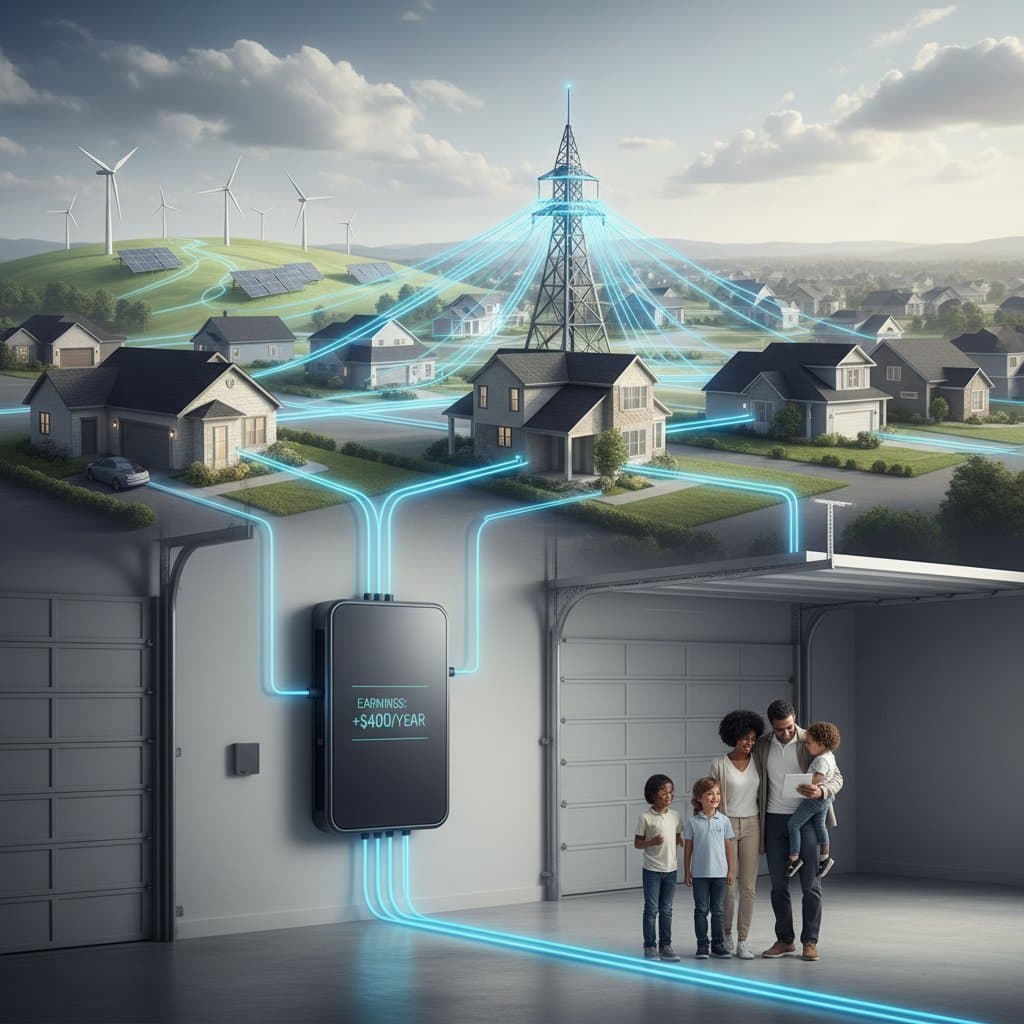
Earn Up to $400 Annually by Renting Your Home Battery to Virtual Power Plants
A home battery installed in your garage holds untapped potential beyond backup power. Throughout the United States, utilities and energy aggregators develop virtual power plants, or VPPs, which combine thousands of distributed batteries, solar installations, and intelligent devices. The core principle proves straightforward yet impactful: rather than erecting additional fossil fuel facilities to handle peak loads, utilities compensate homeowners for accessing stored energy in batteries during brief intervals. Participants receive hundreds of dollars yearly with minimal effort.
With over a decade of experience reporting on distributed energy, the author views this as one of the most accessible and beneficial advancements in renewable energy strategies. This approach integrates grid dependability, individual earnings, and emission reductions into a cohesive framework. However, practical implementation involves technical specifications, regulatory considerations, and regional market differences that influence potential homeowner income.
Understanding Virtual Power Plants
A virtual power plant does not represent a centralized physical structure. It functions as a network of interconnected devices managed collectively as a unified asset. During grid strain from extreme weather, such as heatwaves or cold spells, VPP operators release modest energy quantities from numerous batteries at once. This synchronized action maintains frequency balance, eases peak demand pressures, and diminishes reliance on costly natural gas units.
Technically, VPPs depend on sophisticated software to facilitate interactions between battery inverters and grid controllers. The software assesses available energy, monitors charge levels across units, and deploys precise amounts precisely when required. Certain programs employ direct oversight via intelligent inverters, whereas others utilize pricing mechanisms to prompt homeowners toward exporting power amid elevated grid rates.
Researchers and pilot initiatives have validated the concept for years, yet widespread adoption delivering tangible financial benefits to participants has emerged only in recent times.
Earning Potential for Homeowners
A typical residential battery in a VPP arrangement undergoes several dozen cycles annually. Each cycle involves discharging a segment of stored energy to aid the grid, usually lasting one to two hours. Utilities or aggregators compensate through capacity fees or performance-based payments.
Payment models differ by region. Some offer fixed yearly credits ranging from $300 to $500, scaled to battery capacity and engagement degree. Alternative structures base rewards on verifiable output, incentivizing availability and prompt responses to activation requests.
Homeowners often regard these earnings as supplementary income. An Arizona resident shared that VPP reimbursements covered nearly half his battery loan payments each year. A Massachusetts participant noted that the funds fully offset her summer utility charges. Such experiences reflect growing participation as awareness increases that storage systems yield reliable passive revenue across multiple states.
Core Technology Enabling Compensation
Effective virtual power plants hinge on hardware compatibility and seamless aggregator software. Contemporary lithium-ion batteries in solar setups, including models from Tesla, Enphase, and SolarEdge, feature inverters designed for remote management. These connect securely via encrypted internet protocols, permitting oversight of energy flows while safeguarding user privacy and system integrity.
Aggregator platforms generate value through real-time grid analysis. They forecast demand surges and summon batteries to discharge accordingly. Operations proceed automatically, requiring no homeowner intervention per event. Integrated battery controls reserve sufficient capacity for domestic demands, preventing disruptions or blackouts.
In essence, each unit serves as a distributed energy resource providing services like frequency regulation, voltage maintenance, and reserve capacity. Revenues from these contributions distribute to participants, appearing as utility credits or direct transfers.
Factors Driving Utility Adoption
Utilities launch these programs for economic efficiency, not altruism. Constructing peaking plants demands substantial upfront capital, with expenses passed to consumers. Aggregating dispersed batteries fulfills reliability needs at reduced cost.
Policy plays a pivotal role as well. Multiple states mandate greater renewable integration and emission cuts. VPPs comply by substituting flexible, emission-free resources for traditional fossil generation.
Regulatory proceedings on grid upgrades reveal a preference for customer-involved initiatives. Distributed assets, installed for self-reliance or resilience, extend grid value when leveraged collectively, benefiting all stakeholders.
Variations in Regional Compensation
The $400 estimate serves as a national average; earnings fluctuate with geography, program structure, and system size.
- California: Initiatives like the Emergency Load Reduction Program and utility-led pilots deliver performance incentives. Owners of sizable batteries may exceed $500 yearly through regular activations.
- New England: Massachusetts and Vermont foster aggregation via state support and utility rebates, yielding $300 to $500 annually.
- Arizona and Nevada: Rapidly growing markets provide demand response credits equating to $25 to $40 monthly in peak periods.
- Texas: Deregulated retail environments enable third-party deals tied to wholesale rates, offering variable but potentially elevated returns during high-stress events.
Not all utilities provide these options currently. Pilots persist in some areas, with regulatory barriers in others. Expansion accelerates as operators trust distributed systems more fully.
Operators of Virtual Power Plants
Diverse organizations manage VPPs. Utilities oversee territory-specific programs, while third-party aggregators link battery owners to broader markets.
- Utility Programs: These confine participation to approved equipment within service areas.
- Aggregator Platforms: Spanning utilities, they unify varied hardware via adaptable software. Firms manage sign-ups, surveillance, and disbursements, frequently through apps displaying real-time metrics.
Reliable device-to-grid links remain essential. Measurement and verification protocols confirm delivered power, guaranteeing precise compensation.
Financial Mechanics of Participation
Grid flexibility commands premium value, explaining the $400 benchmark. Peak wholesale rates soar during stress; VPPs mitigate this by curtailing demand, with savings redistributed to users.
Contracts typically span multiple years for income stability. Though modest, payments recoup installation expenses and enhance investment returns, sometimes funding upkeep or updates.
This paradigm evolves energy from utility monopoly to participatory ecosystems, positioning households as grid contributors.
Addressing Key Concerns
Frequent discharges raise battery degradation fears. Programs mitigate this by capping discharge depths and event counts, rendering added wear minimal relative to gains.
Control and data security also concern users. Automated directives respect preset limits; opt-outs for events or full withdrawal occur easily.
Tax implications vary; credits often qualify as nontaxable rebates, but state rules differ. Prospective participants should verify locally.
Advancing the Energy Shift Through VPPs
VPPs extend beyond finances to fortify renewables. They counter solar and wind variability with storage, curb transmission investments, and engage citizens in sustainability.
Early trials once seemed speculative amid utility hesitance. Now, proven efficacy, sound economics, and supportive policies drive mainstream integration.
Steps to Join a Virtual Power Plant
For existing or prospective battery owners, enrollment enhances value. Follow these actions:
- Assess Local Options: Inquire with your utility or review their site for VPP or aggregation availability.
- Confirm System Fit: Ensure your battery qualifies; updates may apply to legacy models.
- Examine Agreements: Clarify compensation methods, operator authority, and exit provisions.
- Monitor Contributions: Utilize provided tools to view energy dispatched and earnings accrued.
Participation not only generates income but also strengthens community resilience and environmental progress.