
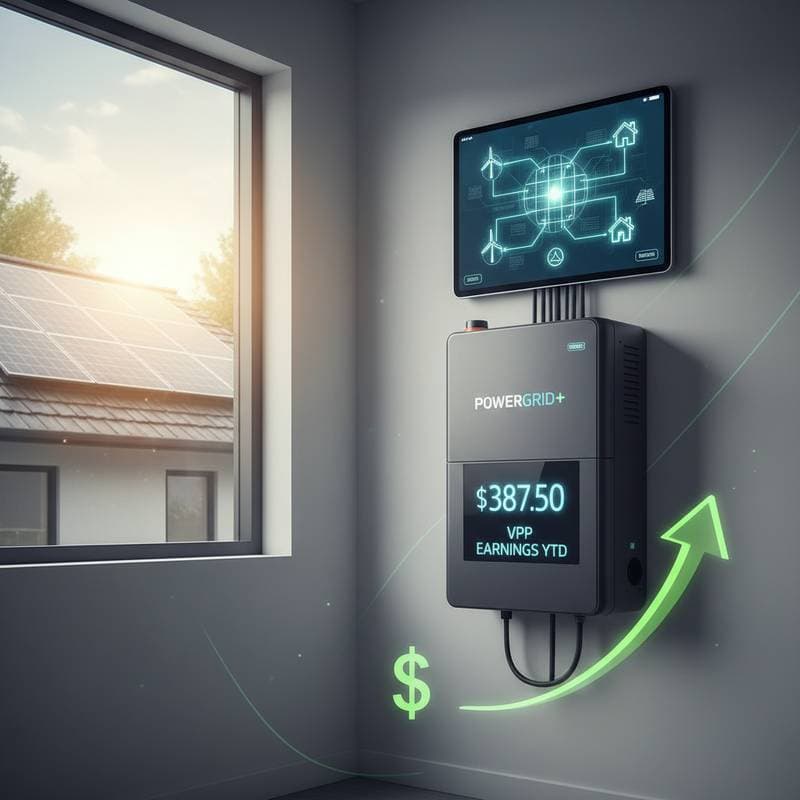
Earn Up to $400 Annually by Renting Your Home Battery to Virtual Power Plants
The concept of receiving payment for allowing others to utilize your home battery may appear advanced, yet this practice occurs throughout the United States today. Homeowners equipped with solar panels and storage systems now generate consistent income by leasing battery capacity to virtual power plants, or VPPs. The process involves installing a battery, linking it to a utility or aggregator network, and permitting the network to charge or discharge the system during grid support needs. Compensation often reaches several hundred dollars annually.
With over a decade of experience covering the solar and energy storage sectors, this author observes that such developments represent significant progress in distributed energy. These initiatives stem from the inherent value of system flexibility rather than subsidies or tax incentives. The electrical grid requires distributed resources to manage supply and demand fluctuations, and residential batteries serve this role effectively.
Understanding Virtual Power Plants
To grasp how battery rental generates income, consider the definition of a virtual power plant. A VPP aggregates distributed energy resources to function as a unified power plant. These resources encompass home batteries, smart thermostats, electric vehicle chargers, and solar inverters. Software enables the VPP to release stored energy during demand surges or absorb surplus supply.
Utilities and grid operators engage these resources instead of constructing additional gas-fired peaking plants to deliver grid stability. These services hold tangible market value, which funds payments to homeowners. In regions such as California, Vermont, and portions of the Midwest, VPPs address peak demands during heat waves or maintain voltage stability amid high solar integration. The approach expands rapidly, benefiting utilities with cost-effective capacity and homeowners with earnings from existing assets.
Sources of the $400 Annual Earnings
The $400 yearly figure derives from average earnings in established VPP programs using standard 10- to 15-kilowatt-hour residential batteries. Actual amounts depend on utility territory, program design, and dispatch frequency. Homeowners receive payments through these mechanisms:
- Capacity payments: A fixed annual or monthly sum for reserving battery capacity for the network.
- Performance payments: Extra compensation for services like frequency regulation or peak demand reduction.
- Energy market revenue sharing: In eligible markets, VPP operators sell aggregated energy wholesale and distribute proceeds to participants.
Utility programs from Green Mountain Power or aggregators like Sunrun and Tesla Energy confirm that several hundred dollars per year proves achievable. Larger systems or high-demand locations may yield higher returns.
Technology Enabling Seamless Coordination
Early smart inverters and grid services involved cumbersome, disjointed technology. Current systems offer smooth integration. Modern batteries incorporate secure communication protocols for VPP connectivity. Software tracks grid conditions, forecasts peaks, and automatically directs energy from enrolled systems.
Homeowners experience minimal disruption. After signing an agreement and having the installer or aggregator set up the connection, the system operates independently. Personal access to stored energy for backup or time-of-use savings remains intact, with the VPP utilizing only designated capacity as required.
Advanced control technology underpins the model's success. It allows numerous small systems to function as a dependable, controllable resource. Grid operators value this reliability enough to compensate participants.
Factors Driving VPP Growth
VPP expansion aligns with evolving market and policy dynamics. Utility-scale solar and wind proliferation yields daytime energy abundance but evening shortages. Concurrently, residential battery installations increase due to declining costs and demand for outage protection.
These patterns elevate distributed storage's grid importance. Utilities now regard batteries as integral infrastructure rather than mere backups. Regulatory reforms promote demand response and distributed resource involvement, advancing grid modernization.
Utility planners and grid operators view VPPs as economical safeguards. Annual payments of a few hundred dollars to homeowners avert multimillion-dollar expenditures on peaking facilities or transmission enhancements. The financial logic supports broad adoption.
Steps for Homeowner Participation
VPP enrollment demands no energy trading expertise. Programs prioritize simplicity and predictability. Participants typically commit 50 percent of battery capacity to grid services, retaining the balance for household needs.
The process includes:
- Verify compatibility: Confirm battery support; Tesla, Enphase, and SolarEdge systems often qualify.
- Review and sign agreement: Examine payment details, usage terms, and duration.
- Activate software: Allow the installer or aggregator to integrate with the VPP platform.
- Track earnings: Use app or portal to monitor activity and receive payments, often as utility credits or checks.
Ownership stays with the homeowner, and opt-out options exist. This structure ensures accessibility.
Grid Services and Their Value
Distributed energy has long appeared undervalued. Homeowners adopt solar and storage for independence, yet system-wide advantages prove extensive. VPP involvement monetizes these contributions directly.
Key services include:
- Frequency regulation: Stabilizing the grid against small supply-demand variations.
- Peak shaving: Curtailing usage during high-demand intervals to cut overall expenses.
- Voltage support: Preserving ideal voltage in neighborhood circuits.
- Backup capacity: Supplying emergency power in outages while enhancing collective resilience.
Each service carries market worth. Aggregated across thousands of residences, the capacity equals a modest power plant, justifying utility payments.
Economic and Environmental Advantages
Environmentally, VPP dispatches from home batteries during peaks replace fossil fuel generation. Broad adoption could reduce emissions and enhance air quality over time.
Economically, earnings bolster battery investment justification. Systems cost thousands of dollars, but $400 annually offsets expenses alongside backup and time-of-use benefits. This multifaceted value exceeds isolated advantages.
Insights from Program Participants
Interviews with early VPP enrollees reveal favorable outcomes. A California homeowner noted infrequent awareness of dispatches yet consistent quarterly payments with no effort. A Vermont participant received utility priority for backup during a storm due to network affiliation.
Such accounts underscore VPPs' dual role. Beyond finances, they foster household-grid collaboration. Participants evolve from mere consumers to reliability and sustainability partners.
Addressing Hurdles and Anticipating Growth
Challenges persist, including inconsistent utility standards and varying incentives. Data privacy and cybersecurity warrant attention given network communications.
Progress remains evident. As markets mature and utilities appreciate distributed assets, payments should increase. Aggregators test dynamic pricing for heightened rewards in key events.
Electric vehicle integration promises VPP expansion. EV batteries hold far greater capacity, potentially transforming grid operations when aggregated.
Steps to Explore VPP Opportunities
Battery rental to VPPs signals evolving energy paradigms. Households transition from wire-end recipients to active stakeholders.
For existing or prospective battery owners, inquire with installers or utilities about VPP options. The modest financial gain underscores genuine service value once reserved for major plants.
This development encourages grid engagement over isolation. It compensates intelligent energy practices with concrete returns.