
Why Professional Installers Choose Microinverters Over Optimizers
Homeowners exploring solar energy seek components that balance ease of installation with strong performance and dependability. In photovoltaic systems, the choice between microinverters and DC optimizers sparks considerable discussion. Experienced contractors consistently lean toward microinverters, particularly for residential or DIY projects, as these outperform traditional string inverters in key areas.
This preference stems from practical considerations in the field, including safety protocols and operational efficiency. For individuals handling their own installations, grasping these distinctions helps avoid expensive errors and supports sustained system performance.
Core Concepts of Solar Power Conversion
Solar panels generate direct current (DC) electricity from sunlight, which requires conversion to alternating current (AC) for household appliances. Traditional string inverters perform this conversion centrally, limiting output to the weakest panel in the array. Factors such as shading or panel variations then drag down the entire system's efficiency.
Microinverters and DC optimizers address these issues through module-level approaches, yet their implementations vary significantly.
- Microinverters transform DC to AC at the individual panel, delivering independent AC output to the home's electrical panel.
- DC optimizers adjust DC output per panel before routing it to a central inverter for AC conversion.
While both enhance independence, microinverters prove more practical for hands-on installers through streamlined design and upkeep.
Streamlined Installation Process
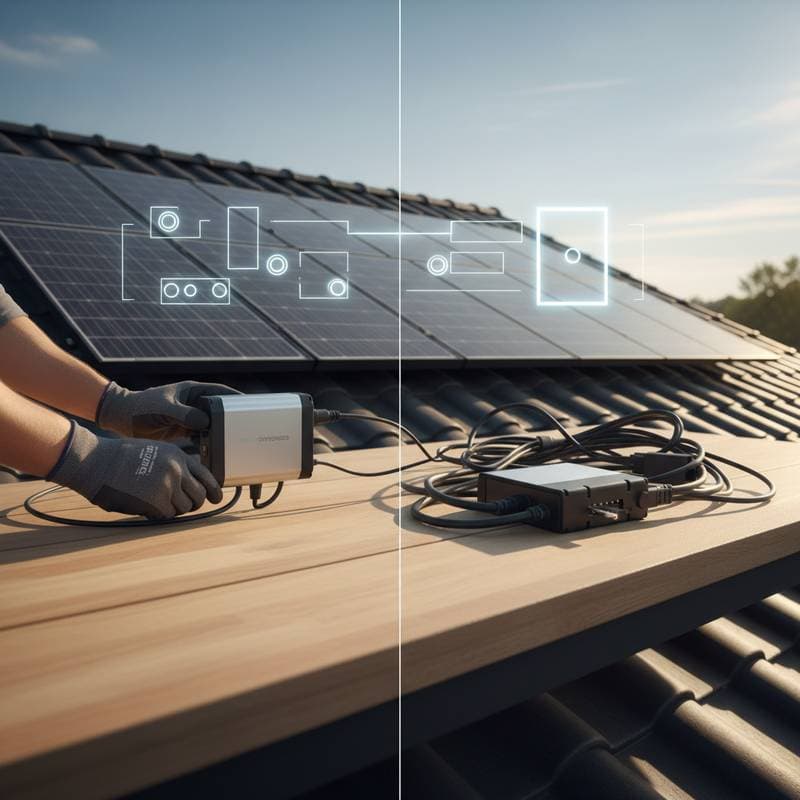
Microinverters facilitate efficient setup by attaching directly under each solar panel and linking to an AC trunk cable. Installers secure the unit to the panel frame, connect the DC leads from the panel, and plug into the cable, completing the task in under five minutes per module. This eliminates separate DC runs and central equipment placement.
DC optimizer setups demand optimizers on each panel plus a central inverter, increasing mounting points, wiring routes, and error opportunities. The inverter requires dedicated indoor or sheltered space, often involving conduit runs and grounding checks. Without professional tools, DIY participants face extended timelines and heightened mistake risks.
Contractors value this efficiency, as it cuts labor hours and failure points. For residential roofs, fewer components translate to quicker completions and lower overall project costs.
Enhanced Safety Features
Safety remains paramount in solar deployments. Microinverters generate low-voltage AC at the panel, avoiding long high-voltage DC lines across the roof. This design complies readily with rapid shutdown standards, minimizing arc flash hazards and easing emergency responses.
DC optimizer configurations retain high-voltage DC cables from panels to the inverter. Faults in insulation or connections can sustain dangerous currents, complicating firefighting or repairs. Service teams report fewer incidents with microinverter arrays due to their distributed, low-risk architecture.
DIY installers gain confidence from handling familiar AC circuits at safe levels. Basic multimeters suffice for checks, reducing the need for specialized DC safety gear.
Superior Performance and Durability
Both technologies enable panel-level optimization, allowing unshaded modules to maximize output despite issues on others. However, long-term reliability sets microinverters apart.
Encased in robust, IP67-rated enclosures, microinverters withstand harsh weather, with warranties spanning 25 years to align with panel lifespans. Distributed design eliminates a central failure point, ensuring partial system operation continues.
Optimizer systems hinge on the central inverter's longevity, which often requires mid-life replacement. This introduces downtime and expenses, prompting professionals to schedule avoidable interventions. Homeowners encounter similar disruptions without on-site expertise.
Advanced Monitoring Capabilities
Effective oversight drives system success. Microinverters transmit data from each unit to a centralized app, displaying production metrics, fault alerts, and historical trends via smartphone.
Users pinpoint issues, such as a shaded panel, and address them promptly without full diagnostics. This granularity supports proactive cleaning or adjustments.
Optimizer monitoring routes through the central inverter, halting if it malfunctions. Microinverters preserve data flow independently, aiding quick isolations during troubleshooting. Both pros and DIY users appreciate this autonomy for efficient problem resolution.
Evaluating Total Ownership Costs
Initial pricing shows microinverters at a modest premium per panel, offset by optimizer systems' added inverter and wiring expenses. Comprehensive assessments include labor, permits, and upkeep projections.
In small-scale setups, microinverters yield savings through reduced components and service needs. Installers report 20 percent fewer callbacks, preserving warranties and customer satisfaction. DIY projects mirror this, with modular parts simplifying future tweaks.
Flexible Expansion Options
Growth potential influences equipment selection. Microinverters support seamless additions by extending the AC trunk and attaching new units, unbound by central limits.
DC systems tie expansions to inverter capacity, frequently necessitating upgrades that disrupt operations. Professionals favor microinverters for phased residential builds, accommodating evolving energy demands without major overhauls.
Simplified Long-Term Maintenance
Accessibility challenges roof components, emphasizing durable designs. Microinverters feature plug-and-play replacements: faulty units swap in 15 minutes using basic tools, without array downtime.
Optimizer repairs span DC and AC elements, often requiring vendor diagnostics or full shutdowns. This complexity burdens DIY efforts and elevates professional callout fees.
Reliable performance minimizes interventions, aligning with installers' goals for repeatable, low-hassle service.
Broad Compatibility Benefits
Microinverters integrate with diverse panels, from high-efficiency monocrystalline to cost-effective polycrystalline types. They adapt to complex roofs with varying orientations or obstructions, optimizing each panel's contribution.
Optimizers demand matched ecosystems across brands, risking inefficiencies or voided coverage. This rigidity complicates sourcing for online buyers or multi-vendor projects, whereas microinverters streamline decisions.
Optimizing Solar Investments for the Future
Professionals select microinverters to align technology with installation demands, safety imperatives, and expansion needs. These units cut wiring demands, elevate monitoring precision, and ensure modular growth.
DIY participants realize parallel gains in setup ease and cost control. Selecting microinverters fosters resilient systems that deliver consistent returns, supporting sustainable home energy goals.