
Is Plug-and-Play Solar Legal in All 50 States?
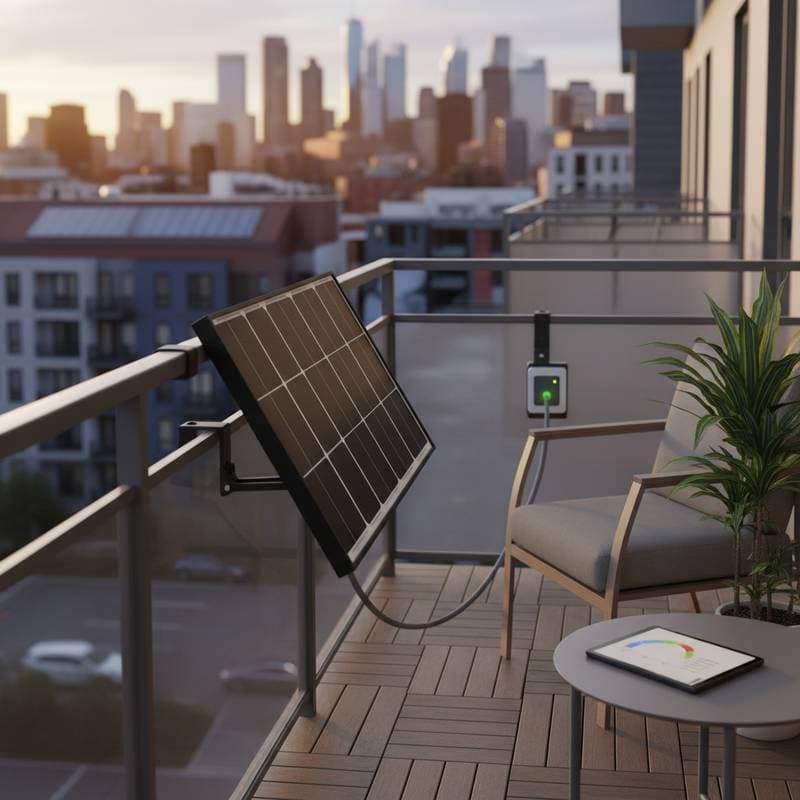
Plug-and-play solar systems, also known as balcony or apartment solar kits, provide an accessible method for renters and homeowners to generate their own electricity. These units, typically rated from 300 to 800 watts, connect directly to a standard wall outlet. Users mount a compact panel on a balcony railing or patio, plug it in, and begin offsetting grid usage right away. Although the technology proves reliable and common in Europe, its legal and regulatory framework in the United States shows significant variation and occasional uncertainty.
Rising Demand for Apartment Solar Solutions
Demand for plug-and-play solar surges as more Americans reside in multi-unit buildings or rent homes where rooftop installations prove impractical. Market research from Wood Mackenzie indicates that about one-third of U.S. households rent their residences. This group frequently faces barriers to conventional solar due to property ownership limits or building constraints.
Portable solar kits address these issues partially. They incorporate microinverters certified to UL 1741 standards, akin to those in large photovoltaic arrays. Upon outlet connection, the system aligns with the grid and powers the local circuit, thereby lowering the building's overall electricity draw. Users often reduce their annual consumption by 5 to 15 percent through this setup.
Challenges in Regulation and Utility Oversight
The technical ease of these systems contrasts with a complex regulatory landscape. The National Electrical Code outlines precise rules for grid-connected setups, and many areas mandate inspections plus utility agreements prior to activation. Plug-and-play devices straddle the boundary between everyday appliances and energy generation equipment. Utilities and inspectors debate whether to classify them as simple plug-ins or require treatment similar to full solar installations.
John Smirnow, vice president of market strategy at the Solar Energy Industries Association, highlights grid safety and responsibility as central issues. “Utilities seek confirmation that all grid-connected devices adhere to proven safety measures and shut down automatically during power outages,” he stated. “The difficulty lies in how many plug-in kits skip standard interconnection steps.”
States like California and New York see utilities issuing warnings about outage-related backfeeding risks. In contrast, other states view UL certification as adequate for safety validation. This inconsistent approach results in products legal in one location facing code violations elsewhere.
Importance of Certification Standards
Certification forms the core of ongoing discussions. Standards such as UL 1741 and IEEE 1547 dictate inverter responses to grid conditions, including anti-islanding protections. Producers of plug-and-play systems maintain that meeting these criteria qualifies their products for immediate use. Most models feature ground-fault protection, quick shutdown options, and built-in limits to avoid circuit overloads.
Thomas Engel, product manager for a European manufacturer expanding into the U.S., emphasizes robust safety design in his company's offerings. “Our balcony kits employ inverter technology comparable to that in large-scale utility installations,” he noted. “Scale differs, but safety remains equivalent.” His organization pursues listing on the California Energy Commission's approved equipment roster, which may encourage wider utility approval.
Responses from Utilities and State Authorities
State oversight bodies increasingly review whether current policies encompass plug-and-play systems effectively. Certain utilities release advisory documents, recommending that customers obtain clearance before linking any power source to home wiring. Additional utilities launch pilot initiatives to assess small, user-installed systems in monitored settings.
Green Mountain Power in Vermont conducted trials with plug-in solar kits among selected participants to gauge performance and safety in practice. Findings showed safe operation on contemporary circuits with ground-fault interrupters. The utility nonetheless insists on prior notification to align with its interconnection requirements.
The U.S. Department of Energy's Solar Energy Technologies Office supports studies on user-deployable solar solutions. These efforts aim to develop technical and policy structures that facilitate secure implementation minus burdensome approvals. Initial results point to national standards as a means to clarify expectations for users and authorities alike.
Opportunities in the Market and Business Landscape
Plug-and-play solar holds considerable commercial promise. BloombergNEF projections suggest that adoption by 10 percent of apartment residents could yield gigawatts in distributed generation. For producers, this area opens fresh income channels alongside rooftop and large-scale solar ventures. Online retailers and home centers now stock kits aimed at urban dwellers.
Engineering, procurement, and construction firms monitor this development closely. Although these kits demand no expert setup, they acquaint users with solar advantages, potentially paving the way for larger projects. Utilities anticipate modest daytime demand reductions from broad uptake, which may shape pricing models and generation strategies.
Addressing Legal Concerns and Liability
Liability stands out as a primary worry. Building owners typically bear responsibility for code-compliant electrical systems. Tenants adding plug-in solar without approval risk breaching leases or voiding insurance coverage. Fire marshals express concerns over balcony cable placement and associated hazards.
Energy attorney Sarah Klein, specializing in distributed generation rules, stresses the need for explicit guidance and user awareness. “Producers should specify if systems suit ongoing or short-term connections,” she advised. “Detailed product guides simplify risk evaluation for authorities and landlords.”
Pathways to Consistent Nationwide Adoption
Industry organizations push for unified federal protocols. The Interstate Renewable Energy Council proposes a streamlined process for systems below one kilowatt, modeled after electric vehicle charger approvals. Such measures would categorize plug-and-play solar as low-risk, relying on certification over per-unit permits.
Consumers should check local ordinances prior to buying. Some cities ban outlet backfeeding outright, while others lack specific guidelines. This variability complicates a market built on ease and accessibility.
Steps for Safe and Effective Implementation
Achieving broad plug-and-play solar acceptance requires collaboration between producers, regulators, and utilities. Established safety benchmarks, clear product disclosures, and uniform approval steps can drive expansion while safeguarding the grid. As renters and city dwellers prioritize energy autonomy, interest in compact, self-setup solar will grow steadily.
Advancements in inverters, monitoring tools, and user-centric designs position plug-and-play solar for mainstream integration. The sector must resolve regulatory differences across states to fulfill this potential fully.