
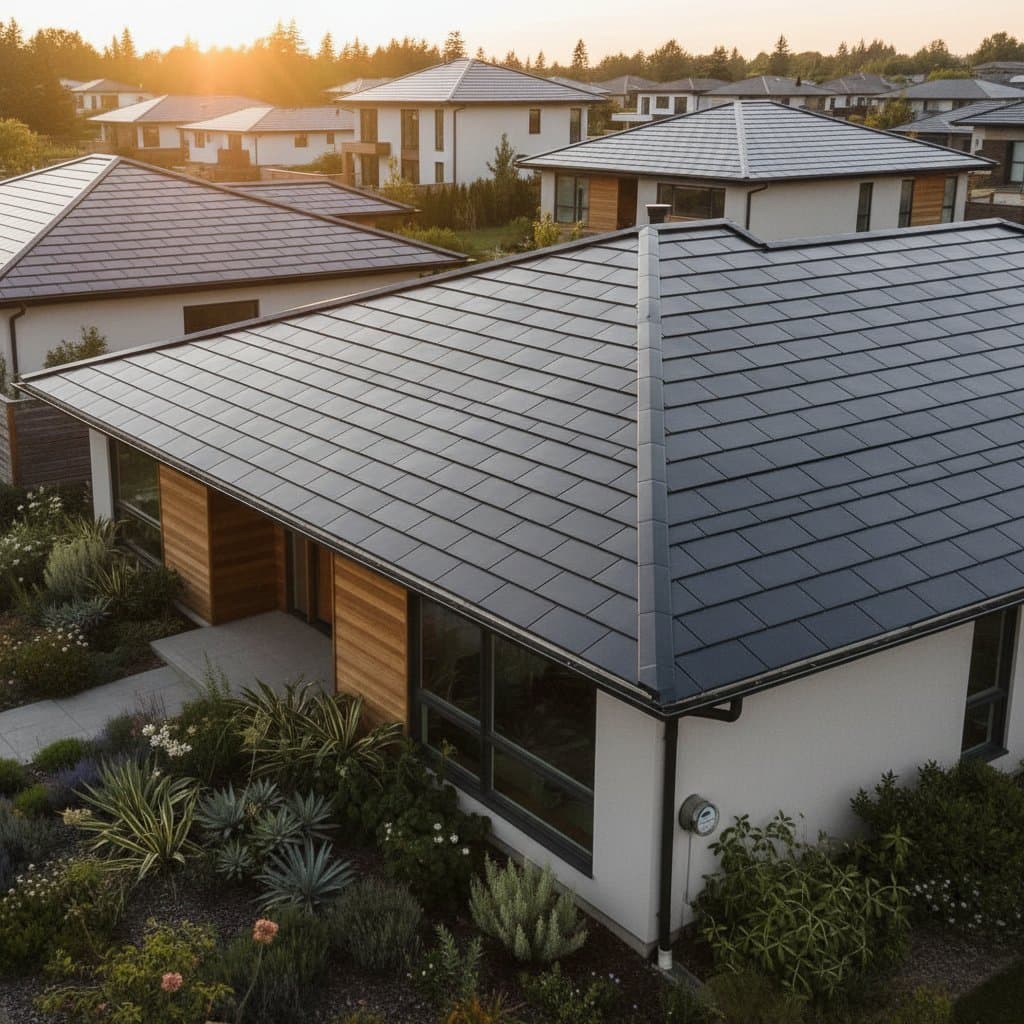
Solar Shingles Set to Match Panel Prices by 2026
Solar shingles, previously a high-end option for homeowners prioritizing design, now approach cost levels of standard solar panels. Experts forecast that these integrated roofing systems will achieve price parity with traditional rack-mounted photovoltaic modules in the coming years. This development promises to blend visual appeal with energy generation, making solar more accessible for residential use.
Current data indicates that average residential solar setups in the United States range from $2.70 to $3.20 per watt for conventional panels. In contrast, solar shingles cost between $3.80 and over $5.00 per watt, varying by manufacturer and roofing type. Producers address this difference through larger-scale operations, automated processes, and enhanced cell integration.
Boosting Manufacturing Efficiency to Lower Costs
Advancements in production stand out as the primary driver of reduced expenses. Solar shingle makers implement automated assembly lines that minimize labor needs and material losses. By embedding thin-film or efficient monocrystalline cells into roofing components, companies streamline both fabrication and setup phases.
GAF Energy in California highlights that its Timberline Solar products have increased output by over 40 percent since launch. Martin DeBono, President of GAF Energy, states, "Our focus is on volume manufacturing. Every increase in yield brings us closer to cost parity with standard modules." This unified approach to roofing and solar production cuts transportation challenges and installation time.
Firms like CertainTeed and Luma Solar follow suit by expanding U.S. facilities. The Inflation Reduction Act supports this growth with incentives for domestic production, which qualifies projects for enhanced tax benefits and fosters competitive pricing.
Streamlining Installation to Cut Labor Expenses
Labor accounts for a major portion of solar project costs. Standard 7 kW rooftop installations often demand two to three days of work, influenced by roof conditions and site specifics. Solar shingles simplify this by functioning as both protective covering and energy producer, removing requirements for additional mounts, seals, and barriers.
Brian Hedges, owner of SunCraft Roofing and Solar in Colorado, notes, "Every hour saved on the roof directly improves our margins." With shingles, crews install power elements during roof construction, avoiding racks, supports, and excess roof piercings. This method shortens timelines and decreases follow-up repairs.
Expanded training initiatives aid this transition. The National Roofing Contractors Association collaborates with solar educators to create certification standards for combined installations. Such programs enable roofing professionals to incorporate solar expertise without full engineering qualifications.
Advancing Materials for Better Integration
Innovations in materials play a key role in cost and performance improvements. Earlier solar shingles faced issues with efficiency and longevity. Current models employ durable glass layers and protective coatings that rival top asphalt or composite roofs in resilience.
Tesla's Solar Roof, a prominent example, overcame initial hurdles in affordability and setup duration. Updates to its structure, including easier wiring and modular designs, have lowered material and workforce demands. Installers observe that recent installations align more closely with conventional solar expenses.
Additional experiments involve perovskite layers and dual-sided cells. These enhancements boost energy output per area, enhancing overall value. As efficiency nears that of traditional panels, users gain options that prioritize both function and style.
Shaping the Market Through Demand and Incentives
Residential solar growth in the United States stems from regional rebates, national credits, and escalating utility rates. Design compatibility emerges as a vital factor, particularly in areas with rigorous community guidelines limiting visible panels.
A Solar Energy Industries Association survey reveals that about 30 percent of potential solar adopters view aesthetics as a primary obstacle. Solar shingles resolve this by mimicking standard roofing while providing substantial power returns.
Abigail Ross Hopper, President and CEO of SEIA, explains, "Consumers want solar that looks like part of the home, not an add-on." Declining prices for these systems will spur uptake in regions once deterred by obtrusive arrays.
Integrated solar also elevates home values. Zillow research demonstrates that properties with seamless solar elements fetch higher prices, especially compared to rail-mounted alternatives. This added worth strengthens the economic rationale for choosing shingles.
Leveraging Policies for Broader Adoption
Government measures significantly influence solar shingle viability. The Investment Tax Credit covers these systems, enabling deductions on setup expenses. Domestic components or placements in energy-focused areas unlock bonus credits, accelerating return on investment.
The Department of Energy invests in building-integrated photovoltaics research, encompassing shingles, walls, and enclosures. These initiatives develop uniform testing and approval standards to promote reliability among producers. Streamlined evaluations will expedite approvals and connections, trimming administrative overhead.
In states like California, Florida, and Texas, local programs fuel expansion. High sunlight exposure and robust housing sectors position these areas for leadership. Developers increasingly offer solar shingles as default features in new builds, amplifying market reach.
Fostering Collaboration Between Industries
Efforts to reach cost equality merge roofing and solar sectors. Established roofing companies team up with technology providers to create hybrid solutions. These partnerships utilize established sales channels and specialized knowledge.
CertainTeed in Pennsylvania integrates its roofing proficiency with internal solar advancements. Mark Rayfield, CEO of CertainTeed, asserts, "We see integrated solar as the natural next step for roofing." Incorporating power generation during full roof replacements maximizes utility.
Solar contractors monitor these changes, anticipating slimmer hardware profits but expanded roles in roof services, upkeep, and oversight. Firms skilled in both fields will lead as integrated options gain traction.
Projecting Future Costs and Growth
Projections suggest solar shingle installations will fall under $3.00 per watt in the next cycle. This outlook relies on sustained manufacturing gains, increased local output, and reliable silicon and glass supplies.
Supply chains for essential components like glass and sealants have steadied after past disruptions. These elements form a large share of expenses, so their consistency aids affordability. U.S. producers ramp up for connectors, cables, and integrated seals.
Persistent trends position integrated solar to claim a large residential segment. Wood Mackenzie estimates building-integrated systems could install gigawatts yearly soon, fulfilling key new demand. Roofing suppliers may emerge as central solar distributors.
Accelerating Adoption Through Preparation
To realize price matching, stakeholders must prioritize scaled production, skilled workforce development, and public awareness. Producers should automate while upholding quality standards. Certification paths that combine roofing and electrical skills will equip installers effectively.
Homeowners benefit from clear information on these roofs as practical, cost-effective choices. Evolving finance options treat solar roofs as core property upgrades. Lenders and service providers now streamline approvals for affordable loans.
This alignment of affordability, style, and output integrates solar roofing into everyday homes. Price parity eliminates design surcharges, establishing shingles as routine modern features. Roofs evolve into dual-purpose assets, sheltering and powering residences from the outset, and advancing sustainable energy in communities.