
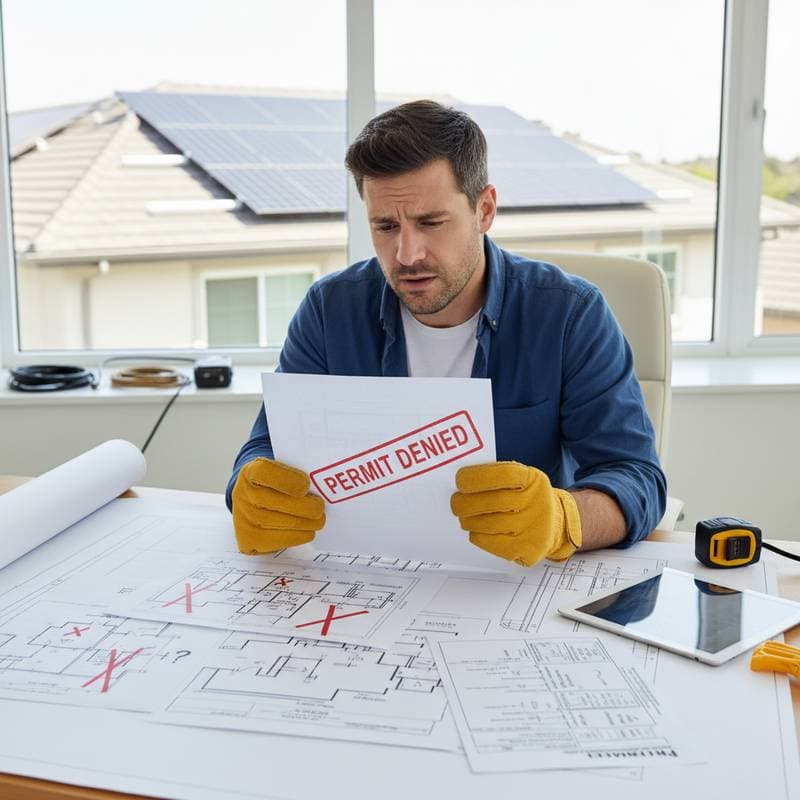
7 DIY Solar Mistakes That Doom Permit Approval
Homeowners frequently undertake solar installations to reduce expenses, yet errors in design, documentation, and safety compliance result in permit rejections. Building departments throughout the United States note an increase in denied residential solar applications due to these DIY oversights. One violation alone can postpone a project for several months, incur additional costs, and necessitate professional corrections.
1. Incorrect Array Layout and Roof Loading
Inspectors often reject DIY submissions that overlook structural integrity. Solar panels impose significant weight on a roof, demanding precise engineering assessments for rafter spacing, load distribution, and secure mounting points. Submit stamped drawings from a qualified engineer to demonstrate that the structure supports both dead loads from the panels and live loads from potential maintenance activities.
Thomas Nguyen, a structural engineer at SolarCert Engineering in California, observes, "Many submittals we see from homeowners lack basic load calculations." Even modest arrays require proof that the roof withstands these stresses without risk of failure. Without such certification, authorities deny permits to protect against structural hazards.
2. Using Non-Listed or Improper Equipment
The National Electrical Code mandates UL listings for all solar components, including inverters, modules, and mounting hardware, tailored to their specific uses. Homeowners sourcing parts from unregulated online vendors risk selecting uncertified items. Verify listings by cross-referencing product datasheets and model numbers against official databases before inclusion in plans.
Uncertified equipment fails code inspections and invalidates warranties along with insurance protections. Extend this check to minor elements like bolts and grounding lugs, ensuring every part complies with standards for durability and safety.
3. Skipping Detailed Electrical Diagrams
Comprehensive wiring schematics must detail conductor sizes, overcurrent devices, grounding routes, and disconnect placements. DIY applicants commonly provide rudimentary drawings that omit these essentials. Create professional-grade diagrams using software tools to illustrate the full electrical flow, mirroring utility interconnection specifications.
Maria Lopez, permitting manager at SunGrid Services in Arizona, emphasizes, "Electrical diagrams need to be as detailed as the local utility’s interconnection requirements." Inspectors trace paths on these plans to identify issues like inadequate wire sizing or absent safety switches. Address these proactively to avoid safety violations and resubmission delays.
4. Ignoring Local Fire Code Setbacks
Fire safety codes demand clear access paths around rooftop solar arrays for emergency responders. DIY designs frequently encroach on required spaces, such as 36-inch walkways between panel rows and edges, or vertical clearances from roof ridges. Consult municipal fire department guidelines to customize layouts, incorporating setbacks that accommodate ladder placement and panel removal.
Authorities also enforce labeling for system shutdown points and rapid shutdown features to facilitate safe firefighting. Adhering to these variable local rules prevents denials and supports community safety standards.
5. Misstating Utility Interconnection Details
Grid-connected systems require alignment with utility-specific protocols, distinct from building permits. DIY planners often assume permit approval suffices, overlooking separate utility reviews. Include system capacity ratings, inverter specifications, anti-islanding safeguards, and meter configurations in your submission to preempt redesigns.
Utilities may insist on dedicated production meters or precise disconnect locations near service entrances. Coordinate early with your provider to integrate these elements, ensuring seamless parallel approvals and avoiding project halts.
6. Neglecting Grounding and Bonding Requirements
Effective grounding and bonding safeguard against faults, surges, and lightning. DIY installations commonly feature discontinuous paths or undersized conductors between panel frames and the main ground. Install equipment grounding conductors that connect all metallic parts, using wire gauges rated for the system's fault current capacity.
Kevin Stone, senior inspector for the City of Austin, notes, "Improper grounding is one of the top reasons for inspection failure." Inspectors perform continuity checks during reviews; failures lead to immediate rejections. Prioritize full-circuit verification to pass these critical tests.
7. Submitting Incomplete Documentation Packages
Technically accurate plans falter without a complete application set, including site surveys, load analyses, schematics, equipment specs, and service panel photos. Digital portals in many areas auto-reject partial files. Assemble packets using official checklists, organizing files with clear labels like "Electrical Schematic v1" for easy navigation.
Double-check requirements via city websites or offices to include any unique forms, such as affidavits or neighbor notifications. Thorough preparation streamlines processing and minimizes administrative bounces.
Steps to Secure Permit Approval
Approach permitting as a rigorous engineering task to achieve DIY success. Engage licensed professionals for structural certifications and electrical designs to eliminate common pitfalls. Confirm component certifications, detail every wiring element, and validate load capacities against certified calculations.
Examine jurisdiction-specific fire and electrical codes for precise spacing, labeling, and pathway compliance. Authorities welcome compliant owner-builders, applying rules uniformly to uphold safety. Submit with professional diligence to gain initial approval and expedite system activation.