
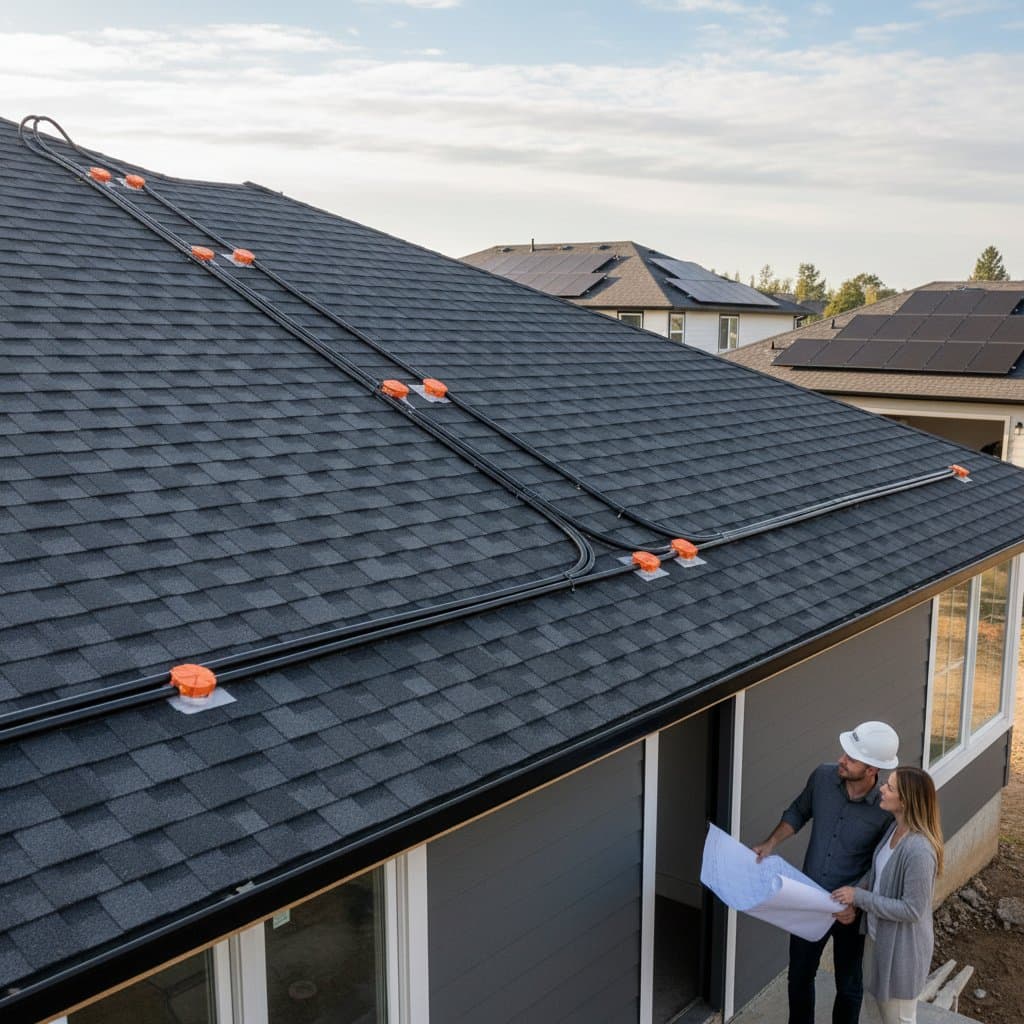
Why Builders Pre-Wire Roofs for Seamless Solar
Homebuilders throughout the United States integrate pre-wiring into roof construction to simplify solar panel installations and lower overall system expenses. This process involves embedding conduit paths, junction boxes, and dedicated electrical lines during the initial build phase, resulting in what experts term a solar-ready roof. Such preparation applies to both residential and commercial developments, with benefits that surpass mere convenience for potential solar adopters.
Data from the Solar Energy Industries Association indicates that pre-wired roofs reduce installation costs by hundreds of dollars per home and decrease labor time by as much as 30 percent. Builders leverage these efficiencies as a key competitive advantage in regions with rising solar demand, where purchasers prioritize energy-efficient attributes.
The Technical Foundation of a Solar-Ready Roof
A solar-ready roof features targeted design elements and electrical setups that enable photovoltaic systems to integrate without extensive modifications. Essential components consist of conduit routes extending from the roof to the primary electrical panel, enhanced roof load capacity to bear the weight of mounting racks and panels, pre-placed junction or combiner boxes adjacent to the roof, and reserved circuit breakers with clear labeling for photovoltaic connections.
Paul Jennings, senior electrical engineer at Sunframe Design Group in Colorado, highlights the advantages for homes with multiple roof sections. Routing conduit post-construction proves labor-intensive and disruptive, he explains. Integrating wiring amid framing and roofing phases prevents the necessity for cutting drywall, navigating attics, or installing conduits over completed areas.
Early incorporation of these pathways ensures that subsequent solar setups proceed swiftly, with minimal mess and disturbance to occupants.
Streamlining Installation and Reducing Costs
Standard solar setups on established homes frequently demand that technicians access walls or attics to thread wiring from rooftop arrays to the electrical panel. These procedures extend labor hours and heighten the chances of permitting delays due to code issues. Pre-wiring removes such obstacles entirely.
For instance, a pre-wired roof might feature a one-inch metal conduit linking a rooftop junction box to a termination point near the main panel. Solar installers then pull photovoltaic cables through this conduit at the time of system activation.
Every on-site minute incurs expenses, notes Olivia Parker, operations manager for BrightBuild Solar in Arizona. Upon reaching a pre-equipped home with suitable conduit and markings, her team finishes the job in one fewer day. This efficiency directly lowers labor charges for property owners.
Parker estimates that pre-wiring cuts installation expenses by 5 to 10 percent, varying with system scale and configuration. In expansive residential communities, these reductions accumulate across numerous units, rendering solar incorporation more feasible for developers and residents alike.
Code Compliance and Market Readiness
Certain regions enforce solar-ready stipulations within building codes, specifying structural loads, equipment spacing, and electrical parameters to support future photovoltaic additions. Structures compliant during initial construction expedite subsequent permitting.
States including California, Washington, and various northeastern areas mandate solar readiness for select building categories. Compliance requires records of roof load capabilities, conduit placements, and panel capacities sufficient for solar integration.
Pre-wiring evolves from optional enhancement to essential compliance tool, states Daniel Ruiz, policy director at the National Renewable Construction Council. Local governments acknowledge the inefficiency of retrofitting homes years after completion. Constructing with foresight conserves resources for all involved parties.
Integrating Rooftop Design with PV Potential
Effective solar-ready roofs harmonize visual appeal, mechanical functionality, and orientation to optimize energy output. Builders collaborate with solar specialists to assess roof slope, shadow patterns, and usable area prior to finalizing blueprints.
Recommendations often include reserving unobstructed south- or west-facing roof sections for panel arrays. Steering clear of vents, dormers, or barriers in these areas eases future mounting.
Roof configuration plays a pivotal role, according to Michael Tran, director of product development at Skyline Builders, a nationwide construction company. Solar viability receives evaluation during architectural planning. Early conduit and layout decisions guarantee that properties accommodate economical photovoltaic systems absent structural alterations.
Such foresight delivers enduring benefits to owners, who retain solar options even if immediate installation does not occur.
The Business Case for Builders
Pre-wiring roofs constitutes a forward investment in market appeal for builders. Prospective buyers regard solar readiness as a premium attribute, irrespective of panels at purchase.
Research from Lawrence Berkeley National Laboratory reveals that solar-prepared homes fetch superior resale prices compared to unprepared equivalents. The upfront pre-wiring expense amounts to a small portion of the eventual value uplift.
In major developments, builders partner with solar providers for bulk rates, incorporating pre-wired setups into standard pricing. This strategy permits promotion of communities as solar-equipped, postponing panel additions until buyer preference.
Builders recognize solar readiness as both engineering choice and promotional asset, observes Kelly Larson, senior market analyst at GreenTech Research. It conveys innovative planning and distinguishes new constructions in saturated markets.
Technical Considerations for Installers
Pre-wiring imposes precise duties on builders and installers alike. Trade coordination proves vital to maintain accessible, rated, and regulation-adherent conduit routes.
Installers favor unbroken conduit spans with few turns for effortless cable extraction. Junction boxes require placement in reachable spots, accompanied by explicit solar circuit labels. Builders sometimes add pull strings inside conduits to facilitate later work.
Electrical panels need ample space for photovoltaic input. Undersized panels may necessitate upgrades prior to connection, diminishing pre-wiring gains.
Electrician-solar designer dialogue remains crucial, emphasizes Parker from BrightBuild Solar. Misplaced conduit endpoints or absent grounding lead to expensive setbacks. Builders benefit from supplying wiring schematics to installers at project outset.
Commercial Applications and Multifamily Projects
Pre-wiring extends beyond single-family residences to commercial and multifamily builds, facilitating rooftop or carport solar deployments.
Developers of offices, educational facilities, and storage units embed electrical conduits and roof entry points during erection, regardless of near-term photovoltaic plans. This minimizes future operational interruptions and infrastructure overhauls.
In multifamily settings, pre-wiring accommodates unit-specific metering for distributed solar. Consolidated conduit systems allow efficient links from individual arrays to separate meters.
Multifamily initiatives suit solar-ready approaches exceptionally well, asserts Tran of Skyline Builders. Shared conduits, allocated roof segments, and inverter-ready electrical rooms support varied photovoltaic configurations. This adaptability promotes later adoption sans extensive rebuilding.
Policy Drivers and Incentive Structures
National and regional initiatives promote solar-ready builds via tax incentives, rebates, and efficiency funding. Certain programs award extra credits for designs satisfying defined pre-wiring benchmarks.
Utilities and regulatory bodies issue solar-ready validations, aiding builders in promotion and verification. These attest to adherence in electrical, structural, and safety aspects for photovoltaic compatibility.
Expanding policy support looms on the horizon, predicts Ruiz of the National Renewable Construction Council. Efforts target soft cost reductions in solar uptake. Pre-wiring mitigates permitting and inspection challenges ahead.
Market Outlook for Solar-Ready Construction
With solar expansion, solar-ready methodologies solidify as standard practice. Projections indicate that forthcoming construction waves in solar-prone areas will routinely feature pre-wired elements.
Consumer preferences bolster this shift, as polls reveal emphasis on energy autonomy, durability, and bill reduction. Builders embracing these elements anticipate regulatory and demand evolutions.
For solar firms, the pattern yields reliable project streams. Pre-wired properties lessen workflow variability, enabling scaled efforts across uniform developments.
Solar-ready builds link current methods to future grid demands, as Larson of GreenTech Research concludes. They curb present expenses while ensuring adaptability tomorrow.
Advancing Unified Energy Infrastructure
Solar-ready construction signals an industry pivot in energy system perspectives. Rather than positioning solar as retrofit, integration occurs from inception.
This encompasses more than wiring: Engineers rate roofs for rack loads, architects optimize for solar access, and electricians dimension panels for generation influx.
Convergence among these fields propels toward holistic energy frameworks, where new edifices support renewables, storage, and intelligent management natively.
Builders grasp the imperative: Roof pre-wiring transcends technical ease. It elevates asset worth, eases enhancements, and matches progressing owner priorities.
Implementing these strategies equips buildings for code adherence and the renewable era's demands.