
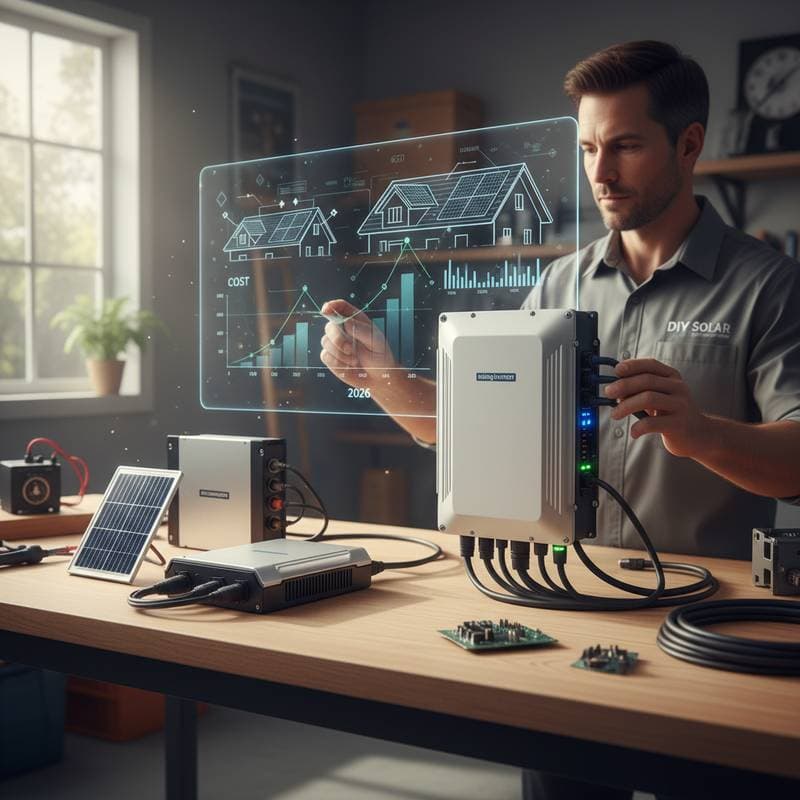
The 2026 Inverter Competition: Microinverters Versus String Inverters
United States solar installers gear up for a pivotal pricing battle that will influence residential and commercial system designs. Microinverters and string inverters compete fiercely as module-level power electronics capture greater market segments, while string systems hold strong in expansive applications. Experts project that inverter expenses account for 6 to 10 percent of overall system costs, with architectural variations now guiding developers toward profitable bidding strategies.
Economic Considerations for Each Inverter Type
Microinverters perform DC-to-AC conversion at the individual module level, yielding superior energy capture and detailed monitoring capabilities. These units command a higher price per watt compared to string inverters, which handle conversion centrally for the entire array. In residential setups under 15 kW, the cost differential spans 15 to 25 percent, influenced by manufacturer, warranty duration, and setup demands.
String inverters prevail in commercial and utility-scale installations due to bulk production efficiencies and streamlined components. One 100 kW string inverter can substitute for numerous microinverters, thereby lowering material and labor outlays. However, this approach introduces compromises in output stability and repair ease.
"Module-level optimization maintains a premium price, yet the energy uplift justifies it in shaded scenarios," notes David McKenna, technical director at SunEdge Consulting. "Project the financial outcomes by calculating lifetime energy gains."
Key Installation and Maintenance Aspects
Microinverters streamline installation through direct module connections, eliminating intricate string calculations and minimizing mismatch issues. Teams complete commissioning faster and pinpoint problems at the module level with precision. This method suits varied rooftop layouts where shading varies.
String inverters demand careful DC cabling and string arrangements to sustain optimal voltage and current ranges. Although design efforts increase, fewer rooftop devices result. "Teams replace one string inverter more quickly than multiple microinverters distributed across the roof," explains Lisa Thornton, operations manager at Pacific Solar Installers in California. "This efficiency proves essential for projects with high installation volumes."
Maintenance approaches differ significantly. Microinverters come with extended warranties of 20 to 25 years, surpassing the 10 to 15 years typical for string inverters. Account for replacement expenses in long-term projections; microinverter failures necessitate rooftop visits, elevating service fees, whereas string inverters, often positioned on the ground or walls, allow straightforward exchanges despite centralized vulnerability.
Evaluating Performance and Reliability
Advancements have bolstered reliability in both inverter categories. Modern microinverters incorporate superior thermal controls and protective materials to overcome past overheating issues. String inverters now feature enhanced MPPT channels, improving their response to partial shading over earlier models.
Clean Energy Associates reports indicate that microinverter setups produce 2 to 8 percent more annual energy in rooftops with obstructions. Uniform arrays with little shading allow string systems to achieve comparable or better efficiency at reduced upfront investment. Consider site-specific factors, such as roof orientation and obstacle proximity, to forecast yield differences accurately.
"The performance divide has diminished," states Rahul Deshmukh, senior analyst at EnergyTrend Research. "Microinverters no longer hold an absolute edge; suitability hinges on project details. Assess if enhanced monitoring and optimization warrant the additional investment."
Market Trends and Policy Effects
United States manufacturing policies shape inverter economics through expanded domestic production incentives. Enphase Energy, based in California, utilizes multiple local contract facilities for microinverters, and string inverter providers like SMA America and Solectria bolster assembly operations nationwide.
Tariffs on imports and mandates for local sourcing continue to affect price points. Engineering, procurement, and construction firms should scrutinize equipment costs alongside tax credit qualifications linked to domestic content. Such policies may compress the cost disparity, particularly as microinverter producers strengthen American supply networks.
Tailored Strategies for Installers and EPC Firms
Inverter selection impacts operational workflows and client experiences. Residential installers lean toward microinverters for their straightforward integration and real-time monitoring, which empower homeowners to track module outputs and schedule upkeep proactively.
Commercial engineering, procurement, and construction entities emphasize scalability and unified servicing. A 500 kW rooftop array using string inverters incurs 10 to 15 percent lower installation costs than a microinverter equivalent. In shaded urban settings, however, microinverters' production edge may recoup expenses through sustained output.
Hybrid solutions gain traction, such as optimizer-enhanced string systems from SolarEdge, which deliver module-level insights at centralized inverter pricing. These options expand in commercial and industrial sectors needing adaptable designs and shading resilience.
Building Robust Financial Models
Financing viability hinges on equipment standardization and historical performance records. Lenders favor string inverters' established presence in large-scale ventures, fostering trust. Microinverter providers respond with prolonged warranties and output assurances to secure funding commitments.
Focus on levelized cost of energy calculations beyond initial outlays. A microinverter system may demand 18 percent more capital yet yield 4 percent higher annual energy, potentially lowering lifetime costs. For expansive, even sites, string inverters offer superior watt-cost ratios and expedited repairs.
Incorporate variables like local labor rates, energy tariffs, and incentive timelines into models. Use tools such as discounted cash flow analysis to compare scenarios and identify the optimal path for return on investment.
Optimizing Inverter Choices for 2026 Projects
Installers and developers will hone inverter selections by analyzing site profiles, workforce expenses, and incentive opportunities as the 2026 dynamics evolve. No universal victor emerges; application scale and environmental factors determine technology fit.
Manufacturers advance by cutting fabrication costs without sacrificing efficacy. United States solar professionals who integrate these insights into planning will secure competitive advantages, ensuring resilient and profitable installations amid shifting market conditions.