
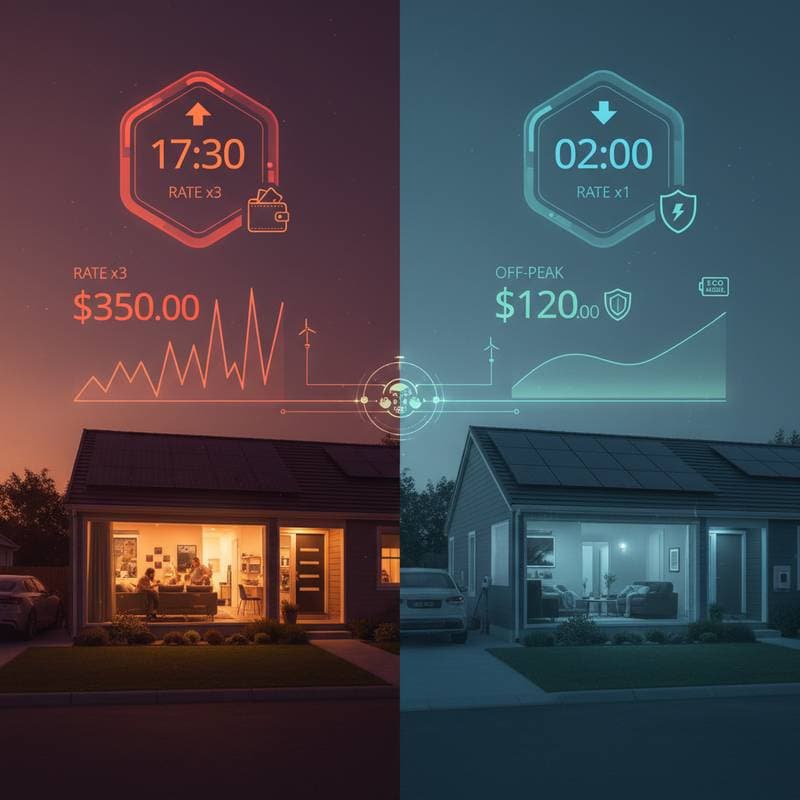
Why Time-of-Use Rates Tripled Your Power Bill
Utility customers across the United States face sharp rises in monthly electricity bills as more providers implement time-of-use (TOU) rates. These plans adjust prices based on usage time, imposing higher charges during peak demand periods. In certain regions, bills have nearly tripled for customers switching from flat rates to TOU structures.
Analysts attribute this shift to utilities' efforts to stabilize the grid and incorporate renewables more effectively. For households and businesses, however, the adjustment brings confusion and irritation, particularly when evening usage drives up costs.
Understanding Time-of-Use Rates
TOU plans vary the cost per kilowatt-hour (kWh) according to the time of day. Providers designate peak, off-peak, and occasionally mid-peak intervals. Peak times, marked by intense demand, carry rates two to three times those of off-peak hours.
Consider a scenario where a utility bills 18 cents per kWh from 4 p.m. to 9 p.m., dropping to 9 cents otherwise. A family using significant energy in the evening might face a substantial bill hike, despite unchanged total consumption.
"Customers anticipate bills tied to energy volume, not timing," notes Laura McKenzie, senior energy policy analyst at Energy Market Strategies. "TOU rates introduce a timing premium that challenges many to adapt."
Reasons Utilities Adopt TOU Pricing
Providers justify TOU rates as essential for aligning supply with demand amid expanding renewables. Solar and wind output surges at specific times but wanes elsewhere. As solar fades at dusk while demand holds steady, utilities turn to costly reserves.
Mark Hollister, vice president of regulatory affairs at Pacific Grid Energy, explains that TOU pricing smooths these imbalances. "Daily service costs fluctuate," he states. "Time-based rates mirror those variations and prompt usage shifts from strained grid moments."
This strategy also postpones new infrastructure needs. By curbing peak consumption, utilities enhance efficiency and cut future expenses.
Challenges of Aligning with Peak Periods
Peak hours frequently overlap with routine activities. Individuals arrive home, prepare meals, launder clothes, and operate climate controls within this costly span.
Without solar panels or batteries, residential users have few options to relocate usage. Devices like smart thermostats and programmable appliances assist, yet habit changes prove restrictive. Businesses encounter parallel issues, especially those active evenings or dependent on cooling, illumination, or steady operations.
Utility records indicate that unaltered habits lead to bill surges of 50 to 200 percent under TOU. Such jumps threaten financial stability for lower- and middle-income families.
Solar Owners Navigate TOU Hurdles
Solar system owners anticipate stable, reduced bills. TOU rates can diminish these gains if excess midday power sells at low rates while evening imports cost more.
"Solar peaks midday, but TOU charges escalate near sunset," observes Jared Thompson, director of product strategy at First Solar Installations, an Arizona-based engineering firm. "This timing gap leaves solar users purchasing premium evening power, even if daytime needs are covered."
Batteries address this by saving surplus solar for peak discharge. Integrated solar-storage setups cut peak exposure markedly, though initial expenses deter some.
Effects on Businesses and Industries
Commercial and industrial clients grapple with intricate TOU frameworks, often layered with demand charges for usage spikes. Rate adjustments demand operational tweaks to control expenses.
A factory operating machinery afternoons risks cost spikes if those slots turn peak. Relocating shifts or adding on-site power and controls can help, but demand strategic foresight and funding.
"Enterprises manage energy adeptly, yet TOU shifts impact them severely," says Erica Lam, energy economist at GridEdge Advisors in California. "Plants and storage facilities cannot routinely relocate to off-hours for savings."
Oversight and Policy Framework
Public utility commissions approve TOU designs. Numerous states enforce them within grid upgrade initiatives. The goal involves precise pricing that captures live supply dynamics, particularly with rising renewables.
Advocates for consumers contend that introductions lack sufficient outreach. Some providers enroll users automatically sans thorough details or simple exits. Detractors claim this undermines confidence and imposes undue strain.
Regulators in various states mandate comparison calculators for flat versus TOU costs. Others insist on trials prior to broad rollout. Implementation varies, leaving many users surprised by escalations.
Economic Drivers of Peak Costs
Grid expenses hinge on the costliest active generator at any instant. Off-peak relies on economical base-load or renewables. Demand surges activate pricier gas or oil peakers.
TOU mirrors this variability. Elevated peak fees signal utilities' expense patterns. This rationale, however, clashes with daily routines and lifestyle constraints.
"Grid benefits align with the approach," affirms Daniel Ruiz, managing director at Solar Economics Research Group. "In practice, inflexible users shoulder disproportionate loads, fostering inequity views."
How Solar and Batteries Alter Dynamics
Advancing distributed solar and storage transforms TOU responses. Intelligent inverters, lithium batteries, and optimization software let users dictate grid draws.
A fitting battery releases reserves during peaks, avoiding high buys. A 10 kWh unit might handle a home's evening needs, slashing TOU impacts.
Installers note surging interest in hybrids. "Storage inquiries dominate discussions," reports Travis Cole, regional manager at BrightSun Solar in Nevada. "TOU volatility highlights battery benefits."
Addressing Fairness and Awareness
Advocates highlight TOU's heavier toll on at-risk groups. Tenants, seniors, and low earners often cannot time usage flexibly. They inhabit subpar structures or rely on nonstop devices like medical aids.
Providers test reduced TOU options, safeguard intervals, or aid initiatives to buffer shocks. Awareness gaps persist, with many unclear on schedules or adjustments.
"Rate changes demand paired education," asserts Sylvia Greene of the National Energy Consumers Council. "Absent direction, TOU punishes rather than motivates."
Practical Ways to Control TOU Expenses
Users can implement these measures to curb peak costs:
- Relocate heavy appliance runs to off-peak slots. Overnight operation of dishwashers, washers, or EV chargers delivers solid reductions.
- Acquire storage to bank daytime solar for peak release.
- Deploy smart thermostats for pre-peak climate adjustments, minimizing high-rate HVAC use.
- Track rate timetables, as periods and levels evolve.
- Evaluate solar-storage combos for durability and rate hedging.
These actions build awareness and may involve outlays, yet collectively blunt TOU effects.
Solar Sector Shifts from TOU Trends
TOU expansion redefines solar project viability for homes and firms. Designers now target not just offsets but timed optimizations.
Batteries proliferate in stringent TOU areas. Data shows over half of new home solar in select states pairs with storage. Declining costs and refined software fuel this momentum.
For builders and planners, adaptations pose hurdles and prospects. Models incorporate hourly profiles, rates, and behaviors. Firms leveraging forecasts and adaptability secure edges.
Embracing Adaptive Energy Practices
TOU rates will persist as a key element in the U.S. power landscape. They embody dynamic pricing attuned to production and distribution realities. Customers must cultivate fresh routines, leverage tools, and seek utility clarity.
Solar and storage stand out as prime navigators. On-site production and retention restore purchase timing control. Smart tech, monitoring, and rate strategies convert TOU from obstacle to asset.
As providers hone designs, emphasis turns to adaptability and user agency. Grasping TOU mechanics and adopting shifts safeguards finances while aiding grid equilibrium and sustainability.