
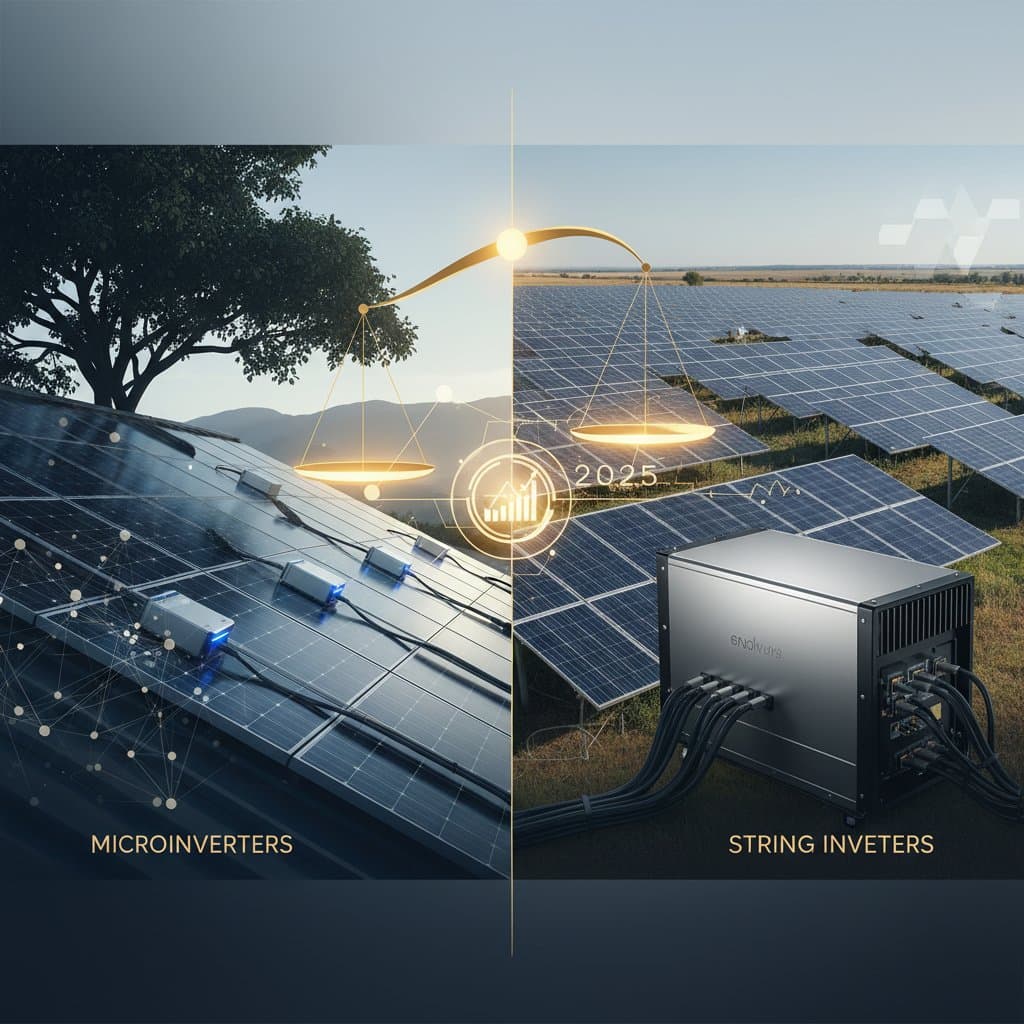
Microinverters vs String Inverters: Lifetime Value Takes Center Stage in 2025
The debate between microinverters and string inverters has persisted for over a decade. Recent 2025 data introduces new dimensions to this discussion. After incremental advancements, both technologies now deliver reliable, high-performance results. The focus has shifted from mere conversion efficiency to comprehensive factors such as design economics, serviceability, and data analytics. This evolution moves the conversation beyond general superiority to evaluating lifetime value tailored to specific project needs.
Fundamental Architectural Differences
String inverters link multiple solar panels in series. They channel combined DC power to a centralized unit for AC conversion. This setup simplifies the system by concentrating electronics away from the roof.
Microinverters attach directly to each panel. They handle DC-to-AC conversion individually at the module level. This design influences all key tradeoffs in technical performance and economic viability that professionals consider.
String inverters offer lower initial costs and fewer rooftop components. Maintenance becomes straightforward with ground-level access. However, the entire string's output matches the weakest panel, so shading or dirt on one module reduces overall array efficiency.
Microinverters address this limitation through independent optimization per panel. They boost energy production in uneven lighting or shaded conditions. The downside involves elevated material expenses and additional rooftop electronics, which may complicate installation and raise durability questions over time.
Field Performance Insights
Data from residential installations across U.S. regions demonstrate that microinverter systems yield two to six percent more annual energy than comparable string setups. This advantage shines in roofs with irregular shapes or partial shading.
In optimal conditions, such as uniform, unshaded orientations, the difference narrows to under one percent. Observations from test sites in the Southwest and Mid-Atlantic confirm this trend. Complex layouts with nearby trees or vents consistently benefit from microinverters, while clear, high-sunlight roofs show minimal variance.
Site-specific factors drive these outcomes more than inverter type alone. Professionals use such data to match technology to environmental realities, maximizing harvest without unnecessary premiums.
Reliability and Maintenance Considerations
Advancements in microinverter design have lowered failure rates significantly. Current models from major distributors report annual failures below one percent. Improvements in thermal management and component durability mark progress from prior iterations.
String inverters facilitate quicker repairs due to their accessible placement. Technicians can replace a unit in hours without roof work. In commercial projects exceeding 250 kilowatts, this accessibility often tips the scale toward strings for streamlined operations.
Microinverter replacements demand panel access, increasing labor. Yet, their distributed nature avoids total system downtime from a single failure. EPC firms weigh these logistics against project scale when selecting architectures.
Evolving Cost Structures
Upfront pricing continues to favor string inverters, particularly with features like optimizers or advanced MPPT. Microinverters have seen steady price reductions, aided by AC module integration that cuts labor.
Procurement data indicate the installed cost gap for residential systems has shrunk to under fifteen cents per watt. Small commercial installs may widen this based on racking and wiring demands.
Lifetime economics often favor microinverters when accounting for higher yields and reduced losses from mismatches. This holds especially true in shaded or multifaceted roof scenarios, where performance gains offset initial investments.
Enhanced Monitoring and Data Features
Microinverters provide superior module-level insights. This capability enables rapid fault identification, proactive upkeep, and detailed production analysis. Owners gain tools to spot issues early, preventing yield drops.
String systems achieve comparable monitoring via add-on optimizers, but these raise costs and complexity. Built-in microinverter dashboards deliver user-friendly interfaces that appeal to residential and small business users.
Installers report client preference for this transparency as a key adoption driver. Detailed metrics empower better system management and informed decisions on maintenance.
Applications in Commercial and Utility-Scale Projects
Microinverters lead in residential markets due to shading resilience and monitoring perks. String inverters prevail in commercial and utility domains for scalability and simplicity.
Centralized wiring and maintenance suit large arrays, with efficiencies often surpassing 98 percent. High-capacity models handle multi-megawatt demands cost-effectively.
Hybrid approaches emerge as alternatives. Distributed string configurations deploy multiple smaller units across sites. These balance microinverter-like redundancy with string efficiency and service ease.
Market Trends and Expert Views
Manufacturers and EPC leaders observe convergence in both technologies. Microinverters gain cost and efficiency edges. String inverters incorporate modularity and enhanced connectivity.
Choices hinge on project priorities: microinverters suit data-focused, resilient designs; strings excel in centralized, budget-driven operations. The market segments clearly, with each filling distinct roles.
This maturation fosters innovation in performance, integration, and value delivery per kilowatt.
Aligning Technology with Project Needs
Selecting between microinverters and string inverters requires assessing site layout, scale, and objectives. Microinverters deliver tangible gains in energy capture and oversight for oriented or shaded residential roofs.
String inverters optimize economics and upkeep for expansive commercial or ground-mount arrays. Rapid advancements in both will further integrate their strengths.
This targeted approach ensures systems perform optimally over decades, delivering sustained returns on solar investments.