
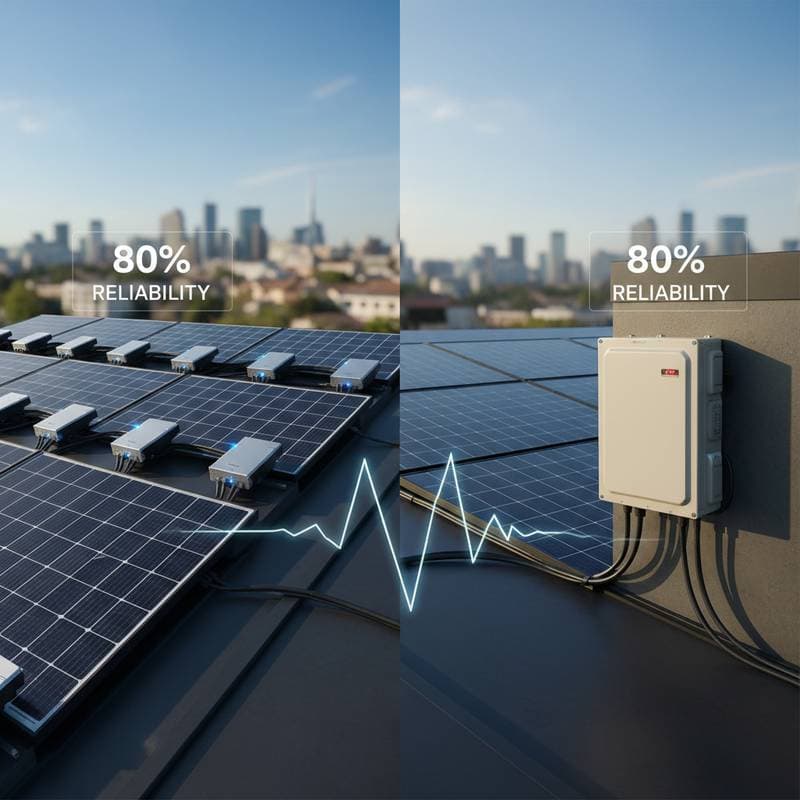
Key 2025 Insights: Microinverters vs. String Inverters in Reliability
Recent reliability data from the United States solar market underscores significant differences between microinverters and string inverters. Reports from leading installers indicate variations in long-term performance, failure rates, and replacement expenses for both residential and commercial installations. These results prompt evaluations of which option provides optimal reliability, ease of service, and overall lifecycle value.
Failure Rate Comparisons by System Type
A comprehensive dataset from over 120,000 monitored systems in various states reveals microinverters with an annual failure rate of 0.25 percent per unit, compared to 1.3 percent for string inverters. This analysis, drawn from installer records and warranty claims, connects reliability to component design, environmental conditions, and installation standards.
"Microinverters experience fewer catastrophic failures since each unit functions independently," stated Jason Miller, Director of Technical Operations at SolEdge Installers, a California-based engineering, procurement, and construction firm. "A string inverter failure affects the entire string, amplifying the consequences."
Repair times also vary considerably. Replacing a microinverter often requires under one hour per module, whereas string inverter swaps demand system shutdowns that extend several hours. Such interruptions lead to production losses and increased labor expenses.
Core Design and Technical Factors
Microinverters perform DC-to-AC conversion at the individual module level, while string inverters manage conversion for groups of modules. This distinction influences thermal loads and electrical stresses. By spreading conversion tasks across numerous small units, microinverters minimize heat buildup and prolong operational life.
String inverters process higher voltages and currents, which heighten wear on components amid temperature fluctuations. "The underlying physics is straightforward," explained Laura Chen, Senior Engineer at VoltGrid Technologies. "Higher current through limited components stresses capacitors and power transistors, resulting in accelerated degradation over time."
String inverter producers have advanced reliability via enhanced cooling mechanisms, protective coatings, and sophisticated monitoring features. Current models incorporate predictive diagnostics to notify operators of emerging issues, enabling maintenance before complete breakdowns occur.
Role of Installation Practices and Environmental Influences
Installation techniques critically determine reliability for both inverter types. Issues such as improper cable routing, insufficient grounding, or incorrect torque application introduce risks that exceed hardware limitations.
Ground-mounted setups in humid or coastal areas report increased microinverter corrosion cases. Rooftop installations in extreme heat zones exhibit more frequent string inverter performance reductions. "Approximately 70 percent of inverter failures stem from installation errors or environmental pressures rather than production flaws," noted Mark Alvarez, Reliability Manager at SunTrack Field Services.
Alvarez emphasized that proper orientation and ventilation spacing greatly affect durability. Installers of both systems routinely apply thermal imaging at startup to confirm heat dissipation and detect hotspots.
Warranty Patterns and Total Ownership Costs
Independent service provider records align with field observations on warranties. Across a standard 10-year span, microinverter setups show under 3 percent cumulative replacements, versus 8 percent for string inverter systems. Leading performers include Enphase Energy, SMA America, and Sungrow Power Supply.
Expenses vary by configuration. Microinverter fixes distribute minor costs but demand more labor in expansive arrays. String inverter repairs occur less often yet incur higher per-incident charges. Residential installers benefit from microinverters' favorable labor-to-material ratios, while utility-scale projects favor string inverters' centralized economics despite elevated failure vulnerabilities.
Solar Analytics Group's internal assessment revealed microinverter systems retaining 97 percent of projected output after five years, against 94 percent for string systems in comparable settings. This gap, though narrow, yields substantial returns over project durations.
Industry Adaptations and Producer Innovations
Producers address reliability challenges through hybrid systems and modular approaches. Certain string inverter providers now offer multi-MPPT configurations that replicate microinverter fault isolation across string sections. Microinverter firms enhance enclosure seals and circuit materials to resist moisture penetration.
Enphase Energy leverages predictive modeling based on data from millions of deployed units. Spokesperson Sandra Lee remarked that the company's firmware adjusts current distribution in real time to lessen component strain. "Our edge in reliability derives from data-informed upkeep," she said. "We identify irregularities prior to fault occurrences."
Huawei and SMA prioritize rugged components with superior heat tolerance and warranties extending to 15 years. These efforts aim to dispel views of centralized inverters as less dependable.
Broader Policy and Market Effects
Reliability indicators shape installer choices, financing options, and insurance rates. Financial institutions and portfolio managers require documented mean-time-between-failure statistics for major project approvals. Higher-reliability inverters qualify for reduced premiums and better loan terms.
State incentives increasingly tie rebates to uptime standards, indirectly promoting lower-failure technologies. This shift may boost microinverter use in homes and small businesses, as utility developers stick with string setups for budget reasons.
Analysts predict heightened focus on reliability with rising solar capacity. CleanTech Insights reports that inverter issues drive about 40 percent of maintenance visits in distributed systems. Minimizing this supports cost reductions and bolsters investor trust.
Enhancing Reliability Through Intelligent Oversight
With United States solar growth, emphasis moves from initial costs to sustained performance. Both inverter types now feature digital tracking, fault detection, and cloud analytics for proactive care.
Installers should weigh upfront expenses, service needs, and site conditions when choosing inverters. Financiers must incorporate proven reliability into risk assessments and warranty pricing. Producers concentrate on heat control, protective designs, and forecasting tools to stay competitive.
Although 2025 statistics favor microinverters on failure metrics, ongoing advancements benefit both. Effective reliability hinges on vigilant monitoring, timely upkeep, and robust support, maximizing system output and value.