
2025 Micro vs String Inverters: Which Technology Leads the Way?
The U.S. solar market enters a competitive era for inverters as installers, engineering, procurement, and construction firms, and developers evaluate technical and financial trade-offs between microinverters and string inverters. Distributed generation expands in residential and small commercial projects, making inverter choices pivotal for operations and economics. Analysts project microinverters hold over 40 percent of residential installations, while string inverters command more than 80 percent in utility and large commercial sectors. Boundaries between these technologies start to fade with ongoing innovations.
Core Technologies Explained
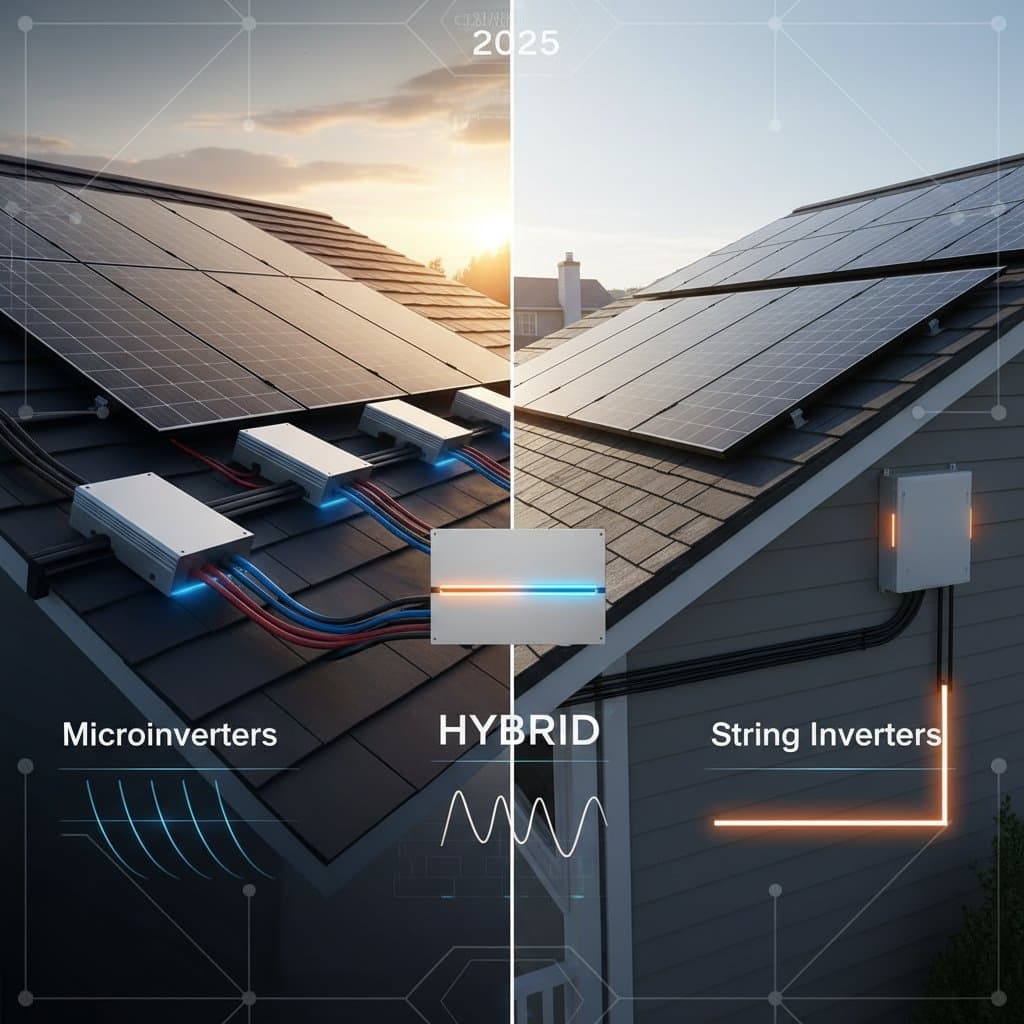
A microinverter serves as a compact, module-level device that converts direct current from one solar panel into alternating current. Each unit functions independently, enhancing output in shaded or fluctuating conditions. In comparison, a string inverter handles conversion for several panels wired in series, forming a string. This setup minimizes equipment and wiring but suffers if any panel underperforms.
Both technologies employ maximum power point tracking to maximize voltage and current for optimal energy production. Microinverters apply this at the individual module level, whereas string inverters manage it per string. These differences dictate responses to shading, panel mismatches, and temperature changes.
Economic Drivers and Market Changes
U.S. installers note declining hardware costs and enhanced reliability close the price divide between the options. Wood Mackenzie data indicates inverter prices fell over 15 percent in the recent cycle, with microinverters dropping faster thanks to expanded production and efficient supply chains.
Microinverters suit residential projects better as homeowners demand panel-specific monitoring. For larger setups, string inverters prevail due to fewer components and quicker setups. String models cost less per watt with capacities from 30 kilowatts to hundreds of kilowatts. Microinverters, limited to 300 to 400 watts each, demand one per panel, raising expenses in expansive arrays. In systems below 20 kilowatts, gaps shrink when optimization and monitoring add value.
Labor and Installation Factors
Labor influences selections heavily. Microinverters reduce DC wiring needs and avoid high-voltage DC lines, lowering installation risks. Units attach directly to racking behind panels, enabling safe parallel AC links for crews.
String inverters need DC combiner boxes and extended wiring but simplify post-installation maintenance through central placement. Replacing a string inverter on a commercial roof proves faster than inspecting multiple microinverters. Choices hinge on labor approaches: high-volume residential teams favor microinverters for consistent timelines and simpler designs, while commercial groups handle higher DC voltages for efficient large-scale commissioning.
Reliability and Maintenance Insights
Failure rates and durability shape buying decisions. Microinverters spread risks across many units; a single failure leaves the system operational. This redundancy attracts homeowners seeking steady production and low downtime.
String inverters centralize risks in fewer units, where one issue halts a string until repaired. However, monitoring and replacement occur easily, with modern diagnostics enabling remote issue spotting. Serviceability strengthens string inverters: problems isolate quickly for hour-long fixes, avoiding roof searches for faulty microinverters.
Warranties highlight contrasts. Microinverter makers provide 25-year terms aligning with panel lives, offsetting initial costs for residential users. String inverters offer 10 to 15 years of protection.
Efficiency and Yield Analysis
Efficiencies align closely. Leading string inverters exceed 98 percent conversion, while microinverters reach 96 to 97 percent. String units edge out in pure efficiency, but microinverters excel in shaded or mismatched scenarios.
Independent maximum power point tracking in microinverters keeps each panel at peak output, boosting annual yields by 5 to 10 percent over strings in challenging conditions. Uniform, unshaded arrays show minimal differences, favoring string economics.
Yield varies by site. Ideal arrays benefit from string inverters on cost and output. Complex roofs gain from microinverters' reliable performance without extensive redesigns.
Monitoring and System Integration
Monitoring stands as an expectation in residential and commercial sectors. Microinverters deliver panel-level tracking, helping detect early issues like dirt, shade, or degradation.
String inverters once limited to system overviews now pair with optimizers for string or module insights. Brands such as SMA America and Fronius USA upgrade protocols for swift data and energy system ties.
Grid-interactive and hybrid growth ties choices to storage and controls. Microinverters pair well with AC-coupled batteries; string inverters fit DC-coupled setups efficiently. Evaluations include topology and management features for storage designs.
Policy Impacts and Domestic Trends
Federal manufacturing incentives affect procurement. U.S. assembly announcements meet content rules for tax benefits in clean energy projects. This alters pricing and availability for both inverter types.
Analysts foresee domestic options rising in utility and community solar, where sourcing compliance impacts finances. Residential effects rely on scaled microinverter production to satisfy demand.
Competitive Landscape and Future Directions
Microinverter firms aim at bigger systems with multi-module designs to cut costs per watt. String suppliers downsize for flexibility. Enphase Energy advances higher-capacity microinverters. Huawei and SolarEdge enhance strings with optimizers.
Rivalry spurs advances in cooling, communications, and safety. Rapid shutdown rules boost module electronics. String makers add comparable safeguards.
Hybrid models blend string bases with targeted optimization, potentially redefining categories.
Selecting the Right Inverter for Your Project
Installers and developers balance scale, sites, and services when choosing. Microinverters provide flexibility and precise monitoring for residential roofs, shaded, or uneven arrays. String inverters power commercial and utility needs with efficiency, central maintenance, and low costs per watt.
Top firms view inverters as design elements. Yield models, labor assessments, and warranty reviews in planning maximize performance and profits.