
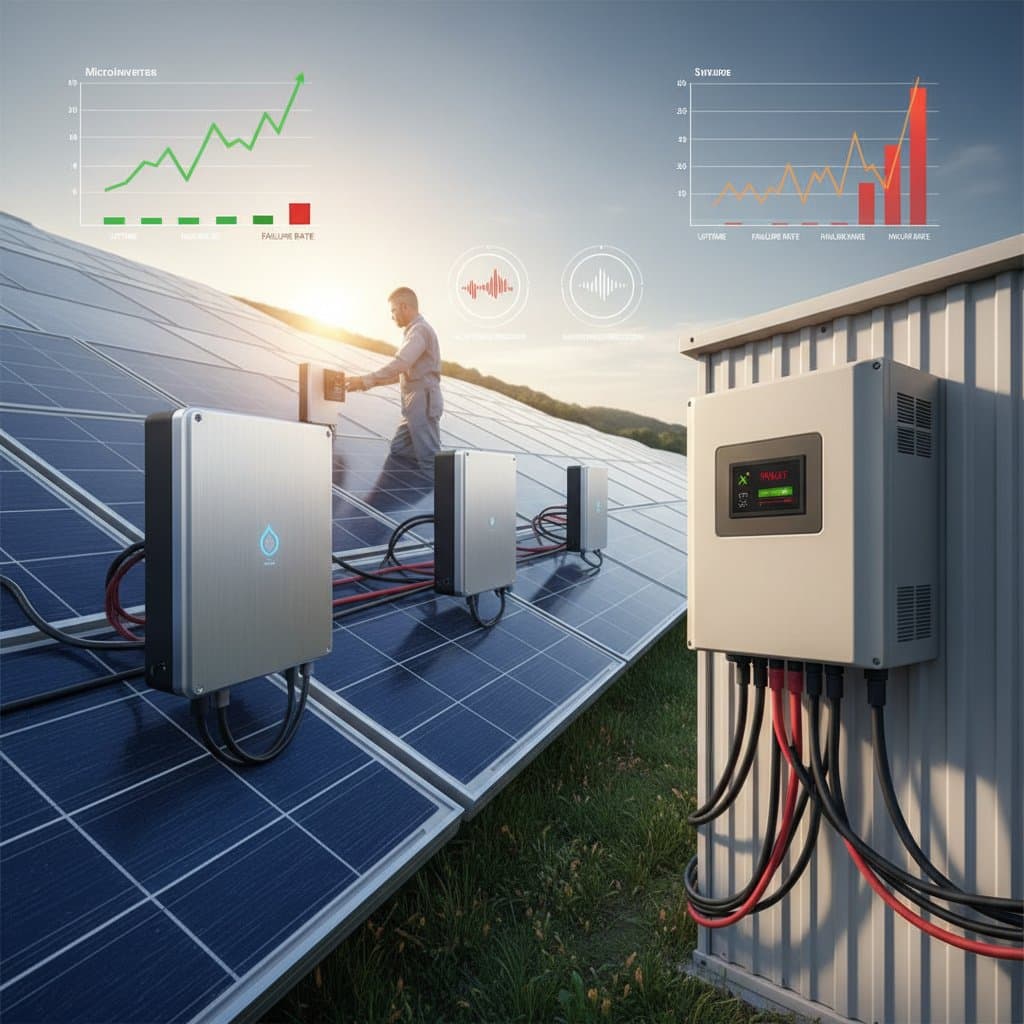
Field Tests in 2025: Microinverters Surpass String Inverters in Key Metrics
The debate over microinverters versus string inverters has intensified within the solar industry. Recent reliability data from field tests challenges long-held assumptions that string inverters offer superior dependability and cost efficiency. These findings prompt installers and developers to reassess equipment choices based on performance in real-world conditions.
Key Insights from Recent Field Data
Data gathered from commercial and residential solar installations reveals that microinverters exhibit lower failure rates over time. Independent asset managers report fewer service interventions per megawatt for microinverter systems compared to string inverter setups. This trend holds particularly in sites with shading variations or uneven panel orientations.
String inverters continue to lead in large ground-mounted arrays due to their reduced initial costs and streamlined servicing. However, microinverters demonstrate advantages in uptime, often exceeding 99 percent across diverse environments. Failures in string systems tend to cluster after five years, creating a subtle but significant reliability edge for microinverters in smaller projects.
Shifting Installer Perspectives
Many installers, previously drawn to string inverters for their straightforward installation and affordability, now consider microinverters viable alternatives. The enhanced durability of microinverters justifies the premium price through reduced operational disruptions and quicker repairs. For instance, one regional installation firm notes a marked decrease in maintenance trips after adopting microinverters for residential work.
Module-level monitoring in microinverter systems provides detailed insights into individual panel output, aiding in the identification of issues like partial shading or debris buildup. String inverters, by comparison, aggregate data at the array level, potentially concealing problems in specific modules. This granularity supports proactive maintenance, especially in homes with complex rooflines.
The Impact of Inverter Reliability on System Performance
Reliable inverters ensure consistent energy production and maximize returns on solar investments. A failure in a string inverter halts power from connected panels until resolution, whereas microinverters isolate issues to single modules, preserving overall output. Common failure causes include heat buildup, electronic wear, and degradation from power surges.
Manufacturers counter these challenges with advanced cooling mechanisms, robust surge safeguards, and durable components. Over time, the reliability disparity has diminished, yet current data positions microinverters ahead for distributed applications like residential rooftops.
Balancing Costs with Long-Term Benefits
Upfront expenses remain a primary consideration, with string inverters delivering better value per watt in expansive utility or commercial setups. Their centralized architecture minimizes wiring complexity and component counts. Microinverters, despite higher costs, enable flexible system expansions and eliminate centralized vulnerabilities.
Homeowners benefit from adding panels without major redesigns, and the design enhances resilience against localized faults. Integration with battery storage varies by inverter type; string systems pair seamlessly with certain platforms, while microinverters suit those requiring per-module control. Professionals should assess warranties, software compatibility, and site-specific needs during selection.
Manufacturer Adaptations and Industry Trends
In response to emerging data, string inverter makers introduce modular features that sustain partial operation during faults. Microinverter producers enhance scalability and data transmission for larger rooftop arrays. Warranty claims have declined industry-wide, thanks to rigorous quality measures and firmware updates that prolong equipment life.
This rivalry drives advancements in monitoring and durability, ultimately improving options for solar adopters. Analysts observe that both technologies mature rapidly, with innovations addressing previous shortcomings.
Guidance for Solar Installers and Developers
Project evaluation demands a tailored approach, avoiding one-size-fits-all solutions. Opt for microinverters in scenarios involving irregular shading, steep roofs, or restricted access, where their independence outweighs added costs. Reserve string inverters for uniform, large-scale installations with easy servicing points.
Long-term planners should factor in maintenance logistics alongside budgets; microinverters often lower total ownership costs through minimized downtime. Operations teams gain from detailed monitoring to spot anomalies early, safeguarding revenue streams.
Aligning Technology with Project Goals
Evolving data underscores the value of matching inverter types to specific conditions, resources, and economics. Informed decisions elevate system efficiency and longevity. Solar professionals who monitor reliability updates and apply field lessons will deliver optimized installations that sustain performance over decades.