
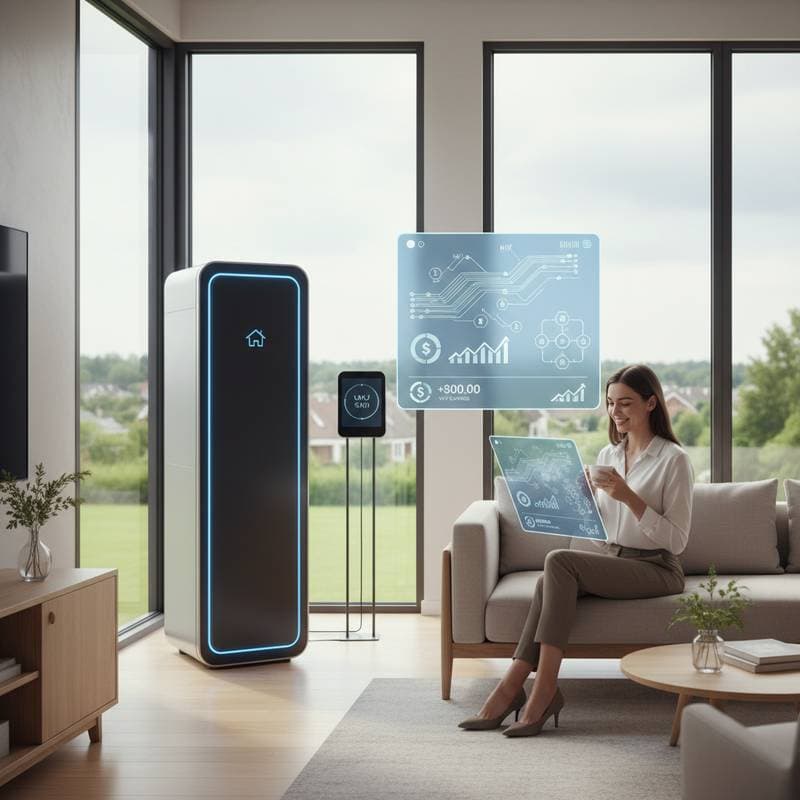
Rent Your Home Battery to Virtual Power Plants for Up to $800 in Annual Income
Homeowners throughout the United States with battery storage systems have an opportunity to generate additional income by integrating their setups with virtual power plants, known as VPPs. Various programs compensate participants with payments that can reach approximately $800 each year for providing stored energy to the grid during periods of high demand. This approach gains momentum as utilities and energy aggregators seek to enhance grid stability and decrease dependence on fossil fuel-based peaking facilities.
Virtual power plants unite numerous distributed energy resources, such as home batteries, solar panels, and intelligent thermostats, into unified networks capable of real-time responses to grid requirements. This innovation alters electricity market dynamics by enabling residential participants to contribute to services previously handled solely by large industrial generators.
Understanding the Virtual Power Plant Mechanism
A virtual power plant consolidates energy storage units from diverse sites into a single, manageable entity. Grid operators, anticipating elevated demand or supply shortages, direct the VPP to release energy from participating batteries to maintain voltage and frequency equilibrium. Homeowners earn rewards for the energy delivered or for reserving capacity during essential intervals.
Homeowners start by installing a battery system equipped for remote management. The unit stays primarily under the owner's direction for everyday needs, though the VPP may access restricted power quantities during specified grid events. These occurrences typically span a few hours, with advance alerts delivered via mobile applications or email notifications.
The U.S. Department of Energy projects that widespread VPP adoption across homes and businesses could curtail peak loads by dozens of gigawatts across the nation. Such reductions would lessen the demand for additional peaking infrastructure, cut emissions, and bolster overall grid durability.
Exploring Financial Rewards and Compensation Structures
The potential to secure up to $800 annually attracts owners of solar-integrated storage systems. Earnings fluctuate based on location, utility policies, and program specifics, often combining payments for exported energy, available capacity, and event involvement.
Sunrun, headquartered in San Francisco and specializing in solar and storage solutions, connects customers in select states to VPP initiatives via utility collaborations. The provider indicates typical yearly payouts ranging from $500 to $800, influenced by regional pricing and event occurrences. "Virtual power plants establish a fresh revenue channel for customers while aiding utilities in handling peak demand with greater efficiency," noted Chris Rauscher, Senior Director of Market Development at Sunrun.
Tesla's Virtual Power Plant initiative, operational in several states, follows a comparable framework. Owners of Powerwall units enroll through the Tesla application. During grid support requests, Tesla pools capacities and initiates discharges from the collective. Contributors receive utility bill credits or direct compensation proportional to their input.
Providers like Enphase Energy and Swell Energy continue to broaden these services. Based in Los Angeles, Swell Energy collaborates with utilities in Hawaii, California, and Southeastern states to implement residential VPPs that furnish grid assistance alongside owner reimbursements.
Essential Technical Specifications for Involvement
Participation in most VPP programs demands batteries with internet connectivity, remote operation features, and alignment with the aggregator's software. These setups generally feature lithium-ion storage linked to intelligent inverters supporting two-way communication.
Professionals configure installations to grant secure VPP access without affecting user privacy or system efficiency. "Achieving seamless integration among battery units, inverters, and utility controls presents the primary hurdle," observed Jasmine Lee, an energy systems analyst at Wood Mackenzie. "Uniform protocols for data exchange prove essential for broad program expansion."
Prospective participants should confirm their equipment satisfies aggregator criteria, including adequate storage volume, backup reserves, and reliable online access. Certain programs mandate commitments of two to five years to guarantee consistent grid support.
Influences from Policies and Market Forces
National and regional regulations propel the use of distributed energy assets and their entry into broader markets. The Federal Energy Regulatory Commission's Order 2222 permits aggregated distributed resources, like home batteries, to engage in transmission organization markets.
States including California, Vermont, and Massachusetts introduce storage aggregation boosts through rebates and results-oriented incentives. California's Self-Generation Incentive Program, for instance, has facilitated numerous residential battery deployments now integrated into VPP arrays.
Utilities appreciate the economic edges of decentralized systems. Research from the Rocky Mountain Institute reveals that VPPs supply capacity at reduced costs per kilowatt compared to conventional sources in various areas. The study further posits that utilities might postpone billions in grid enhancements by utilizing home batteries for peak management.
Opportunities for Installers and Energy Developers
The rise in VPP engagement opens fresh avenues for installation firms. Packaging storage with VPP signup clarifies investment returns for clients. "Highlighting how a battery generates $700 or $800 yearly via grid involvement significantly accelerates payback timelines," stated Mark Doran, CEO of Solar Edge Solutions, a Florida engineering, procurement, and construction company.
Developers and aggregators gain from dependable capacity suitable for energy market bids. Individual batteries offer modest outputs, yet thousands combined yield hundreds of megawatts. These networks then vie with traditional facilities in capacity markets.
Battery producers also see revenue diversification. Firms embedding VPP-compatible features in products prepare for sustained expansion as utilities pursue adaptable resources. Experts anticipate ongoing momentum with falling storage prices and supportive policies favoring distributed involvement.
Differences in Regional Earnings
Payouts vary considerably by local grid dynamics and regulatory frameworks. In California, with intense peak demands and elevated wholesale rates, participants often attain the $800 maximum. Midwestern areas with steadier conditions might yield averages of $300 to $400 yearly.
Hawaii's initiatives stand out, driven by abundant solar resources and constrained grid lines. Hawaiian Electric's Battery Bonus, in alliance with Swell Energy, delivers initial bonuses and sustained payments for grid aid. Enrollees can recover a large share of battery expenses over time.
In New England, Green Mountain Power's residential VPP illustrates utility-scale integration for smaller operators. Customers lease or donate battery capacity for monthly credits. The utility employs this network to curb peak usage and limit wholesale energy acquisitions.
Additional Benefits for Homeowners
VPP involvement extends value beyond earnings by preserving battery functionality for personal backups during disruptions. Programs typically allocate reserved energy for homeowner priorities, ensuring outage readiness remains intact.
These efforts aid renewable energy assimilation by mitigating solar and wind variability. Synchronized charging and discharging across vast arrays sustain grid equilibrium without relying on fossil fuel adjustments.
Technically, VPPs enhance demand flexibility, frequency control, and voltage maintenance at local levels. These functions grow vital amid rising electric vehicle use and broader electrification trends.
Embracing Distributed Energy Integration
Virtual power plants signal a transition from concentrated power production to widespread, community-based energy networks. Coordinating home batteries into responsive groups delivers economic gains for individuals and strengthens utility operations.
Observers forecast swift growth in enrollment as programs gain visibility and payout structures mature. For numerous owners, $800 annual compensation signifies solid investment recovery alongside support for advanced grid infrastructure. Providers emphasizing VPP compatibility capitalize on increasing demand for eco-friendly, profitable solutions.
Utilities increasingly turn to everyday assets in homes for efficient capacity. Transforming home batteries into income sources via VPPs redefines consumer roles in the power sector.