
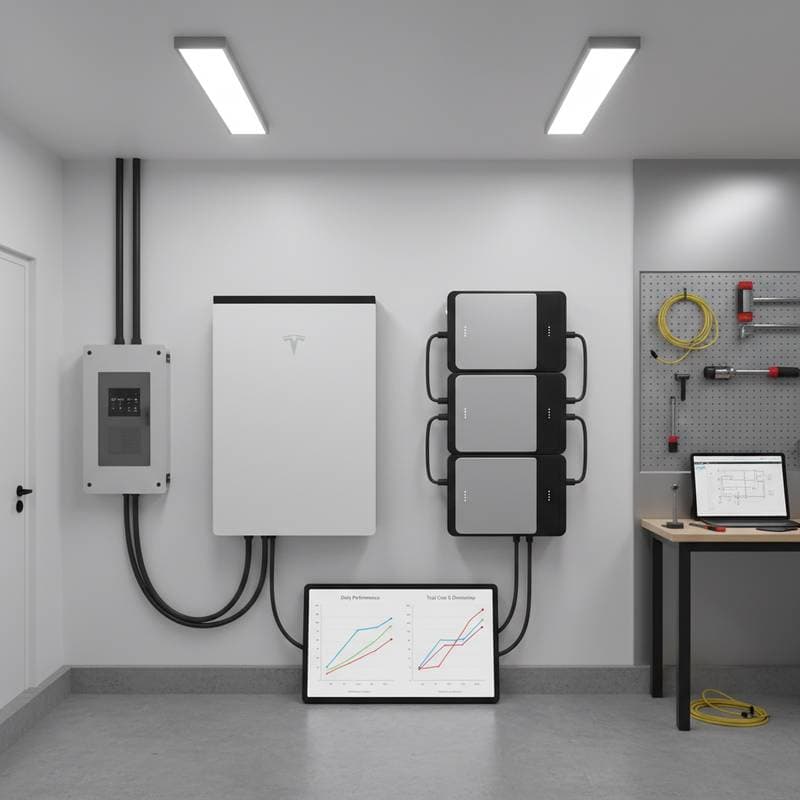
Homeowners Disclose Authentic Costs: Powerwall 3 Versus Enphase IQ
Residential energy storage has shifted from an optional upgrade to a vital component of home infrastructure. Concerns over grid stability and escalating electricity rates have empowered homeowners with greater knowledge of battery performance and financial implications. However, actual ownership expenses frequently diverge from promotional materials. Insights gathered from extensive discussions with installers, distributors, and property owners reveal that Tesla Powerwall 3 and Enphase IQ Battery series offer distinct approaches to home energy storage.
Listed Prices Versus Installed Expenses
Tesla Powerwall 3 attracts notice for its advertised price, frequently regarded as the most economical option available. The narrative shifts with full installation costs. Verified quotes from installers across diverse regions indicate that a complete Powerwall 3 system, encompassing the battery, integrated inverter, and labor, ranges from twelve thousand to sixteen thousand dollars.
Enphase IQ Battery 10T, when paired with the IQ System Controller, typically installs for thirteen thousand to seventeen thousand dollars. Initial differences seem minor, yet underlying cost frameworks vary significantly. Enphase modularity permits gradual capacity increases, whereas Tesla Powerwall 3 demands a substantial initial outlay for its integrated unit.
A Midwest installer summarized the matter: “Tesla’s price per kilowatt-hour appears attractive initially, but incorporating the gateway, labor, and electrical modifications results in costs comparable to Enphase.” This perspective prevails among many professionals. Variations often stem from property specifics, regulatory approvals, and requirements for backup circuits.
Capacity and Usable Energy Output
Powerwall 3 delivers approximately thirteen point five kilowatt-hours of usable capacity per unit, alongside a continuous output of eleven point five kilowatts. These specifications mark a notable advancement from prior Tesla models, which necessitated separate inverters. The built-in hybrid inverter streamlines setup and lowers component expenses.
Enphase IQ Battery 10T supplies about ten point five kilowatt-hours of usable energy, with a continuous output of three point eight kilowatts. Additional units can combine for expanded systems, and the Enphase setup provides redundancy. Should one battery malfunction, remaining units function autonomously.
This scalability appeals to numerous owners. An Arizona resident shared, “I began with one IQ battery and incorporated another after six months. The process proved straightforward, requiring no other replacements.”
Tesla’s unified design offers less adaptability for growth. Each Powerwall functions as a standalone large device, where expansion involves acquiring a full new unit. Certain households value this straightforwardness, though others find it constrains personalization.
Compatibility with Solar Installations
Tesla maintains a proprietary ecosystem. Powerwall 3 integrates effortlessly with Tesla solar inverters and monitoring software. Such cohesion proves reliable, yet it limits pairings with non-Tesla inverters. Installers note Tesla’s strategy increasingly favors comprehensive system acquisitions over hybrid setups.
Enphase emphasizes broad interoperability, particularly with its microinverter lineup. The IQ Battery links seamlessly to Enphase microinverters and the Enlighten monitoring application. A centralized software layer enables comprehensive oversight of generation, storage, and usage.
This openness enhances user satisfaction for Enphase. Tesla’s application presents a polished yet basic interface, trading detailed controls for ease of navigation.
Practical Efficiency and Backup Performance
Round-trip efficiency represents an overlooked element in overall expenses. Both products claim over ninety percent efficiency, but owner-gathered data provides finer details.
In a California suburban residence, a Powerwall 3 achieved eighty-eight percent round-trip efficiency across six months. The owner attributed losses primarily to partial discharges and transitions between grid and backup modes.
Enphase reports align closely, with efficiencies from eighty-six to ninety percent influenced by setup and environmental factors. Lower per-unit output in Enphase leads to deeper cycling, potentially diminishing efficiency slightly while maximizing accessible reserves for users.
During outages, both activate promptly. Tesla achieves near-instantaneous switching, whereas Enphase’s microgrid formation may require seconds based on controller settings. In reality, each sustains essential loads without significant interruption.
Warranty Coverage and Enduring Worth
Tesla extends a ten-year warranty featuring unlimited cycles for self-use scenarios, subject to throughput restrictions in alternative applications. Enphase matches the ten-year duration, limited to four thousand cycles or a defined energy throughput.
Interpreting warranty terms poses challenges, and resolution outcomes differ. Interviewed owners praised Tesla’s support overall, though some encountered delays in claim processing. Enphase typically routes service via installers, facilitating efficiency for clients with maintenance agreements.
Financially, warranted cost per kilowatt-hour aligns between options. Tesla may advantage daily cycling uses, while Enphase modularity mitigates future replacement expenses.
Setup Process and Maintenance Encounters
Tesla employs certified installers or internal teams for deployments. Standardization ensures consistency, but inflexibility hampers adaptations. Electricians often favor Enphase for its accommodating nature. Compact units simplify mounting and accommodate varied site constraints.
A Texas-based experienced installer remarked, “Tesla demands strict adherence to protocols. Enphase permits adjustments for complex arrangements or future expansions without system overhauls.”
Such versatility frequently cuts labor for retrofits. In new builds, Tesla’s cohesive approach excels, particularly alongside Tesla solar components.
Software Features and Energy Optimization
Software for energy control emerges as a key differentiator. Tesla emphasizes user-friendliness. The application displays charge status, solar output, and flow dynamics through intuitive visuals. It adjusts automatically for self-consumption or reserves per preferences.
Enphase provides sophisticated options. Owners configure backup priorities, schedule charging and discharging, and track individual microinverters. Tech-oriented users or those under time-based rates benefit from such precision, yielding tangible reductions.
A Florida owner transitioning from Powerwall 2 to Enphase IQ noted, “Tesla offered simplicity, but lacked customization. Enphase allows precise programming of charge and discharge times. The extra involvement yields about fifteen percent bill savings.”
Brand Reputation and Market Dynamics
Tesla’s prominence influences decisions profoundly. Purchasers select Powerwall for its familiarity and innovative legacy. This confidence translates to tangible benefits, despite comparable technical attributes to rivals.
Enphase earns trust among installers via dependable products and support. For clients guided by professionals, this endorsement holds significance. Contractors frequently recommend Enphase, citing ongoing software enhancements and communication without hardware disruptions.
Sustainability and Grid Support Factors
Both firms position their offerings as contributors to grid resilience and renewable integration. Actual ecological impact hinges on usage patterns. Systems promoting greater solar self-consumption alleviate peak grid loads, fostering efficient clean energy utilization.
Selecting and Implementing Your Storage Solution
Homeowners assessing batteries should examine beyond base prices for precise evaluations. Labor for installation, electrical enhancements, and software alignments shape total ownership costs. Tesla Powerwall 3 suits preferences for straightforward operation, elegant aesthetics, and robust single-unit power.
Industry observation underscores that optimal selections align with intended interactions rather than isolated specs. Prioritize rapid setup and minimal complexity? Tesla provides a refined pathway.
These advancements affirm residential storage as reliable technology. Rivalry between Tesla and Enphase accelerates progress, refines economics, and enhances grid connectivity.