
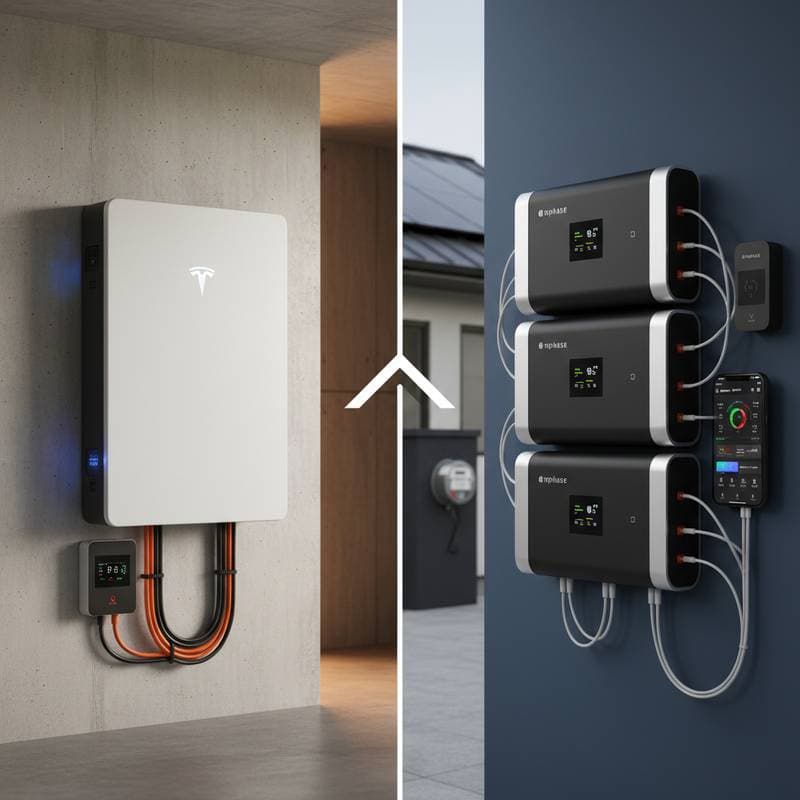
Tesla Powerwall 3 vs Enphase IQ5: Uncovering the True Costs
The residential energy storage market now emphasizes practical economics over initial excitement. Homeowners seek comprehensive cost breakdowns for solar-plus-storage systems. Tesla Powerwall 3 and Enphase IQ5 represent contrasting approaches to value in home energy solutions, prompting detailed comparisons beyond surface-level prices.
Experienced observers of the U.S. solar and storage sector note a shift from brand-driven purchases to data-informed decisions. Buyers now evaluate round-trip efficiencies, inverter compatibility, labor expenses, and software capabilities with precision. An examination of Powerwall 3 and IQ5 specifications reveals nuances that influence long-term ownership.
Tesla Powerwall 3: Integrated Design for Streamlined Setup
Tesla Powerwall 3 introduces an integrated solar inverter within the battery unit, a notable evolution from Powerwall 2. This configuration accepts direct current from solar panels, removing the requirement for a standalone string inverter. Installers benefit from fewer components, reduced wiring complexity, and potentially halved installation duration.
The unit provides 13.5 kilowatt-hours of usable energy, matching its predecessor, alongside a continuous output of 11.5 kilowatts. This capacity supports multiple household loads concurrently. Lithium iron phosphate cells enhance safety and thermal stability compared to prior nickel-manganese-cobalt variants, promoting extended cycle life and lower fire risks.
The inverter handles up to 20 kilowatts of direct current input from solar arrays and incorporates a gateway for backup management. The wall-mounted, weather-resistant design suits outdoor placement. Tesla addresses past field challenges, resulting in a refined product that impacts overall system economics.
Enphase IQ5: Modular Flexibility for Existing Systems
Enphase IQ5 adheres to a microinverter-centric, modular framework. Each battery module includes its own microinverter for alternating current coupling with diverse solar setups. This feature proves essential for retrofitting older arrays without inverter replacement.
A single IQ5 unit offers 5 kilowatt-hours of usable capacity and 3.8 kilowatts continuous output. Paralleling units scales capacity and power as needed. While modularity enables customization, it increases hardware and labor demands due to additional electronics and connections per module.
Enphase software excels in detailed monitoring through its app, displaying per-module data, load management, and grid service options where available. Tesla's interface prioritizes simplicity over granular metrics. Such distinctions may justify modest price premiums for users valuing transparency.
Analyzing Installed Costs
Manufacturer-listed prices often obscure full expenses. Tesla quotes Powerwall 3 hardware at approximately $10,000, typically bundled with installation via its solar division. Independent reports indicate total costs, including permits, labor, mounting, and ancillary materials, range from $12,000 to $15,000 per unit.
Enphase IQ5 modules price at about $4,000 each; three units match Powerwall 3 capacity, totaling $12,000 in hardware alone. Multi-module installations elevate labor, particularly with panel upgrades or extended wiring. Equivalent setups often cost $16,000 to $18,000 installed.
Tesla edges out on cost per kilowatt-hour for new installations, as the built-in inverter saves $3,000 to $5,000 on separate equipment. Retrofit scenarios favor Enphase's alternating current coupling, preserving existing inverters and avoiding redundant purchases.
Efficiency and Operational Performance
Round-trip efficiency quantifies energy recovery after storage. Powerwall 3 achieves 90 percent in standard conditions. Enphase IQ systems, due to alternating current coupling, reach 85 percent. This gap accumulates over repeated cycles, affecting long-term savings.
Enphase modularity permits partial functionality during unit failures, unlike Tesla's all-or-nothing design. Tesla's superior power delivery suits whole-home backups, including high-demand appliances like HVAC or electric vehicle chargers. Enphase may necessitate load prioritization to prevent overloads.
Practical Installation Considerations
Installers appreciate Powerwall 3's unified design for quicker wiring and activation. However, Tesla ecosystem restrictions limit access to certified professionals only, complicating independent work. Lead times for parts and support vary, especially outside urban areas.
Enphase fosters broader accessibility through certified distributors. Standard alternating current wiring integrates seamlessly with microinverter systems. This openness aids scheduling and maintenance, appealing to contractors seeking autonomy.
Software Features and User Control
Tesla's application visualizes solar production, battery status, and consumption patterns effectively. It automates optimizations for time-of-use pricing, reserve levels, and self-consumption. Remote firmware updates enhance usability without on-site interventions.
Enphase platforms deliver module-specific insights, including inverter diagnostics and outage prioritization. Expanded load controls support appliance sequencing. While informative, the depth may challenge less technical users.
Enphase integrates readily with virtual power plants, enabling utility aggregation for grid support and participant incentives. Tesla offers comparable features in limited regions via proprietary channels.
Achieving Reliable Backup Power
Backup capability influences total investment perceptions. A single Powerwall 3 manages essential loads such as refrigeration, lighting, and minor cooling. Dual units cover medium homes comprehensively. Enphase requires multiple modules to match sustained outputs, increasing setup intricacy.
Seamless outage transitions add intangible resilience benefits. Tesla's gateway ensures millisecond switchovers, safeguarding electronics. Enphase matches this with balanced configurations. Both qualify for federal tax credits, reducing costs by about 30 percent when solar-paired.
Longevity and Maintenance Factors
Lithium iron phosphate construction yields over 10,000 cycles for both systems, supporting more than a decade of daily use. Warranties cover cycles or throughput limits. Service differs: Tesla centralizes support via app-scheduled visits, efficient in populated zones but slower remotely.
Enphase leverages installer networks for prompt responses, though quality varies locally. Modular replacement minimizes downtime compared to full-system repairs.
Insights from Homeowners and Installers
Feedback from users and professionals underscores integration versus customization. Tesla garners praise for effortless operation and aesthetics, tempered by configuration limits. Enphase users value adaptability and insights, offset by higher initial outlays.
A California installer observed, "Tesla wins on simplicity, Enphase wins on control." This perspective frames the decision: Powerwall 3 as a set-it-and-forget-it solution, IQ5 as an expandable network element. Selection hinges on desired management involvement.
Selecting Your Optimal Home Battery
Evaluate your solar setup, retrofit needs, and monitoring preferences to determine the best fit. Tesla Powerwall 3 suits new builds seeking cost-effective power. Enphase IQ5 excels in flexible, data-driven environments. Both advance energy independence; the ideal choice maximizes your household's efficiency and reliability.