
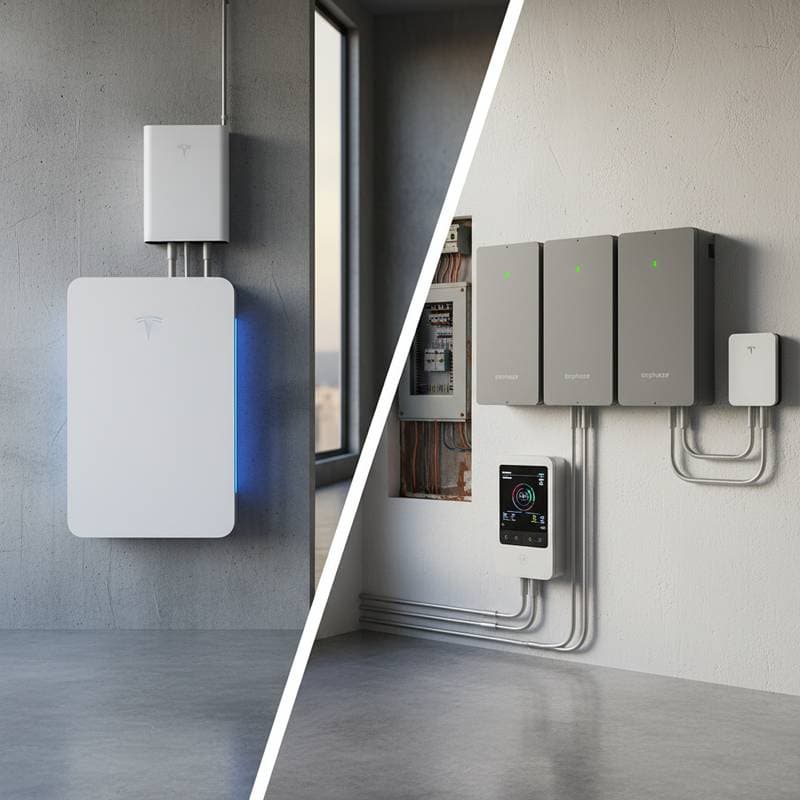
Tesla Powerwall 3 vs. Enphase IQ5: In-Depth Performance Comparison
Recent performance evaluations have compared the Tesla Powerwall 3 and Enphase IQ5 directly. These tests, performed in residential settings across California and Arizona, provide installers and homeowners with insights into real-world operation. Metrics included discharge efficiency, round-trip energy retention, response times, and grid support features. The findings reveal two sophisticated systems tailored to varying needs, each with unique implications for installers, distributors, and utilities.
Core Specifications and Design
The Tesla Powerwall 3 delivers 13.5 kWh of usable capacity and a continuous output of 11.5 kW when integrated with Tesla's inverter. As a DC-coupled system, it pairs seamlessly with Tesla solar panels to minimize energy conversion losses. The unit features an IP67-rated, wall-mounted enclosure suitable for indoor or outdoor use. Its built-in inverter removes the need for additional hybrid components, which streamlines setup for electricians and engineering, procurement, and construction firms.
In comparison, the Enphase IQ5 adopts an AC-coupled, modular architecture. Each 5 kWh module contains its own microinverter, enabling expansion in 5 kWh steps. A standard home setup might incorporate two or three units to achieve 10 to 15 kWh total capacity. This design simplifies retrofits with diverse existing solar inverters. The IQ5 units carry an IP55 rating and support floor or wall mounting.
Both employ lithium iron phosphate batteries, valued for thermal stability and extended cycle life. Tesla arranges its modules vertically inside the enclosure, whereas Enphase offers stackable options for versatile placement in spaces like garages.
Installation and Mounting
Installers appreciate the Powerwall 3's rapid deployment, though its weight and integrated components demand careful maneuvering. The Tesla Gateway 3 manages grid ties, load distribution, and backup transitions. Field reports indicate four to six hours for installing and commissioning a single unit via the Tesla app.
The IQ5's modularity prolongs initial setup marginally but permits single-technician handling of units. Integration occurs through the Enphase IQ System Controller 3 for grid isolation and load oversight. Regional installer feedback highlights reduced maintenance over time, particularly for future capacity additions.
Chris Johnson, operations director at SolarCraft Energy in Tempe, noted, "The Tesla system installs quicker in full Tesla solar configurations. The Enphase IQ5 excels when retrofitting storage onto non-Tesla PV arrays."
Efficiency and Power Output Test Results
Tests exposed key efficiency differences. The Powerwall 3 attained 91 percent round-trip efficiency, benefiting from DC coupling and unified inversion. The IQ5 reached 88 percent, a standard for AC-coupled setups involving dual DC-AC conversions.
The Powerwall 3 sustained 11.5 kW continuous power, surpassing the IQ5's 7.5 kW from three modules. However, the IQ5 showed stronger efficiency at partial loads, ideal for consistent low-demand scenarios like nighttime use rather than high-power surges.
The Powerwall 3 also reacted more swiftly to grid frequency shifts, logging 180 milliseconds of inverter latency against the IQ5's 250 milliseconds. Such differences, though minor, affect eligibility for grid service incentives tied to response speed.
Backup and Load Management
Each system enables whole-home backup, yet their methods vary. The Powerwall 3 handles full-home support natively if loads stay within inverter limits. Its integrated inverter and Gateway facilitate direct circuit control.
The IQ5, paired with the IQ System Controller 3, permits precise load segmentation for essential circuits only. This approach conserves capacity and prolongs runtime. Tests demonstrated the IQ5 sustaining a 6 kWh load for almost ten hours, compared to eight hours of full-home operation from the Powerwall 3 under matching conditions. Enphase's circuit isolation accounted for the extended duration.
In outage simulations, both switched to backup in under one second, protecting devices without user input. Grid restoration occurred automatically upon service resumption.
Software and Monitoring
Tesla's app unifies oversight of solar production, storage, and vehicle charging. The Powerwall 3 links to Tesla's virtual power plant network, enabling grid contributions in select areas. Algorithms optimize for self-use, reserves, or export based on rates.
Enphase's platform integrates via the Enphase App and Enlighten portal for time-of-use adjustments, diagnostics, and updates. It offers detailed module insights and energy visualizations. While Tesla prioritizes simplicity, Enphase delivers deeper analytics.
Lisa Chen, senior analyst at Clean Energy Research Group, observed, "Tesla's software fosters ecosystem synergy, whereas Enphase enhances installer oversight for varied deployments."
Business Implications for Installers and EPCs
Selecting between these systems affects installer finances. Tesla mandates certification, confining access to approved partners and safeguarding quality at the expense of broader availability.
Enphase distributes via channels like CED Greentech and BayWa r.e., broadening contractor reach. Modularity encourages repeat services for expansions and monitoring. Feedback indicates higher ongoing revenue from Enphase projects.
Costs vary: The Powerwall 3 package exceeds equivalent IQ5 setups, but integration cuts extras like separate inverters. For engineering firms handling portfolios, Tesla suits uniform designs, while Enphase accommodates hybrids, impacting timelines, permits, and interconnections.
Grid Services and Policy Context
Rising focus on distributed resources boosts battery relevance for grid stability. Tesla's virtual power plants in various states compensate users for peak contributions. Enphase advances IQ5 qualification via its Grid Services unit.
Policies on domestic content shape choices. Tesla's U.S. assembly satisfies incentives; Enphase's Mexico-based production with U.S. elements may limit some rebates.
Industry consultant Mark Alvarez commented, "Content rules will sway decisions. Installers on subsidized jobs must weigh these factors precisely."
Safety, Compliance, and Recycling Considerations
Compliance includes UL 9540 and UL 9540A for fire and thermal risks. The Powerwall 3 uses passive aluminum cooling; the IQ5 employs airflow and sensors. No active cooling simplifies upkeep.
Recycling evolves: Tesla's program reclaims materials internally; Enphase collaborates externally. Ten-year warranties require installers to plan end-of-life handling in service agreements.
Market Outlook and Competitive Dynamics
Residential storage grows with rate changes and EV uptake. Projections show rising solar-battery pairings. Tesla pursues control through integration; Enphase emphasizes compatibility and scaling.
Adoption varies regionally. California's self-consumption rules favor Tesla; Midwest and Northeast retrofits boost Enphase sales.
Distributors stock both to meet needs; utilities gain from aggregated batteries as software advances.
Selecting the Right Storage Solution
Homeowners and installers benefit from aligning systems with specific goals, such as new builds versus retrofits. Evaluate efficiency needs, expansion plans, and local incentives to maximize resilience and savings. Consult certified professionals to tailor installations for optimal performance and cost-effectiveness.