
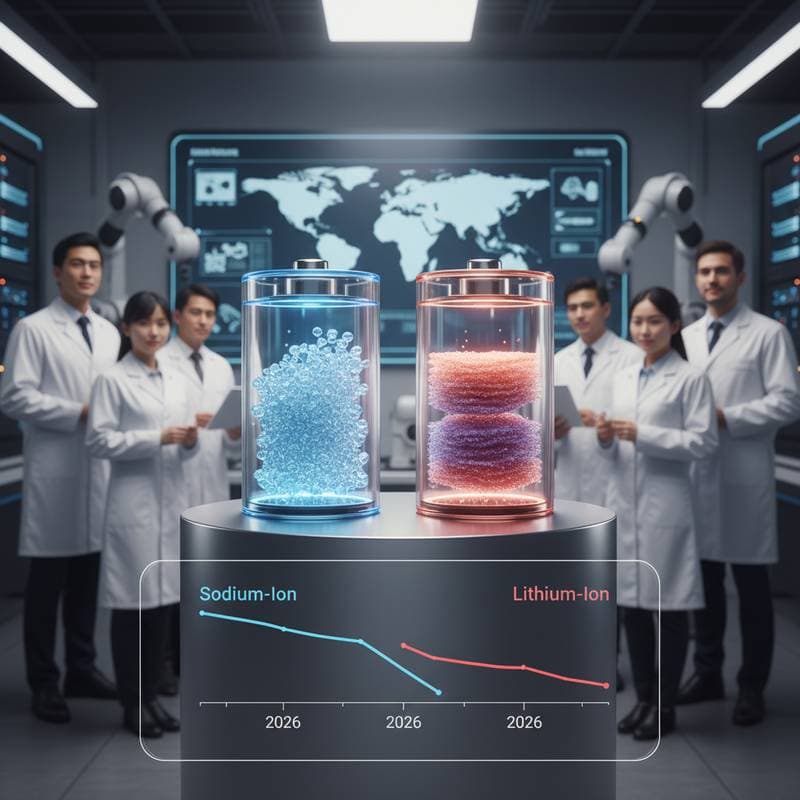
Sodium-Ion Batteries: Cheaper Than Lithium by 2026?
Every few years, the battery industry identifies a new contender that promises to challenge lithium-ion dominance. Sodium-ion batteries currently hold that position. The key question concerns their ability to achieve scale and cost targets that position them as a genuine commercial rival to lithium. Recent developments in China and emerging Western pilot lines indicate this transition may occur sooner than anticipated.
Professionals who have tracked the solar and storage sectors for over a decade observe patterns in such innovations. Nickel-manganese-cobalt variants and solid-state concepts have generated initial enthusiasm, only to encounter hurdles in cost and supply. Sodium-ion batteries stand apart due to their foundation in practical economics and resource availability, rather than speculative performance.
Why Sodium Holds Strong Potential
Sodium ranks among the most abundant elements on Earth. Extraction proves inexpensive, the material remains non-toxic, and distribution spans continents evenly. These traits provide sodium-ion chemistry with a clear strategic edge over lithium, which concentrates in limited regions and experiences price fluctuations. In recent years, lithium carbonate costs have varied widely, introducing uncertainty for battery producers and users in electric vehicles and stationary storage applications.
Sodium-ion cells substitute sodium for lithium in the cathode and electrolyte. The core electrochemical framework mirrors that of lithium-ion batteries. Manufacturers can adapt existing production lines with minimal changes, avoiding the need for extensive reinvestments.
Performance-wise, sodium-ion cells exhibit lower energy density, storing less energy per kilogram than lithium iron phosphate or nickel-rich options. In stationary uses, where weight and space constraints matter less, this limitation becomes negligible. The primary attraction lies in cost reductions, with initial projections indicating double-digit savings at scale.
Factors Shaping the Cost Trajectory
Battery pricing hinges on materials, manufacturing processes, performance metrics, and production volume. Sodium-ion batteries offer strengths in three of these areas.
- Materials: Sodium salts, iron, and manganese cost less and abound more than lithium, cobalt, or nickel. Estimates project raw material savings of 25 to 30 percent under conservative scenarios.
- Manufacturing: Compatibility with modified lithium-ion equipment lowers capital needs and speeds market entry.
- Performance: While energy density lags, cycle life and thermal stability impress. Enhanced safety reduces requirements for elaborate cooling, trimming overall system expenses.
- Scale: Substantial price declines emerge at gigawatt-hour production levels, potentially matching or undercutting current lithium iron phosphate costs.
Analysts predict sodium-ion batteries will reach cost parity with lithium iron phosphate within initial production runs. If lithium prices stay high, some forecast sub-lithium-ion levels before decade's end.
Developments in Practice
Chinese manufacturers have introduced sodium-ion models for compact electric vehicles and grid storage. CATL prototypes show solid cycle life, while various firms commit to large-scale lines. In Europe and the United States, entities like Faradion, Tiamat, and Natron Energy advance pilot projects tailored for grid and industrial needs.
Success depends on progressing from prototypes to reliable high-volume output. Scaling chemistries involves challenges beyond lab validation, including electrolyte uniformity, anode integrity, and moisture management, which impact yields. Sodium-ion producers navigate these obstacles now.
Market conditions favor this timing more than past alternatives. Renewable projects seek affordable storage, and utilities favor options with reduced fire risks and geopolitical dependencies. Sodium-ion addresses these priorities effectively.
Key Chemical Comparisons
Typical sodium-ion designs pair layered oxide cathodes with hard carbon anodes. Research explores Prussian blue variants for elevated voltage and durability. Energy density spans 100 to 160 watt-hours per kilogram, 20 to 40 percent below lithium iron phosphate. Cold-weather operation excels, outperforming lithium-ion efficiency in low temperatures.
Safety profiles shine brighter. Sodium-ion resists thermal runaway better, easing designs for containerized systems and lowering fire mitigation costs. An engineer at a recent industry event described it as a trade-off: modest energy gains for substantial reliability benefits.
Stakeholder Perspectives and Market Preparation
Automotive leaders monitor progress intently. Sodium-ion suits urban vehicles or hybrids over long-range models, given density constraints. Stationary storage presents stronger opportunities, where cost per kilowatt-hour and safety outweigh density.
Funding flows to venture-supported teams expanding pilots, with lithium giants diversifying into sodium research. Capturing 10 percent of stationary storage could alter supply dynamics profoundly.
This scenario recalls lithium iron phosphate's ascent, initially overlooked for performance yet securing roles through safety, affordability, and endurance. Sodium-ion may trace a parallel path.
Implications for Affordable Energy Storage
Large-scale sodium-ion production in coming years could lower storage costs industry-wide, boosting solar-plus-storage feasibility in lithium-sensitive markets. Diversified chemistries enhance energy security amid supply concerns.
Progress stems from real advancements, underscoring the need for varied technologies. The challenge lies in converting prototypes to dependable supply, a process familiar from lithium-ion's evolution from obscurity to ubiquity.