
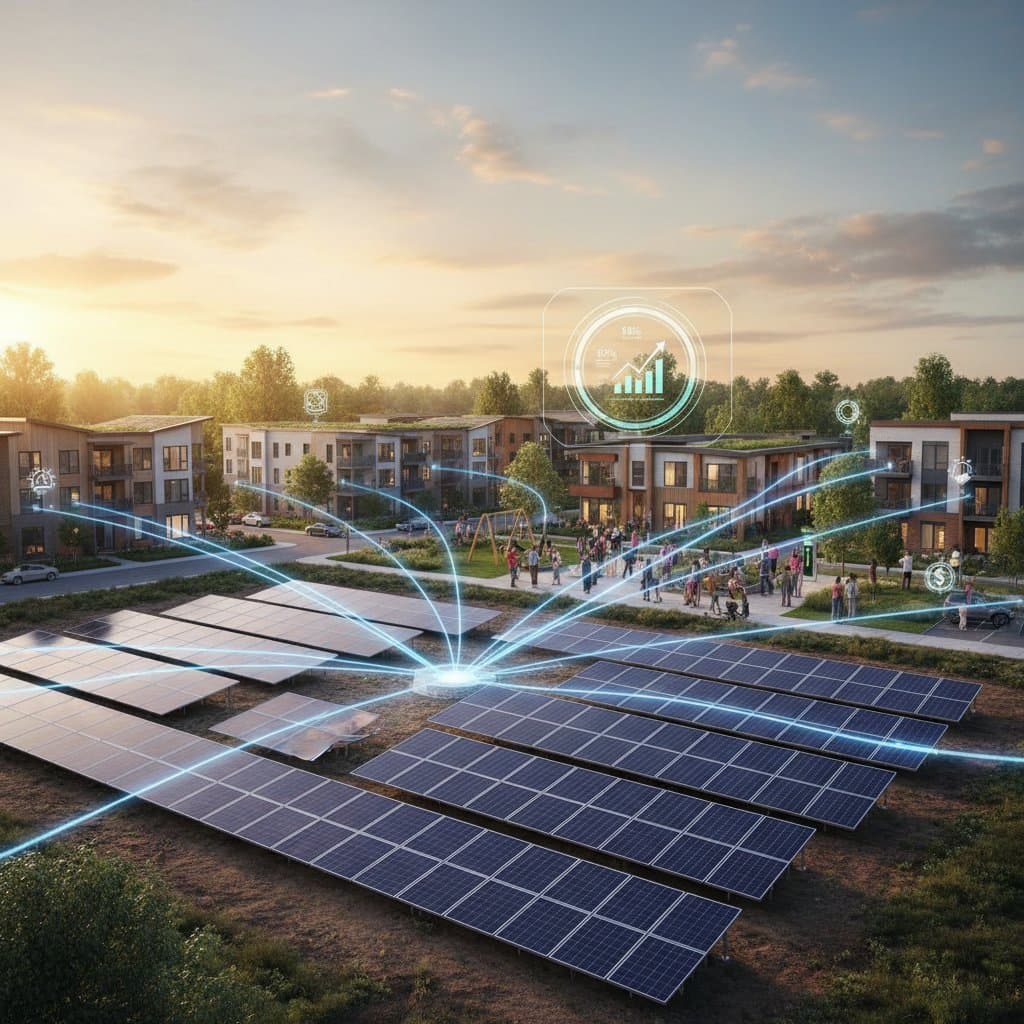
How Virtual Net Metering Enables Neighbors to Share Solar Savings
Virtual net metering transforms community access to solar power by permitting multiple users to divide energy credits from a centralized renewable installation. Participants benefit even without personal rooftop panels, making the system ideal for renters, condominium residents, and properties hindered by shade or structural limits. This framework broadens solar involvement, facilitates cost distribution, and integrates more individuals into the renewable energy sector.
Understanding the Mechanics of Virtual Net Metering
Traditional net metering credits the panel owner for excess electricity fed back to the grid, which offsets their utility bill. Virtual net metering builds on this by allocating those credits across various accounts based on each user's subscribed share or ownership stake.
Solar arrays often occupy spaces like apartment rooftops, parking lot canopies, or dedicated land parcels. Generated power enters the grid, where utilities monitor output and apply proportional credits to participant bills. Billing software handles allocations seamlessly, ensuring straightforward and verifiable savings distribution.
Expanding Solar Access for Diverse Users
Rooftop installations prove unfeasible for numerous households due to tenancy restrictions or site-specific obstacles like shading. Virtual net metering decouples generation from consumption sites, allowing benefits from remote systems within the utility's service area.
This setup spurs community solar initiatives among affordable housing operators, municipalities, educational institutions, and nonprofits, which reduce expenses for residents and members. Smaller users gain entry without bearing full system costs, leveraging collective scale for installation efficiencies and shared upkeep responsibilities.
Financial Advantages and Equitable Savings Distribution
Virtual net metering promotes fairer solar benefits by including renters and lower-income families alongside property owners. Larger-scale projects achieve reduced costs per watt, with maintenance fees spread across subscribers.
Utilities credit accounts using verified production figures, typically at retail rates or close equivalents per regional guidelines. Subscribers enjoy bill reductions, while project operators secure steady income via extended subscriptions. Such dynamics enhance affordability for users and financial viability for initiatives.
Programs frequently reserve capacity for income-eligible participants, fulfilling social mandates and broadening renewable reach. These elements amplify value beyond mere economics, supporting community well-being.
Policy Frameworks and Operational Approaches
State or utility policies underpin virtual net metering, outlining credit computations, transfers, and allocations. Established community solar regulations provide structure, while pilots or tariffs deliver comparable outcomes in other areas. Frameworks prioritize equity, grid stability, and streamlined administration.
Developers typically enroll subscribers and designate shares with the utility, which processes monthly credits from production records. Users may modify or end subscriptions under specified conditions, accommodating evolving needs. Programs often extend to non-residential entities like businesses or public facilities.
Regulators refine pricing to capture distributed energy's worth, including savings on transmission, losses, and emissions. Consistent policies draw funding and shield users from volatility.
Supporting Technologies and Data Handling
Precise metering and data systems form the backbone of virtual net metering. Dedicated meters capture real-time generation, feeding information to utilities and operators for accurate share calculations and performance assessments.
Automated platforms minimize paperwork, enhancing participant transparency. Online portals let subscribers view credits, track output, and assess ecological impacts, fostering involvement and reliability.
Data security protocols protect sensitive billing and personal details. Investments in fortified systems ensure privacy alongside effective energy tracking.
Fostering Partnerships Among Stakeholders
Effective projects emerge from alliances between developers, utilities, and local groups. Developers oversee design, funding, and building; utilities integrate billing and credits; organizations drive recruitment and tailor outreach to varied demographics.
Open dialogue establishes trust through defined agreements and reliable calculations. Local insights from community partners pinpoint high-impact participants, especially in marginalized zones. These collaborations yield inclusive programs with tangible reductions.
Certain utilities offer simplified enrollment, where users select nearby projects online and begin crediting without extensive forms. This ease boosts uptake in homes and businesses alike.
Enhancing Grid Reliability and Market Growth
By spreading generation sites, virtual net metering bolsters grid strength, easing transmission loads as local supply meets nearby demand. This localization aids renewable blending and consumption alignment.
Utilities address integration via refined forecasting, accounting, and connections. Standardized processes and cost mechanisms adapt the grid for hybrid resources.
Market-wise, the model invites investors, generates jobs, and spurs design advances. Blended subscriber projects stabilize finances and ensure enduring viability.
Addressing Design and Implementation Hurdles
Fair credit valuation poses ongoing debates; excessive rates risk utility losses borne by others, while insufficient ones deter investment. Solutions link values to peak timing or site advantages, incentivizing beneficial output and congestion relief.
Stakeholder input and clear processes maintain balance. Education efforts clarify mechanics and enrollment, using accessible explanations and case studies to elevate awareness and join rates.
Building a Collaborative Solar Future
Virtual net metering provides a viable route to solar inclusion sans individual setups, linking communities through shared renewables. It dismantles obstacles, optimizes expenses, and deepens local commitment to clean energy.
Advancing this requires unified efforts from regulators, utilities, developers, and advocates via efficient rules, clear accounting, and broad engagement. Widespread adoption promises amplified gains: lower costs, robust infrastructure, and thriving locales.
Through collective solar sharing, communities advance energy justice and endurance, crafting an accessible, economical renewable landscape.