
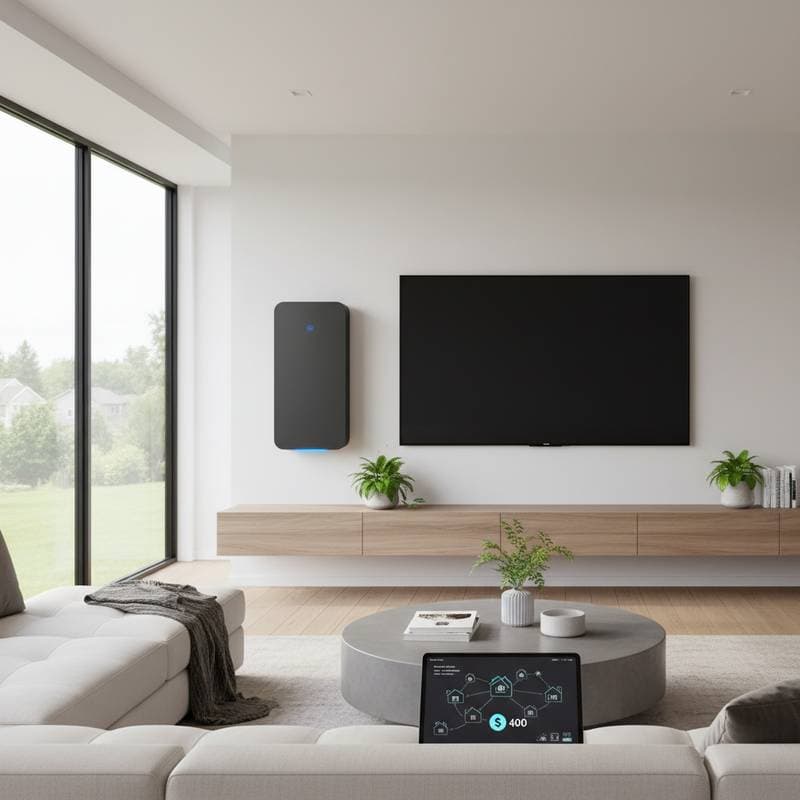
Unlock $400 Annual Earnings from Your Home Battery with Virtual Power Plants
Earning income from a home battery system represents a practical advancement in residential energy management. In various U.S. markets, utilities and energy providers offer programs that integrate residential batteries into virtual power plants, or VPPs. These initiatives compensate homeowners for sharing a portion of their stored energy to bolster grid stability. Depending on factors such as battery capacity, local regulations, and market dynamics, a typical household can expect around $400 in annual earnings.
Distributed energy resources have evolved significantly, with residential storage now functioning as a viable grid asset. Battery manufacturers and software developers have long envisioned networks of home systems operating as coordinated units. Today, this concept operates in multiple states, where utilities leverage these resources to enhance reliability and efficiency.
Understanding Virtual Power Plants
A virtual power plant aggregates distributed energy assets, such as home batteries, smart thermostats, and solar panels, into a unified, controllable resource. Advanced software enables operators to manage these devices collectively, responding to grid fluctuations by drawing minimal power from each participant. This aggregation creates a flexible supply that mimics traditional power plants without the need for centralized infrastructure.
Homeowners participate by granting access to a limited share of their battery's capacity during specified events. In return, they receive monetary payments or utility bill credits. Programs typically preserve sufficient reserve energy for personal use, ensuring backup power remains available during outages.
Breaking Down the $400 Earnings Estimate
The $400 annual figure derives from established VPP programs nationwide and accounts for real-world participation. Compensation structures vary, with some offering fixed monthly stipends and others tying rewards to actual energy contributions. Certain programs also provide enrollment incentives that reduce upfront battery costs.
Consider this breakdown of common payment elements:
- Capacity Compensation: Utilities pay for the availability of your battery during potential grid needs, often $5 to $10 per kilowatt monthly.
- Energy Dispatch Rewards: Additional earnings accrue when your battery discharges power, calculated per kilowatt-hour delivered.
- Reliability Incentives: Programs may offer bonuses for prompt and consistent responses to grid signals.
For a standard 10- to 15-kilowatt-hour battery, these elements combine to yield several hundred dollars yearly. Larger systems or regions with frequent events can produce even greater returns.
Utilities' Rationale for Compensating Home Batteries
Utilities view VPPs as a cost-effective alternative to constructing expensive peaker plants, which activate only during high-demand periods. Distributed storage allows deferral of major infrastructure investments and reduces reliance on high-cost fossil fuel generation. This strategy aligns with regulatory mandates in many states to incorporate distributed resources into grid planning.
Grid operators recognize the value in sourcing power from customer sites, avoiding premium generation expenses. Such approaches enhance economic efficiency while advancing environmental goals by optimizing existing renewable integrations.
Essential Software for VPP Operations
Sophisticated software forms the core of VPP functionality, tracking grid conditions, battery status, and user settings in real time. During events, it directs participating batteries to release targeted amounts of energy briefly. Homeowners experience this as an automated process, often learning of their contribution only through subsequent reports or payments.
Providers like Tesla, Sunrun, and Enphase deploy specialized platforms to orchestrate these networks. These tools have progressed from basic demand management to active participants in energy markets, enabling bids for grid services.
Regions Leading VPP Adoption
VPP programs thrive in areas with robust solar penetration and progressive policies, including California, Vermont, Massachusetts, and select Midwest locations. Utilities in the Southeast and Southwest are launching pilots to test similar frameworks.
Regional variations highlight diverse implementation strategies. Some utilities manage dispatches directly, while independent aggregators handle customer fleets and market capacity. Despite these differences, the economic incentives consistently favor distributed energy contributions to the grid.
Maintaining Backup Reliability Alongside Grid Support
A frequent concern involves whether VPP involvement affects personal power security. Well-structured programs address this by permitting users to define minimum reserve thresholds. For instance, individuals can allocate 30 percent of capacity for emergencies, reserving the rest for grid use.
This setup ensures dual benefits: financial rewards without undermining home resilience. Such designs underscore the model's appeal in balancing individual and communal energy objectives.
Key Challenges in VPP Participation
VPP programs present hurdles, including varied contract durations that may span multiple years. Participants must review terms to confirm control over battery operations. In certain areas, earnings may qualify as taxable income rather than nontaxable rebates.
Compatibility issues arise with older battery models, potentially requiring firmware upgrades or hardware additions. Newer systems, however, incorporate VPP-ready features like standardized protocols from the outset.
Effective participant outreach remains vital, as many view batteries solely as outage protections. Utilities emphasizing transparent explanations achieve stronger engagement.
Implications for Distributed Energy Markets
The emergence of battery income streams signals a paradigm shift, positioning storage as a revenue source rather than a mere expense. Early solar-plus-storage promotions focused on independence and durability. Current developments emphasize market integration, where homes contribute to broader energy ecosystems.
This evolution influences grid architecture, favoring neighborhood-based resources over expansive builds. Coordinated distributed capacity offers economic and ecological advantages, reshaping power delivery.
Operational VPP Programs in Action
Active initiatives provide concrete examples of VPP success. Vermont utilities credit participants monthly for peak-event access to batteries. In California, aggregators coordinate residential fleets for wholesale market involvement. Community cooperatives in other areas pool earnings from collective grid support.
These cases confirm the model's viability, with tangible outcomes in payments and grid performance. Expansion continues as technology and policies align.
Steps to Integrate Your Battery into a VPP
Current battery owners can explore local utility websites or aggregator platforms to identify available programs. Enrollment typically involves verifying system compatibility and signing participation agreements. Those planning installations should prioritize VPP-enabled models to maximize returns.
As costs decline and integrations simplify, VPP involvement will enhance the value proposition of home storage. This pathway not only recoups investments but also supports a sustainable energy landscape.