
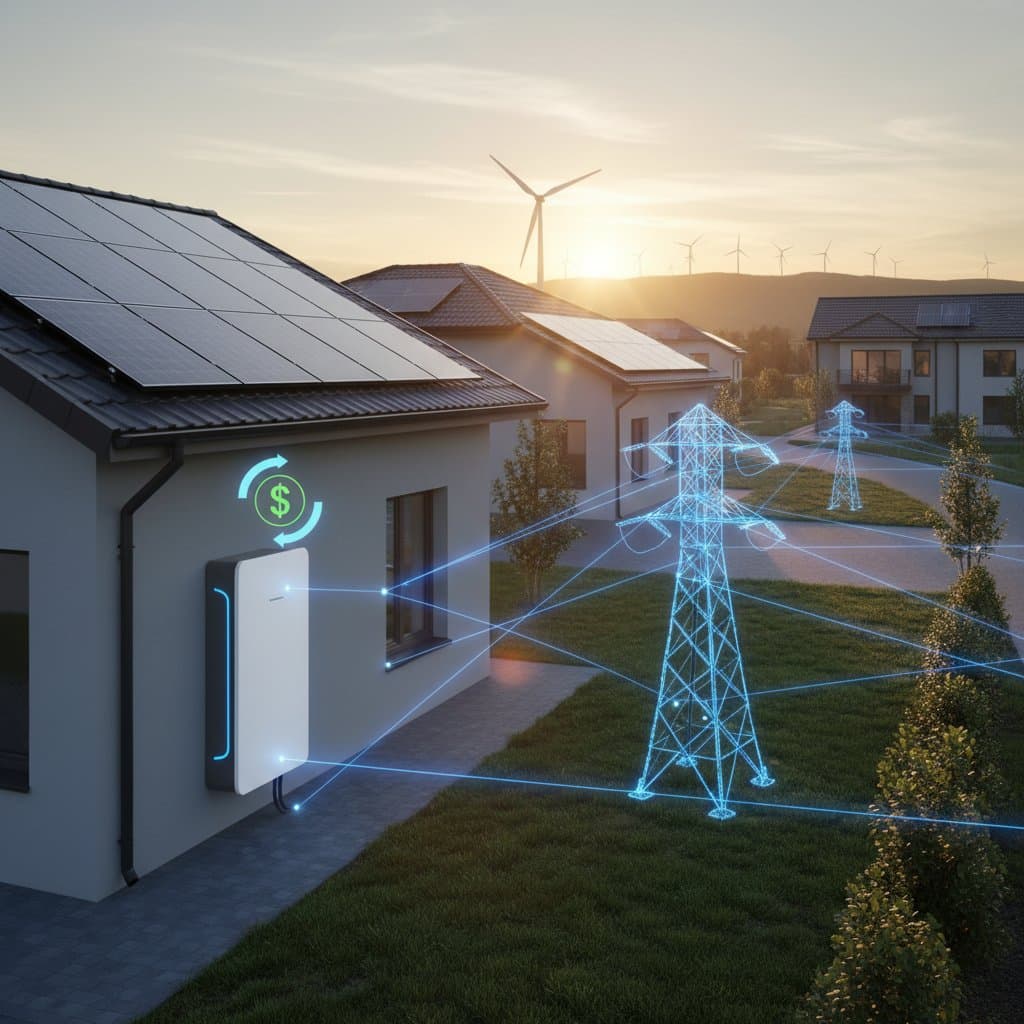
Earn Up to $400 Annually by Renting Your Home Battery to Virtual Power Plants
Homeowners equipped with solar-plus-storage systems now have an opportunity to generate consistent income through participation in virtual power plants (VPPs). These platforms link distributed battery resources via advanced software, enabling utilities and grid operators to access stored energy precisely when demand peaks. Enrollment in a VPP allows a household to receive about $400 per year in exchange for discharging a modest amount of energy to support the grid.
This setup converts residential batteries into revenue-producing components while bolstering overall grid resilience. Utilities increasingly adopt this model to manage the variability of renewable energy sources and fluctuating demand, fostering rapid expansion across regions.
How Virtual Power Plants Operate
A virtual power plant functions as a centralized digital system that pools numerous small-scale energy assets, including home batteries, rooftop solar panels, and electric vehicles. During times of grid stress, the VPP coordinator directs minimal energy releases from participating units. Collectively, these releases mimic the capacity of a conventional power station.
Homeowners maintain full oversight of their systems at all times. Customizable settings determine the volume of energy available for sharing, the frequency of activations, and the minimum reserves preserved for personal consumption. The entire process unfolds seamlessly via encrypted software that interfaces the battery management system with the VPP network.
Utilities compensate participants similarly to how they reimburse large-scale facilities for essential services. Distributions occur based on the quantity of energy provided and the specific grid benefits delivered. Programs commonly provide yearly credits or direct payments, typically amounting to several hundred dollars for each household.
Earning Potential and Payment Structures
An average household stands to gain roughly $400 each year from offering battery capacity to a VPP. Earnings fluctuate according to battery size, regional electricity tariffs, and the intensity of local grid requirements. Systems with greater capacity or in areas prone to high-demand episodes often yield superior financial outcomes.
Programs employ varied compensation approaches. Certain initiatives deliver fixed yearly stipends upon enrollment, whereas others base rewards on individual dispatch instances or kilowatt-hours contributed. Peak-time contributions command premium rates under time-of-use frameworks, amplifying potential returns.
For participants, this income supplements solar-related cost reductions without supplanting them. The extra funds help amortize the upfront expense of battery installation, elevating the long-term value of sustainable energy solutions. Accumulating payments over time can offset a substantial share of the storage system's total price.
Advantages Extending Past Financial Gains
Beyond monetary rewards, VPP involvement yields significant value for users and the broader energy infrastructure. Residential batteries alleviate pressure on transmission lines, avert potential disruptions, and decrease dependence on expensive fossil-fuel backups. They also optimize renewable output by capturing surplus solar or wind energy for deployment during essential periods.
Homeowners experience targeted improvements, such as:
- Accelerated return on battery investment via reliable yearly earnings
- Strengthened regional power reliability to curb outages and voltage dips
- Active role in promoting sustainable energy by facilitating renewables
- Hands-off functionality that demands no routine intervention
Safeguards ensure user priorities remain intact. Agreements delineate maximum discharge limits and activation intervals, guaranteeing sufficient energy for home use. Participants hold the option to pause involvement as circumstances evolve.
Eligibility Requirements for Participation
Access to VPP programs hinges on geographic availability, hardware suitability, and established provider alliances. Numerous utility territories feature operational initiatives, frequently developed alongside prominent battery producers or energy aggregators. Owners of contemporary, grid-connected systems integrated with compatible platforms can sign up via manufacturer interfaces or utility portals.
Standard qualifications encompass:
- A solar-plus-storage installation featuring inverter technology aligned with VPP standards
- Stable broadband access to enable continuous software synchronization
- Consent to protocols governing energy releases and reward mechanisms
Certain programs accommodate isolated batteries lacking solar integration, although yields prove lower due to reliance on grid-sourced charging.
Notable VPP Collaborations
Prominent battery manufacturers and energy firms manage or facilitate VPP ecosystems. In various locales, these entities partner with utilities to streamline user onboarding. Key examples comprise:
- Tesla Virtual Power Plant, which unites Powerwall units to deliver grid assistance across select states
- Sonnen Community, linking home batteries via its dedicated energy management system
- Sunrun Grid Services, collaborating with utilities to harness customer assets for demand relief
- Enphase Energy distributed network, enabling profit distribution through its integrated software
While models vary subtly, all emphasize harnessing scattered storage as a unified grid asset that benefits individual contributors.
Steps to Enroll in a Virtual Power Plant
Initiation requires a series of simple actions:
- Verify system readiness. Consult your battery provider or installer to confirm VPP compatibility.
- Identify regional offerings. Explore listings of active programs on utility or aggregator sites.
- Assess agreement details. Review dispatch protocols, payment terms, and exit options prior to commitment.
- Complete registration. Link accounts and submit digital approvals through the designated portal.
- Track involvement. Use app-based or online tools to observe contributions and accrued earnings post-activation.
Convenience defines these programs. After setup, operations proceed without further input, and exit remains straightforward for most users.
Expansion Trends and Future Prospects
Virtual power plants transition from experimental phases to widespread implementation. Surging adoption of home solar and storage positions these assets as critical for demand management. Clustered residential units postpone the need for grid expansions and supply instant support in crises.
Forecasts from energy experts predict sustained VPP proliferation, driven by declining battery costs and utility-backed incentives. This framework integrates renewables efficiently at a large scale, bypassing exclusive dependence on utility-owned infrastructure. Homeowners gain concrete incentives for aiding power balance.
Regulatory advancements further propel growth. Policies validating distributed resources as compensable grid elements empower fair remuneration. Such measures standardize protocols and spur broader participation.
Maximize Your Battery's Value Through VPP Participation
Securing $400 annually may not constitute a primary revenue stream, yet it delivers substantial returns on existing energy reserves. Of greater significance, it illustrates how households contribute to a more adaptive and durable electricity network.
Advancing technologies will refine VPP capabilities, incorporating electric vehicles and intelligent devices into coordinated responses. This collaborative approach compensates users for flexibility while equipping utilities to handle renewable inconsistencies.
For those evaluating home storage, VPP enrollment activates earning potential. The outcome fosters a sustainable, dependable grid powered by countless interconnected energy contributors leveraging digital innovation.