
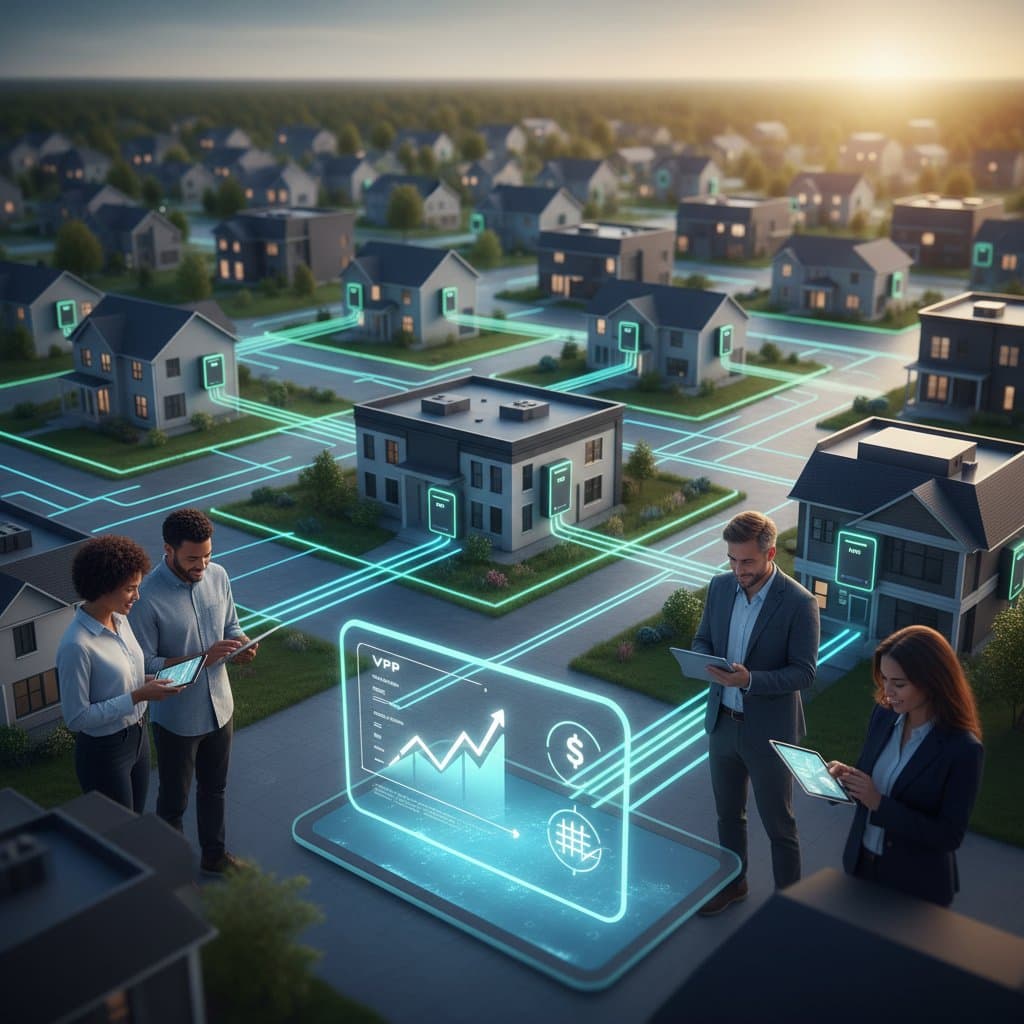
Unlock Steady Income from Battery Storage with Virtual Power Plants
Homeowners and businesses throughout the United States find that battery storage offers benefits beyond backup power. By linking to a virtual power plant (VPP), owners supply grid services during peak demand periods and receive payments from energy aggregators and utilities. This approach creates a reliable revenue source for solar-plus-storage systems while enhancing overall grid performance.
Recent data from energy research organizations indicate that multiple regional markets now exceed hundreds of megawatts in residential storage enrolled in VPPs. Projections suggest this capacity will expand significantly as utilities broaden distributed energy initiatives and battery adoption increases.
Understanding Virtual Power Plants
A virtual power plant connects distributed energy resources, including solar arrays, batteries, and intelligent appliances, through centralized control software. This network functions as a unified power plant, delivering energy or capacity to the grid on demand.
Grid operators signal potential shortages, prompting the VPP to release stored electricity from enrolled batteries and ease system stress. Participants earn compensation tied to delivered power or asset availability.
Specialized software handles aggregation with precise forecasting, remote monitoring, and automated controls. It calculates individual contributions and meets utility standards. Homeowners experience seamless operation, as the system reserves sufficient energy for household needs.
Revenue Opportunities for Battery Owners
Compensation structures differ by location and program, yet prospects continue to develop. Certain utilities provide fixed yearly payments for enrollment, whereas others base rewards on dispatched kilowatt-hours or available capacity.
In regions with established VPPs, residential participants might secure several hundred dollars annually, scaled to system size and dispatch occurrences. Larger commercial batteries yield thousands of dollars each year, augmented by savings from demand charge avoidance and time-of-use adjustments.
Jason Burwen, vice president of policy at a major U.S. energy storage association, noted that VPP programs "give customers a way to monetize storage assets that would otherwise sit idle most of the time. They also create measurable reliability benefits for utilities without the cost of building new central plants."
Core Technology for VPP Aggregation
Contemporary VPP platforms employ cloud-based systems that interface with battery inverters for direct communication. These setups issue instant directives, monitor operations, and confirm energy provision.
Machine learning enhances predictions of grid needs and optimizes dispatch timing for efficiency. Customers need suitable hardware and stable internet; leading lithium-ion battery producers embed VPP features in their software, activatable at installation or via updates.
Enhanced standards like IEEE 2030.5 and SunSpec Modbus promote device compatibility across manufacturers. Such interoperability broadens participation and supports VPP growth in varied markets.
Insights from Utilities and Aggregators
Utilities regard VPPs as economical options for grid support, substituting for costly peaker plants or infrastructure expansions. These efforts address peak loads, alleviate congestion, and heighten resilience.
Aggregators, typically private firms or service providers, bridge customers and utilities by enrolling participants, overseeing integrations, and processing payments. Funds pass from utilities to aggregators and then to owners.
Sarah Brown, director of distributed energy programs at a western utility, stated that "virtual power plants are becoming essential tools for balancing our grid. They give us flexibility during high-demand events and help us avoid expensive infrastructure investments."
Policy Drivers and Market Evolution
Regulatory backing propels VPP expansion. Various states implement performance incentives for storage contributions to the grid. Federal directives enable distributed resources in wholesale markets, benefiting aggregators.
Transmission organizations craft guidelines for VPP bidding in capacity and services markets once limited to major generators. This evolution boosts earnings potential for enrolled batteries.
Incentives range from availability payments during designated periods to rewards for delivered energy. Enrollment often unlocks tax credits or rebates linked to grid support. Professionals must track regional rules to optimize client outcomes.
Key Steps for Installation and Setup
Prospective VPP participants require batteries paired with compatible inverters and gateways. Installers confirm robust data monitoring and connectivity to ensure precise tracking.
Optimal system sizing balances dispatch potential with backup reserves. Model projected earnings using local rates and dispatch patterns to assess viability.
Commercial integrations may involve building management systems for coordinated usage. Select programs permit partial discharges, safeguarding essential loads while contributing surplus capacity.
Navigating Financial and Tax Aspects
VPP earnings qualify as taxable income; administrators supply statements for filings. Businesses apply varied accounting treatments. Consult tax experts for jurisdiction-specific guidance.
Payments arrive via direct deposits or bill offsets. Aggregators offer dashboards showing earnings, dispatch logs, and environmental impacts, fostering transparency on system value.
Addressing Common Hurdles
Opportunities exist amid obstacles. Program availability varies; some utilities limit to approved models or partners. Connectivity lapses may affect verification and payments.
Degradation concerns prompt limits on discharge depth and cycles, preserving battery life. Systems endure extensive cycles, with VPP use adding minimal strain.
Regulatory hurdles demand compliance with participation, metering, and privacy rules, potentially delaying rollout in emerging areas.
Empowering Installers in VPP Expansion
Installers serve as primary advisors, detailing aggregation benefits and finances to storage prospects. They guide clients toward enrollment.
For commercial projects, engineering firms incorporate VPPs into strategies with demand response and optimization for stacked benefits.
Emerging training covers protocols, security, and registrations, equating in importance to hardware skills.
Future Growth of VPPs
Analysts predict robust U.S. VPP capacity increases, with residential and commercial batteries driving enrollments.
Utilities pursue distributed flexibility over conventional sources. Aggregators enter new territories, while software evolves for scale.
Rising solar-storage installations enlarge participant pools. Bolstered by policy and reliability, VPPs integrate into standard energy operations.
Integrate Your Battery into Grid Solutions
Participating in VPPs converts battery capacity into income while aiding stability and distributed energy shifts.
For professionals, this elevates projects from fixed installations to ongoing revenue streams. As utilities embrace adaptable resources, battery owners gain broader access.
Connected battery networks redefine grid dynamics, shifting from central reliance to collaborative systems. VPP involvement links users to this evolution, delivering economic and sustainability gains.