
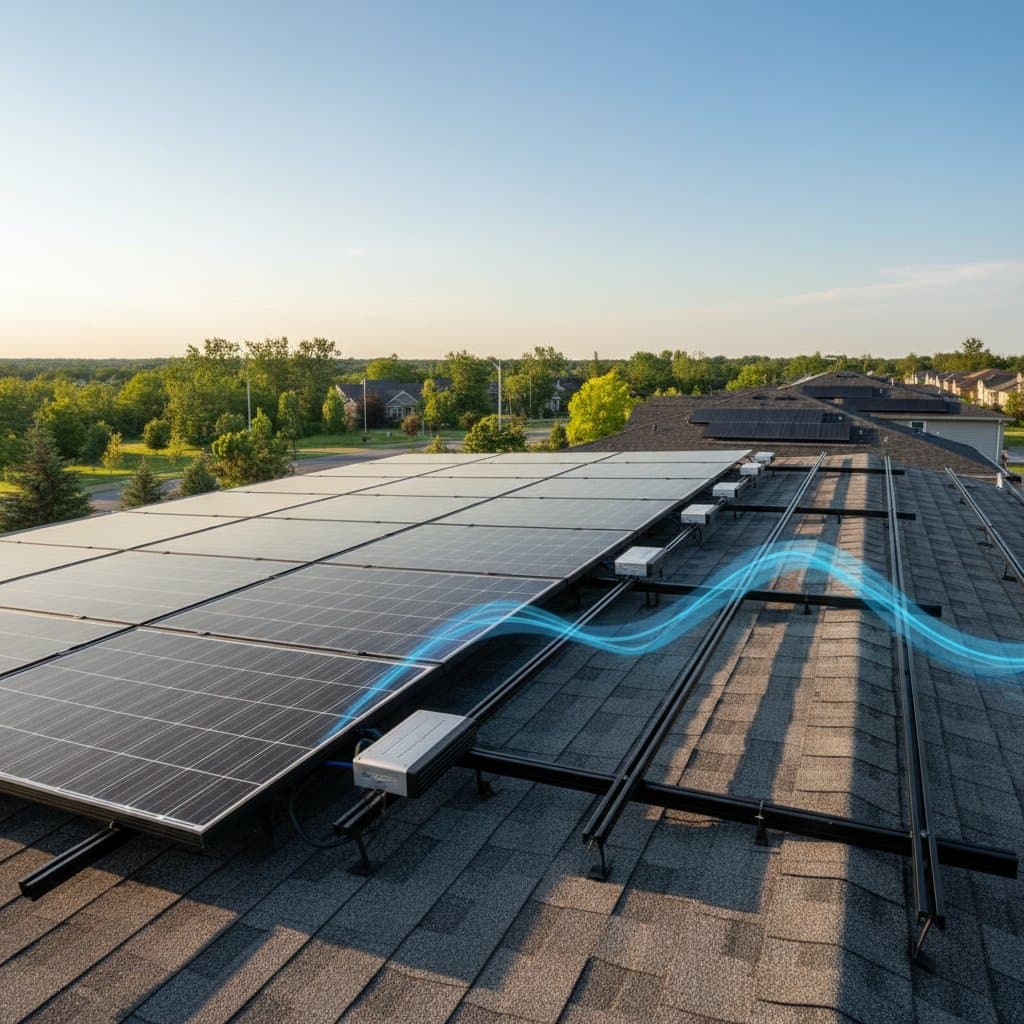
Understanding Micro-Inverters for Effortless Solar Growth
Homeowners expanding solar systems frequently ask about the ease of adding panels. The solution hinges on the components behind the panels. In contemporary modular setups, micro-inverters serve as essential elements. These compact devices at the panel level have reshaped expandable solar technology, transforming intricate modifications into simple enhancements.
Evolution from Centralized to Independent Systems
Early residential solar installations relied on a single central inverter. All panels fed power into this unit, creating one unified circuit. This method functioned adequately, yet it presented significant limitations. Underperformance in a single panel from shading, debris, or damage affected the entire array. Future panel additions demanded precise electrical adjustments and frequently required a larger inverter replacement.
Micro-inverters altered this dynamic. Each panel converts direct current to alternating current directly at its location. This independent operation eliminates reliance on a central unit and enables true modular designs. Installers often describe micro-inverters as plug-and-play components. The capacity to incorporate panels without system overhauls stands as a core advantage of this technology.
Streamlining the Expansion Process
Technically, micro-inverters resolve voltage matching challenges. Traditional string inverters require panels to align in electrical properties, with new additions fitting the existing string's parameters. Micro-inverters treat each panel as an individual alternating current source. Homeowners thus add panels of varying wattages, brands, or vintages without compatibility problems.
Installation follows a comparable straightforward path. Professionals extend the alternating current trunk line, secure new panels, attach their micro-inverters, and integrate the circuit with the current setup. No central inverter replacement or string reconfiguration proves necessary. In most cases, obtaining suitable roof area presents the primary obstacle, rather than electrical connections.
This adaptability proves particularly beneficial for gradual implementations. A homeowner might initiate with a 10-panel array and later expand upon acquiring an electric vehicle or enhancing heating and cooling systems. Micro-inverters accommodate such phased growth. Expansions occur on the homeowner's timeline, independent of inverter capacity constraints.
Enhancing Performance and Ensuring Reliability
Micro-inverters deliver performance gains that surpass mere expandability. Independent panel operation prevents shading on one module from impacting others. Integrated monitoring tools provide real-time data on individual panel production, facilitating quick identification of problems such as accumulated dirt or faulty components.
Safety features further distinguish these devices. Conversion to alternating current occurs directly on the roof, avoiding extended high-voltage direct current lines. This configuration lowers fire hazards and eases adherence to rapid shutdown standards. Installers report that clients value this enhanced protection, regardless of their grasp of the underlying mechanics.
Reliability has advanced considerably in recent models. Initial versions faced scrutiny, but manufacturers have optimized designs, enhanced heat dissipation, and offered warranties comparable to or surpassing those of conventional inverters. This progress has propelled micro-inverters into widespread adoption for residential and small commercial applications.
Evaluating Costs and Design Advantages
Some observers note that micro-inverters carry a higher upfront cost per watt. Initial calculations may support this view, yet comprehensive system analysis reveals a different picture. Accounting for shorter design phases, simplified wiring, and uncomplicated future additions often yields equivalent or lower long-term expenses. This holds especially for users expecting system growth, as string inverter expansions typically necessitate full central unit replacements.
Design versatility represents an additional benefit. Roofs seldom feature uniform orientations. Micro-inverters permit panels to orient in diverse directions or span multiple roof sections without efficiency losses.
Preparing for Evolving Energy Demands
Solar purchasers now prioritize long-term adaptability. Systems capable of scaling with shifting requirements represent prudent choices. Micro-inverters enable this scalability by establishing genuinely modular arrays. They facilitate straightforward setups, safeguard output levels, and simplify subsequent enhancements.
When initiating a solar installation, evaluate current energy consumption alongside potential future changes. Considerations might include additional appliances, structural expansions, or electric vehicle integration. Micro-inverters ensure flexibility remains intact throughout the system's lifespan.