
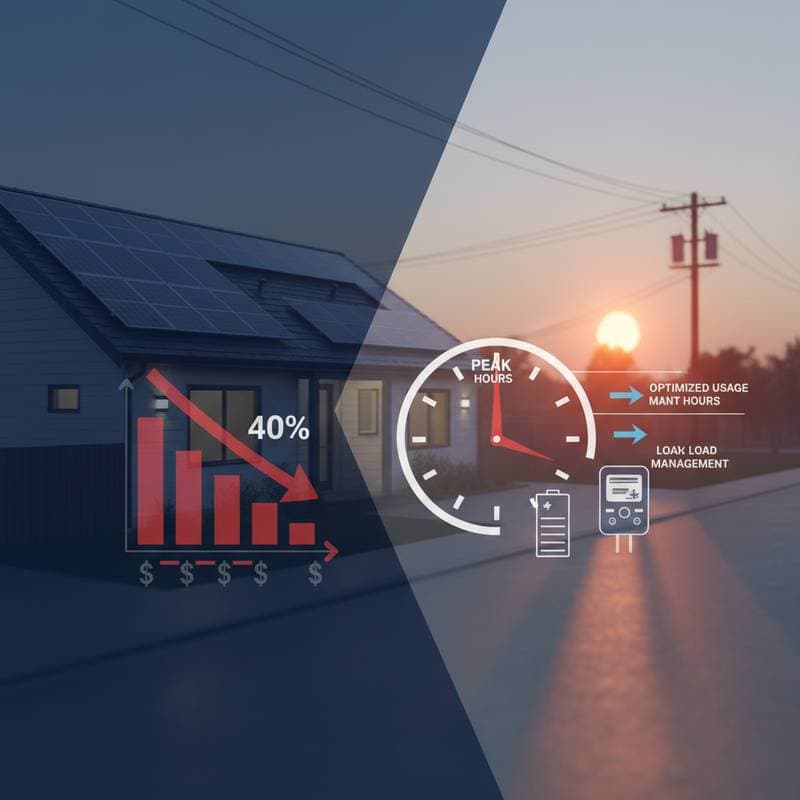
How Time-of-Use Billing Reduces Solar Savings by Up to 40%
Time-of-use (TOU) rates have moved beyond niche applications to affect a wide range of solar customers in key U.S. markets. These rates charge higher prices for electricity during late afternoon and evening peak demand periods, while offering lower rates midday when usage dips. Intended to stabilize the grid by matching supply with demand, TOU pricing creates hurdles for solar owners. Regulatory data from various states reveals that these plans can diminish solar bill savings by up to 40 percent relative to standard net metering.
Understanding the Move from Flat to Time-Based Rates
Major utilities in California, Arizona, and Nevada lead the transition from flat-rate plans to TOU schedules. This change addresses evolving grid needs, where solar power peaks around noon but household and business demand surges later. Solar owners export energy at low midday rates and buy back power at premium evening prices, creating a disconnect that undermines the appeal of rooftop installations.
Experts anticipated this evolution. Jason Thorne, a senior energy analyst at Grid Economics, explains, "Rising solar adoption prompts utilities to align rates with actual supply and demand patterns. The issue lies in rooftop systems originally optimized for flat net metering, not fluctuating prices."
Measuring the Impact on Solar Value
Energy commission analyses highlight price spreads between peak and off-peak times that surpass 200 percent in certain regions. Consider a standard 7 kW residential solar setup: this gap might erase $300 to $500 in yearly savings. Previously, such systems covered most household needs seamlessly; now, much consumption falls into costly evening slots with minimal solar generation.
Businesses and industrial users encounter parallel issues, adjusted for their operations. Daytime-heavy facilities offset some TOU effects through aligned production and use. Even so, experts project 25 to 35 percent savings drops for commercial solar without tools like batteries or usage adjustments.
To illustrate, a small office with evening lighting and HVAC demands might see its solar offset value halve under TOU. Without intervention, the system's payback extends from seven to twelve years.
Adapting Systems and Tactics for TOU Challenges
Solar professionals respond by tailoring installations to TOU realities. One common adjustment involves orienting panels westward to extend production into higher-rate afternoon hours, potentially recapturing 15 to 20 percent of lost value.
Battery integration stands out as a key solution. Storing midday excess in lithium-ion systems allows discharge during peaks, effectively shifting low-cost solar power to high-value times. This setup can preserve original savings levels, though initial costs add $10,000 to $15,000 for a typical home.
Load management tools further enhance outcomes. Smart thermostats and appliances schedule high-energy tasks for off-peak periods, reducing exposure to premium rates. For instance, pre-cooling homes midday or running commercial equipment overnight aligns usage with solar strengths.
Laura Kim, chief operating officer at Solterra Energy in San Diego, notes, "In TOU environments, batteries transform a challenge into an opportunity. Clients with storage often exceed pre-TOU savings, while others face extended payback timelines of three to five years."
Broader Effects on Policy and Solar Markets
TOU expansion influences solar growth and grid strategies at large. Regulators promote it for promoting efficient consumption and easing peak strains. Solar supporters, however, argue it disadvantages pioneers and hampers renewable progress by devaluing distributed energy.
Advocacy groups push for TOU refinements that credit solar's role in late-afternoon peak reduction. Enhanced compensation for exports during shoulder periods could balance incentives. These debates shape future rate designs, potentially fostering hybrid models that reward storage and flexibility.
Steps to Reclaim and Enhance Solar Returns Under TOU
Prospective and existing solar owners must integrate TOU into planning from the start. Begin by auditing your energy usage patterns with utility bills or monitoring apps to identify peak exposures. Next, model scenarios using online calculators that factor in local TOU tariffs and system sizes.
Incorporate storage early if budgets allow; incentives like federal tax credits can offset costs. Explore utility demand response programs, which pay for curtailing usage during peaks. For businesses, consult installers on hybrid inverters that optimize exports based on real-time rates.
These steps not only mitigate TOU impacts but position systems for long-term gains. As dynamic pricing spreads, proactive adaptations ensure solar remains a sound investment, delivering reliable savings amid grid evolution.