
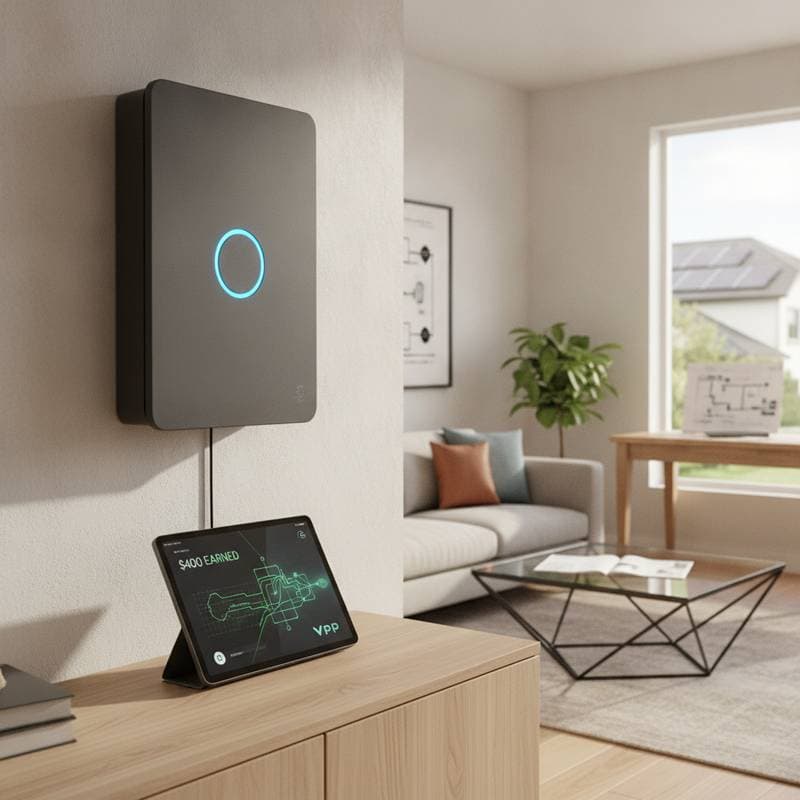
Make $400 a Year by Renting Your Battery for Grid Use
Homeowners across the United States are discovering a new revenue stream from existing solar investments. By renting out their residential batteries to virtual power plant programs, participants can earn up to $400 a year while supporting grid stability. The model is gaining traction as utilities and energy firms expand networks that use consumer owned batteries to balance supply and demand.
How Virtual Power Plants Operate
A virtual power plant connects thousands of distributed batteries, solar arrays, and controllable loads into one coordinated network. When aggregated, these assets perform functions such as frequency regulation, voltage support, and peak load reduction.
The system uses cloud based software to dispatch stored energy from participating homes. During peak demand the platform releases small amounts of energy from each connected battery. This collective response helps utilities avoid costly peaker plant operations.
Each household battery typically contributes between 3 and 10 kilowatt hours per event. Homeowners receive compensation based on the frequency of dispatch and the availability of their system.
Payment Structures and Earnings
The $400 annual figure represents the upper range of earnings in established programs in California, Massachusetts, and Vermont. Payments vary by utility territory, program design, and battery size. Some programs pay a flat monthly fee while others compensate based on energy discharged.
In a performance based model a household with a 13.5 kilowatt hour battery might earn 20 to 35 dollars per month during peak seasons. Aggregators such as Sunrun, Tesla, and Enphase manage technical and contractual aspects. Customers participate automatically once enrolled.
Steps to Join a Program
Confirm that the battery system is compatible with aggregator software and that the inverter supports remote management. Many modern hybrid inverters already include communication modules for two way data exchange.
Installation contractors often handle integration by configuring network permissions and setting discharge limits. Most programs allow users to retain a portion of stored energy for personal use during outages.
Industry data shows that additional cycling from grid services remains minimal. Aggregators limit depth of discharge to preserve long term performance.
Market Growth and Policy Support
State incentives and federal funding for grid modernization accelerate adoption of residential virtual power plants. These programs reduce reliance on fossil based peaking resources and support renewable integration.
Distributed storage capacity continues to grow rapidly. Virtual power plants are expected to provide several gigawatts of flexible capacity nationwide within the next few years. This expansion improves grid reliability during extreme weather and high demand periods.
Value Streams for Participants and Operators
Aggregators coordinate thousands of small assets into market ready capacity blocks. Value streams include frequency regulation payments, capacity market bids, and utility demand response contracts. Utilities gain reduced infrastructure costs and improved system resilience.
Residential customers receive steady income that offsets the original battery investment. A typical home storage system can recover a portion of its cost through annual payments. Over the lifetime of the battery total earnings may reach several thousand dollars.
Tiered participation options now match different homeowner preferences. Some select guaranteed fixed payments while others choose variable structures tied to market performance.
Preparing for Broader Adoption
Open communication standards and fair compensation structures will determine the next stage of development. As networks mature the ability to earn money by renting battery capacity is becoming a standard feature of residential energy systems.