
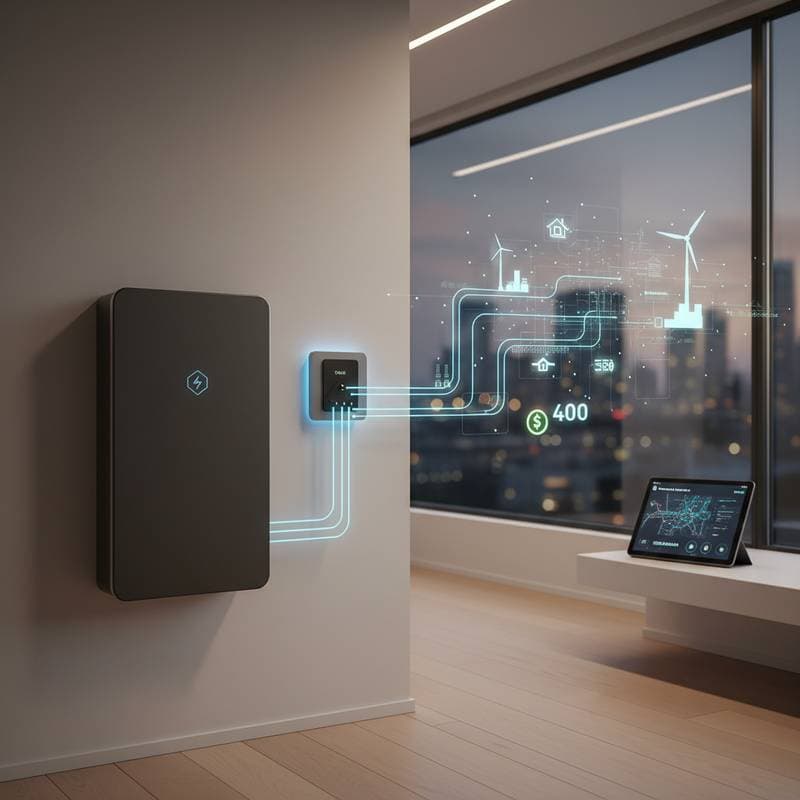
Earn $400 Annually by Renting Your Home Battery to the Grid
Home solar batteries serve purposes beyond backup power. In the United States, homeowners increasingly view them as sources of income through virtual power plants, or VPPs. By permitting utilities or aggregators to access stored energy temporarily, battery owners can earn approximately $400 per year. This amount varies based on location, battery size, and program specifics. As grid operators seek flexible capacity, distributed energy resource aggregators expand participation opportunities.
Understanding Virtual Power Plants
A virtual power plant coordinates distributed energy resources to function as a single, utility-scale facility. These resources encompass residential batteries, rooftop solar systems, smart thermostats, and electric vehicles. Specialized software aggregates thousands of devices to provide grid capacity.
During peak demand, VPP operators dispatch energy from enrolled batteries to ease grid strain. When demand decreases, operators recharge batteries, frequently using rooftop solar output. This process balances supply and demand efficiently, enhancing reliability and minimizing reliance on costly peaker plants.
Recent analysis from Wood Mackenzie indicates that U.S. VPP capacity exceeds 1 GW of enrolled resources. Projections show accelerated growth as utilities incorporate distributed energy resources into planning.
Financial Incentives for Homeowners
Homeowners receive battery rental income, averaging $400 annually. Participants lease a portion of their battery capacity to the grid at designated times. Compensation differs by region and program.
In California, Southern California Edison offers monthly bill credits for VPP involvement. Vermont's Green Mountain Power provides a fixed annual fee for partial control of Tesla Powerwalls. Massachusetts' ConnectedSolutions program pays per kilowatt-hour discharged during events.
"The economics strengthen as grid demands grow," states Sarah Klein, director of distributed energy programs at GridFlex Energy in Colorado. "Customers gain reliable income without compromising backup power. The grid acquires flexibility, and participants receive steady returns."
Payments depend on discharge duration, capacity provided, and event frequency. Programs limit discharge depth to maintain battery life, preserving sufficient energy for household needs.
Requirements for Battery Integration
Participation demands secure communication hardware and software for remote dispatch and monitoring. Systems from Enphase Energy, Sonnen, and Tesla feature platforms that facilitate integration.
Essential elements include:
- Smart inverters supporting bidirectional flow and grid communication
- Stable internet for data exchange
- Utility approval confirming system compliance and interconnection
Installers or aggregators typically manage enrollment. Connected systems join demand response events automatically, requiring no daily input from owners.
"Communication protocols form the foundation," explains Mike Peterson, senior engineer at SunVault Systems in Arizona. "Grid operators require assurance that dispatched energy arrives precisely. This demands accurate telemetry and real-time verification."
Suitable batteries offer 10 to 20 kWh capacity, often paired with photovoltaic systems via hybrid inverters. Installations adhere to National Electrical Code standards, including disconnects, labeling, and ventilation. Some states mandate inspections for grid-interactive setups.
Equipment mounting accounts for weight and heat dissipation. Wall-mounted units like the Tesla Powerwall employ sturdy brackets for loads over 250 pounds. Floor units use adjustable frames. Proper setup ensures safety amid automated grid interactions.
Engineering, procurement, and construction firms standardize VPP-compatible designs. "We prepare every installation for aggregation," notes Laura McIntyre, project manager at SolarEdge EPC in New Jersey. "This readiness future-proofs the system and enhances property value, even if enrollment follows later."
Policy Influences and Market Trends
State regulations and utility strategies drive battery rental programs. California, Massachusetts, and Vermont frameworks qualify aggregated distributed energy resources for compensation.
Federal incentives for battery production and storage deployment lower costs, encouraging adoption. Homeowners find it simpler to invest in revenue-generating systems.
Utilities avoid expenses by contracting aggregators for residential battery fleets instead of building peaker plants or upgrading lines. This approach meets resource needs and aids renewable integration.
"Each VPP we deploy saves millions in infrastructure costs," says Jason Holmes, vice president of resource planning at Pacific Grid Operations. "Utilities find it more economical and swift to compensate households than to build new facilities."
Addressing Risks and Ensuring Reliability
Homeowners often worry about battery degradation. Programs mitigate this with discharge limits and frequency caps, restricting grid access to 20 to 50 percent of capacity.
Warranties hold under manufacturer-approved conditions. Tesla endorses participation in vetted programs without warranty impacts.
Distributed storage bolsters grid reliability. During outages, batteries disconnect and power homes, combining income potential with resilience.
Aggregators and Software in Action
Aggregators link homeowners to grid markets. Firms such as Swell Energy, Sunrun, and Virtual Peaker oversee multi-state fleets, securing utility contracts and distributing earnings.
Swell Energy's Hawaii VPP engages thousands of systems for capacity and regulation, yielding $30 to $40 monthly for participants in peak seasons.
"Software intelligence rivals hardware importance," comments Swell Energy CEO Matt Roberts. "Predictive analytics forecast grid needs and refine schedules. This accuracy verifies contributions, maximizes payments, and protects battery health."
Aggregators ensure compliance with Federal Energy Regulatory Commission guidelines for wholesale market involvement, promoting transparent accounting.
Calculating Overall Economic Benefits
Annual earnings of $400 offset battery ownership costs. For a $10,000 system, this shortens payback by one to two years, augmented by time-of-use savings and solar utilization.
A 13.5 kWh battery in Massachusetts might yield $350 to $500 yearly via ConnectedSolutions. California systems could produce $30 monthly in high-demand periods.
These exclude arbitrage gains from off-peak charging and peak discharging, potentially surpassing $600 annually in optimal areas.
"VPPs render distributed storage financially viable," observes Eric Daniels, senior energy economist at Renew Insight. "Initial revenues build markets valuing flexibility. Scaled implementation transforms asset financing and deployment."
Advances Enhancing Participation
Improved software and inverters broaden eligible systems. Multi-protocol platforms unite diverse batteries in VPPs.
AI algorithms forecast energy demands using weather, loads, and prices for optimized dispatches across networks.
Hardware like lithium iron phosphate batteries withstand frequent cycles with extended life and stability, suiting aggregation demands.
Utilities Embracing Distributed Resources
Utilities integrate residential assets into modernization efforts. Duke Energy pilots aggregation for peak reduction across states.
"We regard distributed storage as dispatchable assets," states Duke Energy spokesperson Amanda Reyes. "This maintains reliability while harnessing customer investments in flexibility."
Rate designs now include incentives for participation, acknowledging decentralized energy's role alongside traditional infrastructure.
Overcoming Enrollment Challenges
VPP adoption lags installed battery numbers due to awareness gaps, program limits, and enrollment complexity.
Aggregators partner with installers for streamlined processes. Many systems enable grid service activation via apps.
"Simplifying explanations boosts uptake," says Emily Nguyen, marketing director at SolarPlus Installations in Texas. "Homeowners embrace passive income alongside outage protection once they understand it."
Building a Participatory Energy Future
Battery rental programs foster an engaged energy landscape. Connected systems fortify the grid, cut emissions, and compensate owners. As adoption grows, homeowners contribute to sustainability while reaping financial rewards. This model positions residential storage as a cornerstone of efficient, resilient power networks.