
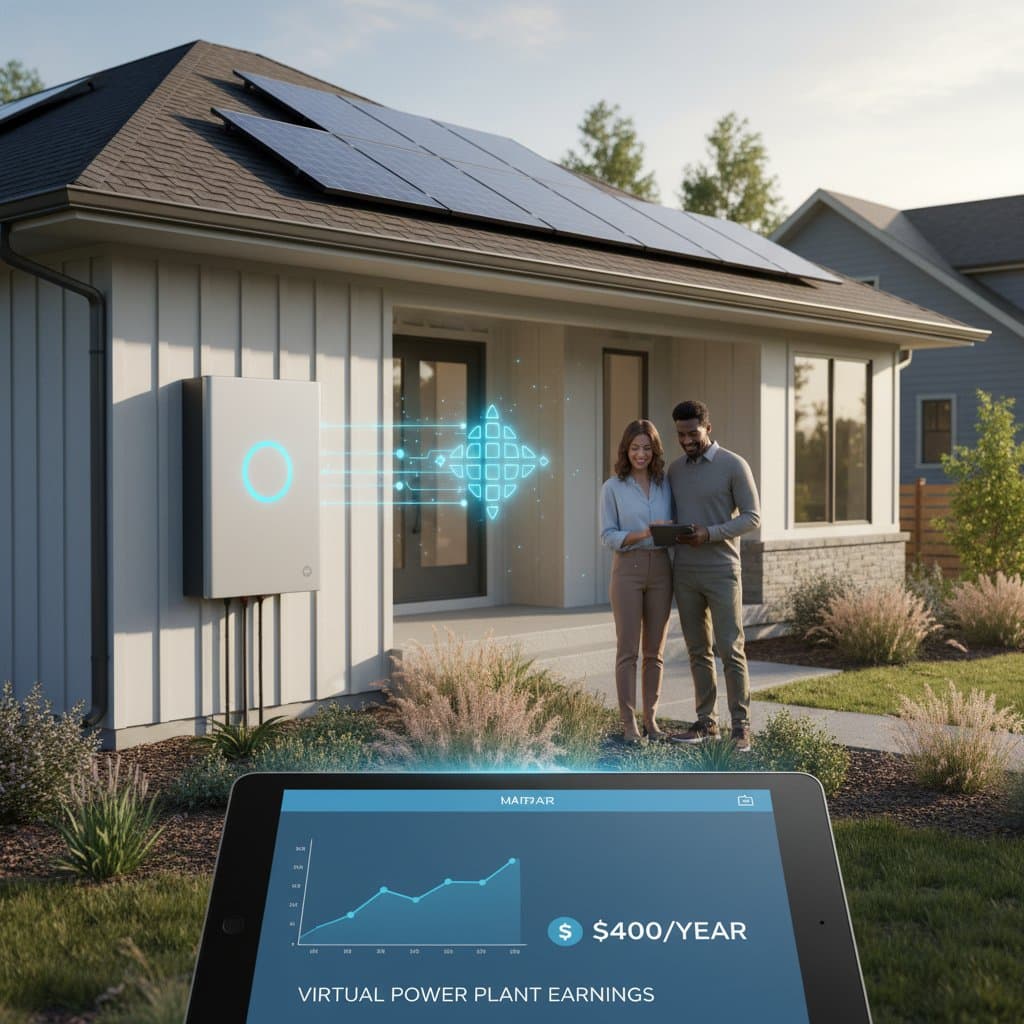
Rent Your Home Battery for Steady Grid Income
Home energy storage systems extend beyond backup power and personal use. In the United States, utilities and aggregators offer programs that enable homeowners to rent battery capacity to the grid. Through virtual power plants, participants earn about $400 annually for providing energy services, a model gaining traction as distributed resources prove essential for network stability.
Understanding Virtual Power Plants
A virtual power plant connects distributed assets like rooftop solar, home batteries, and EV chargers into a unified, software-controlled network. Aggregators or utilities dispatch these resources during grid needs, such as peak demand or frequency adjustments. When numerous batteries activate together, they mimic a large-scale power plant delivering capacity or response services.
In battery rental programs, homeowners grant access to part of their system's capacity during specified periods. Compensation, often $400 per year, varies by location and program. Owners maintain battery control outside dispatch times, with agreements safeguarding asset longevity through usage limits.
Analysts at Wood Mackenzie report that U.S. VPP-linked residential batteries have doubled recently. Growth accelerates in solar-rich states like California, Arizona, and Massachusetts, marking a transition from solo energy management to collective grid support.
Financial Benefits of Participation
The $400 payment offers solid returns alongside savings from solar self-use and rate optimization. Aggregators calculate earnings based on capacity availability, dispatch frequency, and regional service values.
Consider a 10 kWh battery allocating 5 kWh for grid use. Across 1,000 systems, this yields 5 MWh to offset peaks or fossil fuel plants. Aggregators earn from grid operators and distribute proceeds to participants.
"Distributed storage emerges as a key asset for grid operators," notes Leah Martinez, senior analyst at Clean Energy Associates. "Homeowner payment programs demonstrate the tangible value of small-scale systems."
For aggregators, larger networks boost wholesale market sales. Homeowners see faster investment recovery through this added income stream.
Setting Up for VPP Integration
Eligible batteries require internet-enabled controllers for aggregator commands. Systems from Tesla, Enphase, and Sunrun often include this feature.
Installers configure settings, check firmware, and link inverters to software during setup. Some programs need extra gateways; others leverage manufacturer clouds.
"Interoperability poses the main challenge," explains Aaron Pike, product manager at a California EPC firm. "Diverse protocols demand integration, though software advances simplify this."
Physical installations change little; focus shifts to commissioning and owner guidance. Explain dispatch impacts on cycles, warranties, and performance to build confidence.
Policy and Market Influences
Federal and state incentives, plus grid flexibility demands, propel VPP growth. Aggregated resources now access wholesale markets in select areas, strengthening business viability.
FERC rules enable broader participation, with transmission organizations crafting bidding frameworks for batteries. These changes fuel program expansion.
Utilities address reliability amid weather extremes and load surges by leveraging distributed assets over costly infrastructure. Battery rentals manage spikes efficiently.
"Virtual power plants fortify the grid intelligently," states Dana Roberts, vice president of distributed energy at GridFlex Energy. "They ease transmission strain and compensate customers for stability contributions."
Compensation Structures and Opportunities
Fixed annual payments of $300 to $500 dominate, though performance tiers reward higher responsiveness. Alternatives include one-time rebates or bill credits.
Local factors like congestion fees influence rates; high-volatility areas yield more. VPP involvement can double battery ownership value.
Installers gain edges by promoting income potential, often bundling enrollment. Partnerships with aggregators streamline sales.
Ensuring Battery Durability
Homeowners worry about dispatch-related wear. Aggregators cap discharge depth and events to minimize impact.
Warranties adapt for VPP use within limits. Grid cycles add little to lifetime throughput.
"Battery stress remains low versus gains," says Megan Lin, technical director at SolarEdge North America. "Algorithms balance support and preservation."
Pilots show under 10 percent cycle increases, shortening payback by about one year while delivering income.
Insights from Utilities and Aggregators
Utilities value VPPs for rapid, targeted deployment against constraints. Aggregators handle dispatch, payments, and telemetry.
Standardization aids coordination; automated bidding and real-time data ensure delivery.
"Batteries respond swiftly for regulation," observes Thomas Yates, director of grid operations at a Midwest utility. "Coordinating assets demands treating them as one unit."
Predictive analytics optimize responses, prioritizing data security in distributed setups.
Growth Across Regions
California tops enrolled capacity, trailed by Massachusetts, Arizona, and Vermont. Compensation varies, but integration goals unite them.
Southeast and Midwest pilots explore behaviors and costs with national partners. Declining equipment prices will spur wider adoption.
Commercial sites earn far more, up to $10,000 yearly, scaling homeowner models to larger operations.
Addressing Key Challenges
Operational risks include communication glitches and regulatory variances. Aggregators prioritize reliable delivery and data handling.
Customer hesitancy stems from control fears; clear education confirms outage access remains intact.
Standardization lags regionally, slowing uniform growth.
Steps to Join and Maximize Benefits
Start by checking local VPP programs via your utility or aggregator sites. Verify battery compatibility and review terms for dispatch limits.
Engage certified installers for setup. Monitor earnings through participant portals to track performance.
This participation not only generates income but empowers you in a resilient energy ecosystem, blending personal savings with broader reliability.