
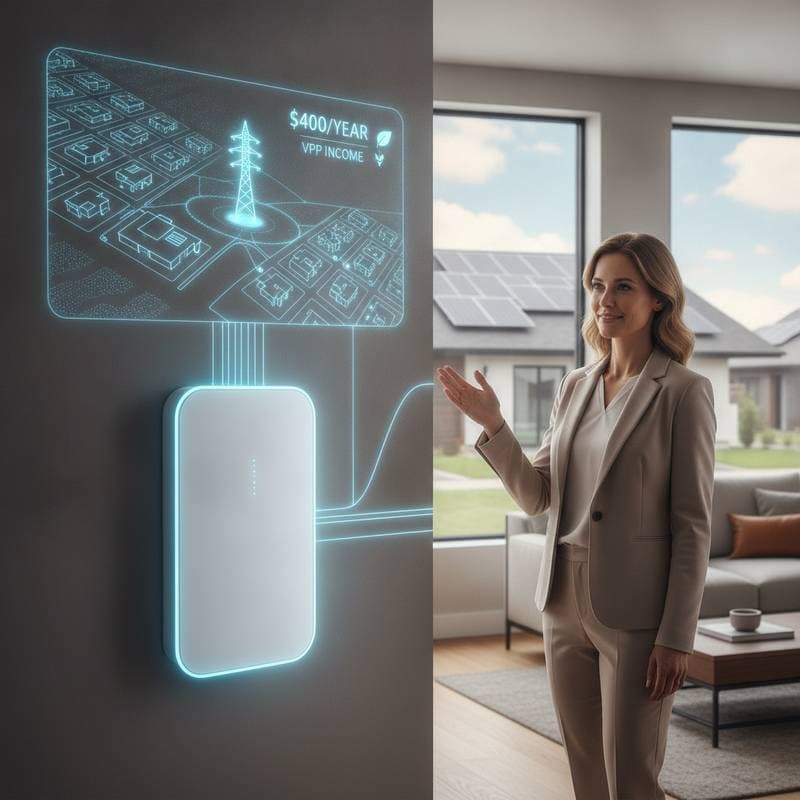
Earn $400 a Year Renting Your Battery to Virtual Power Plants
Households with home batteries can now earn steady income by joining virtual power plant programs. These programs connect hundreds or thousands of residential energy storage systems into a single digital network that helps stabilize the grid. In return, participating homeowners can receive payments that often reach about four hundred dollars per year.
The concept is straightforward. When electricity demand peaks or when renewable generation drops, utilities can draw small amounts of energy from enrolled home batteries instead of firing up fossil fuel plants. This aggregated capacity supports grid reliability while giving homeowners a financial return on equipment they already own.
How Virtual Power Plants Operate
A virtual power plant, or VPP, uses cloud-based software to coordinate distributed energy resources such as batteries, rooftop solar systems, and smart appliances. The system monitors grid conditions and automatically dispatches power or reduces consumption when needed. Each connected household contributes a small share of capacity, but collectively the impact rivals that of a traditional power plant.
Homeowners do not lose control of their batteries. Most programs set clear limits to preserve backup reserves and protect battery health. The software only accesses stored energy within agreed parameters. Participants can usually view activity through an app that shows when and how their battery supports the grid.
Typical Earnings and Incentives
Payments vary by region and utility program, but many homeowners report annual earnings around four hundred dollars. Some programs pay a flat enrollment fee, while others compensate participants based on how often their battery is used. In markets with frequent grid events or high energy prices, compensation can be even higher.
Beyond direct payments, VPP participation can reduce time-of-use charges and lower electricity bills. When the system automatically discharges during high-rate periods, households use less grid power at expensive times. This dual benefit, combining bill savings and incentive income, strengthens the financial case for home energy storage.
Program Availability and Enrollment
Utilities and energy service providers across multiple states are expanding access to VPPs. Enrollment usually requires a compatible battery system, such as those from major manufacturers with integrated communication features. Once the homeowner opts in, the provider verifies connectivity, sets performance thresholds, and activates remote control functions.
Some programs are operated directly by utilities, while others are managed by third-party aggregators that coordinate resources across different service territories. Aggregators often partner with hardware manufacturers or installers to simplify participation. The process is typically digital, with online agreements and automated performance tracking.
Key Considerations Before Joining
Before enrolling, homeowners should review several factors:
- Battery Compatibility. Confirm that the storage system supports remote dispatch and meets program communication standards.
- Participation Limits. Understand how much capacity the provider can access and ensure it does not interfere with household energy needs.
- Payment Structure. Clarify whether compensation is fixed, performance-based, or a combination of both.
- Program Duration. Check contract terms, including minimum participation periods and early exit conditions.
- Grid Event Frequency. Areas with frequent grid stress events may offer higher earning potential.
Joining a VPP should not compromise backup capabilities or battery lifespan. Reputable programs prioritize equipment health and maintain transparency on usage patterns.
Broader Industry Implications
Virtual power plants are becoming a central feature of distributed energy management. By linking residential storage systems, they provide utilities with flexible capacity that can replace or delay costly infrastructure upgrades. This approach supports renewable integration by balancing intermittent solar and wind output.
For installers and developers, VPP participation adds value to energy storage projects. It creates a recurring revenue stream that can shorten payback periods for customers. Developers who integrate VPP-ready technology into their offerings position themselves competitively in markets where grid services are in demand.
Policymakers are also recognizing VPPs as a tool for grid modernization. Incentive programs and updated interconnection rules are helping accelerate adoption. The result is a more resilient, responsive, and decentralized energy network that benefits both consumers and grid operators.
Steps to Enroll
Homeowners interested in earning income through their battery should start by contacting their battery manufacturer or local utility to check VPP availability. Many energy providers maintain enrollment portals that list compatible devices and payment details. Installers can also guide customers through the process during system commissioning.
Participation requires minimal ongoing effort once setup is complete. The software manages dispatch automatically and tracks performance for payment calculations. Renting your battery to a virtual power plant transforms a static backup system into an active resource that supports cleaner energy while generating steady annual income.